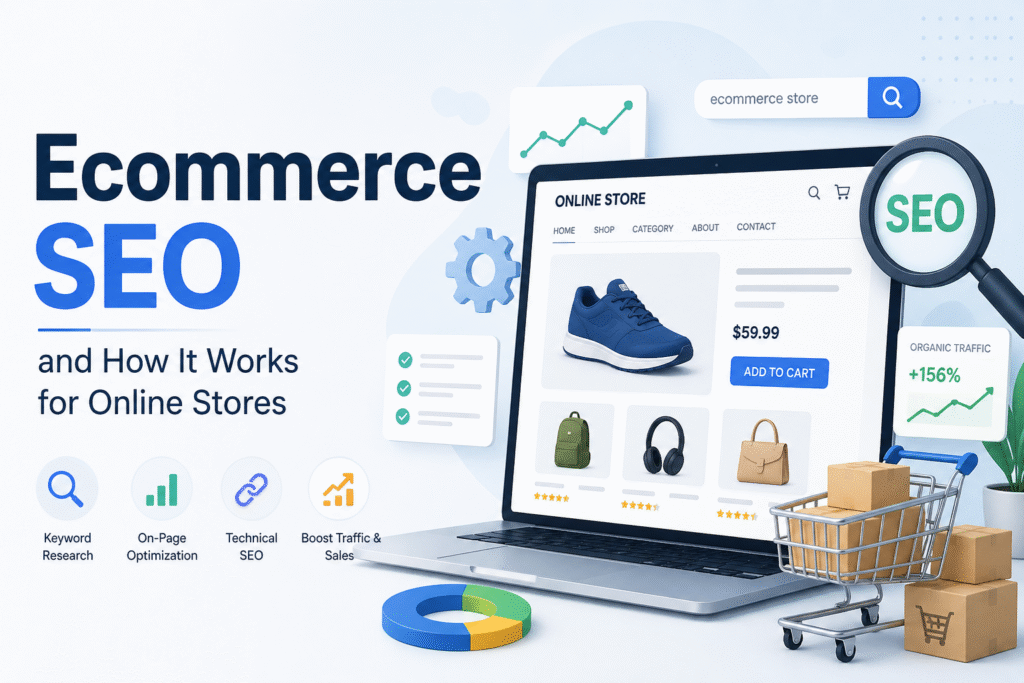
Ecommerce SEO is basically how online stores make sure their products actually show up when you Google stuff instead of getting lost in the internet void. It involves improving product pages with relevant keywords, optimizing site structure, enhancing page speed, and ensuring a mobile-friendly design so search engines can easily crawl and understand the store. For ecommerce businesses, this means more potential customers discovering products naturally instead of relying only on ads.
In this blog, we’ll break down how this exactly works and why it’s a game-changer for online businesses.
Key Takeaways
|
Ecommerce SEO Foundations
How Search Engines Crawl and Index Ecommerce Websites?
Search engines crawl ecommerce sites using bots that follow internal links, render pages, and store data in indexes, evaluating structure, relevance, and content quality for ranking and retrieval purposes accurately. It involves:
Crawl Budget Allocation and Its Impact on Large-Scale Ecommerce Sites
Crawl budget determines how many pages search engine bots will crawl on ecommerce sites, affecting large catalogs, prioritization of important pages, and frequency of updates indexed across product listings efficiently
XML Sitemap Configuration for Ecommerce Product and Category Pages
XML sitemaps help search engines discover product and category URLs efficiently, ensuring proper indexing hierarchy, especially for large ecommerce stores with frequent updates and dynamically generated page structures at scale
Robots.txt Rules and Crawl Directives for Ecommerce Platforms
Robots.txt files guide search engine crawlers by allowing or disallowing access to specific ecommerce pages, controlling crawl flow, preventing duplicate content indexing, and improving overall site efficiency, performance optimization
Log File Analysis for Identifying Crawl Coverage Gaps in Online Stores
Log file analysis examines server logs to track how search engine bots crawl ecommerce sites, revealing missed pages, crawl frequency issues, and indexing gaps affecting visibility, performance optimization opportunities identified
Ecommerce Site Architecture and URL Structure
A well-structured site architecture ensures that both search engines and users can navigate an ecommerce store efficiently. This section covers the principles of flat site architecture, logical category hierarchy, and URL formatting conventions that support strong organic search performance.
Flat vs Deep Site Architecture
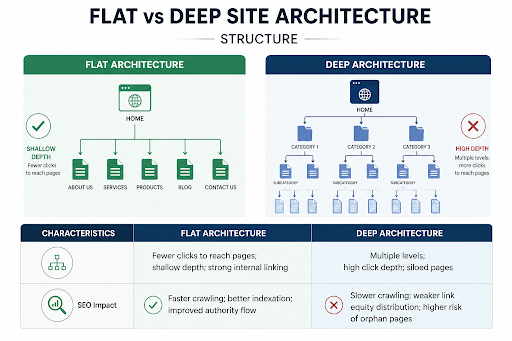
| Structure | Characteristics | SEO Impact |
| Flat Architecture | Fewer clicks to reach pages; shallow depth; strong internal linking | Faster crawling; better indexation; improved authority flow |
| Deep Architecture | Multiple levels; high click depth; siloed pages | Slower crawling; weaker link equity distribution; higher risk of orphan pages |
Category and Subcategory Hierarchy Best Practices for Ecommerce SEO
Establish a clear hierarchical structure where primary categories target broad keywords, subcategories refine intent, and products sit at the lowest level, ensuring minimal click depth, contextual relevance, and scalable expansion without creating orphan pages or diluted topical signals across the site.
URL Slug Formatting Rules for Product Pages, Category Pages, and Filters
- Use short, descriptive, keyword-focused URLs with hyphens
- Maintain lowercase formatting
- Include primary terms for products and categories
- Manage faceted filters with canonical tags or noindex rules to prevent duplicate content
- Crawl inefficiencies on large sites.
Internal Linking Principles That Distribute Page Authority Across an Ecommerce Store
Implement internal links between categories, subcategories, and products, use breadcrumb navigation, and prioritize high-value pages to distribute link equity, improve crawl paths, and strengthen topical authority across the ecommerce domain.
On-Page SEO Elements for Ecommerce Product and Category Pages
Now let’s look at the core on-page elements that influence rankings for both product and category pages in competitive ecommerce verticals.
Title Tag and Meta Description Formulas for Ecommerce Product Pages
Title tags and meta descriptions directly impact rankings and click-through rates by signaling relevance and intent to search engines and users.
- Title tags include primary keyword, product name, brand, and modifiers within 50–60 characters
- Meta descriptions use persuasive copy, secondary keywords, and CTAs within 150–160 characters for improved click-through rates.
H1 and Heading Hierarchy Structure for Category and Product Page Templates
Heading structure helps search engines understand content hierarchy while improving readability and accessibility for users. Hence, H1 tags must clearly define the primary topic using target keywords, while H2–H4 headings structure supporting content, improving crawlability, semantic relevance, and user experience across scalable ecommerce templates and dynamic product pages.
Category Page Content Depth Requirements for Competitive Ecommerce Keywords
Content depth establishes topical authority and improves rankings for competitive category-level keywords. Include 300–600 words of unique, keyword-optimized content with internal links, product context, and structured formatting to enhance both SEO performance and user engagement.
Image Alt Text, File Name, and Compression Standards for Ecommerce SEO
Image optimization improves accessibility, page speed, and search visibility, especially for image search traffic. Use descriptive, keyword-rich filenames, concise alt text for context, and compressed formats like WebP to balance quality with faster load performance.
Indexability, Canonicalization, and Duplicate Content in Ecommerce
Ecommerce sites are particularly susceptible to duplicate content issues stemming from faceted navigation, product variants, and URL parameter proliferation. Here are some parameters that handle clean indexing for ecommerce stores.
Canonical Tag Implementation for Product Variants and Filtered Category Pages
Canonical tags are critical for consolidating ranking signals and avoiding duplicate content dilution across similar URLs. Implement by assigning a preferred URL for product variants and filtered pages, ensuring all alternate versions reference the main canonical page
Noindex Directives for Thin, Duplicate, and Low-Value Ecommerce Pages
Noindex directives help maintain index quality by excluding low-value or duplicate pages from search results. Apply noindex tags to filtered pages, internal search results, and thin content pages to preserve crawl budget and focus indexing on valuable pages.
URL Parameter Management in Google Search Console for Ecommerce Stores
URL parameters can create large-scale duplication issues, confusing search engines and wasting crawl budget. Configure parameter handling in Google Search Console to specify how filters, sorting, and tracking parameters are crawled and indexed.
Hreflang and International Canonicalization for Multi-Region Ecommerce Sites
Hreflang tags ensure the correct regional or language version appears in search results, improving user experience and relevance. Combine hreflang with proper canonical tags to prevent duplication and ensure accurate indexing across international ecommerce pages.
Ecommerce Keyword Research and Search Intent
Keyword Research Methodology for Ecommerce Sites
Keyword research for ecommerce involves mapping search demand to product categories, individual products, and informational content. Let’s take a look at the tools, data sources, and classification frameworks used to build a comprehensive keyword strategy for an online store.
Transactional vs Informational Keyword Classification in Ecommerce SEO
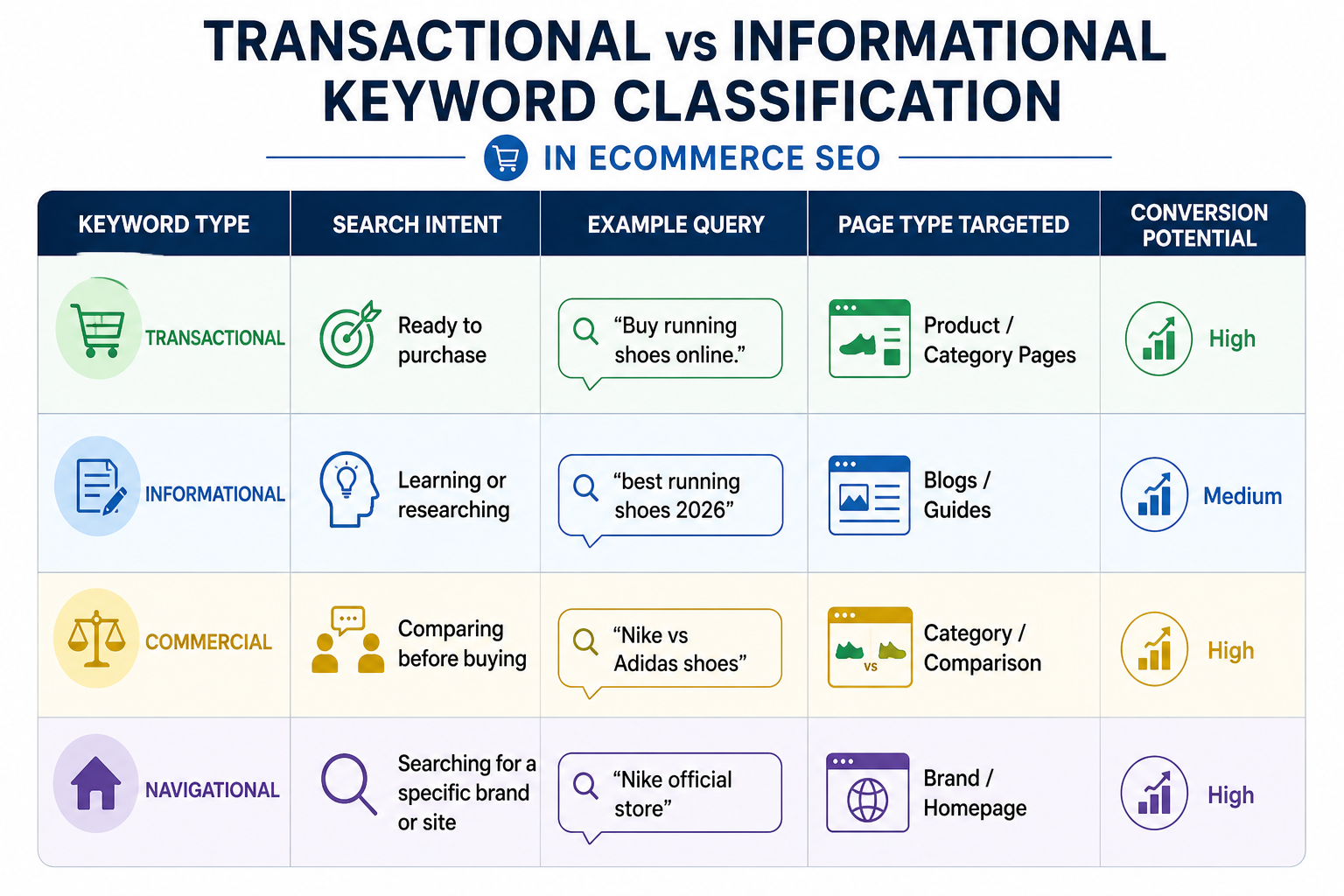
| Keyword Type | Search Intent | Example Query | Page Type Targeted | Conversion Potential |
| Transactional | Ready to purchase | “Buy running shoes online.” | Product / Category Pages | High |
| Informational | Learning or researching | “best running shoes 2026” | Blogs / Guides | Medium |
| Commercial | Comparing before buying | “Nike vs Adidas shoes” | Category / Comparison | High |
| Navigational | Searching for a specific brand or site | “Nike official store” | Brand / Homepage | High |
Category-Level Keyword Mapping and Topical Cluster Architecture
Category keyword mapping organizes high-volume keywords into clusters, assigning primary terms to category pages and supporting subtopics to related content, improving topical authority, internal linking, and semantic relevance across the ecommerce site architecture.
Long-Tail Keyword Identification for Product Page SEO Opportunities
Long-tail keywords capture specific, low-competition queries with high purchase intent by targeting detailed product attributes, user modifiers, and search variations, improving ranking opportunities and driving qualified traffic to individual product pages
Competitor Keyword Gap Analysis for Ecommerce Stores Using SEO Tools
Keyword gap analysis identifies high-value keywords competitors rank for, but your store does not, using SEO tools to uncover missed opportunities, prioritize content creation, and expand visibility across competitive ecommerce search landscapes
Understanding Search Intent for Ecommerce Queries
Search intent determines whether a user is ready to buy, researching options, or comparing products. This is done by figuring out four intent categories: informational, navigational, commercial, and transactional. Well, let’s find out how?
Four Search Intent Categories and Their Ecommerce Page Type Mapping
- Informational: Users seek knowledge; target with blogs, guides, and FAQs to build awareness and authority
- Navigational: Users look for a specific brand or website; optimize brand and homepage pages
- Commercial Investigation: Users compare options; target with category pages, comparison content, and reviews
- Transactional: Users are ready to buy; optimize product and high-intent category pages for conversions
Commercial Investigation Intent and Category Page Content Alignment
Commercial intent users evaluate options, so category pages must include comparison elements, filters, reviews, and descriptive content aligning with mid-funnel queries to guide decision-making and improve engagement and conversion rates
Transactional Intent Signals and Their Relationship to Product Page Optimization
Transactional queries include modifiers like “buy,” “price,” or “discount,” requiring optimized product pages with clear CTAs, pricing, availability, and structured data to maximize conversions and match high-intent search expectations
Informational Intent and the Role of Blog Content in Ecommerce SEO Strategy
Informational queries drive top-of-funnel traffic, where blogs and guides target educational keywords, internally linking to category and product pages, nurturing users toward purchase while improving overall site authority and keyword coverage
Keyword Prioritization and Content Gap Analysis
Not all keywords deserve equal resource allocation. This chapter covers how to prioritize keywords based on search volume, keyword difficulty, conversion potential, and business relevance, and how to identify content gaps that represent untapped organic search opportunities.
Keyword Difficulty vs Search Volume Matrix for Ecommerce Prioritization
A keyword matrix evaluates search volume against difficulty, prioritizing low-competition, high-volume keywords first while balancing achievable rankings with traffic potential to maximize ROI in ecommerce SEO campaigns efficiently
Conversion Rate Weighting in Ecommerce Keyword Priority Scoring
Keyword prioritization should factor conversion rates by assigning a higher value to transactional and commercial queries, ensuring SEO efforts focus on keywords that not only drive traffic but also generate measurable revenue outcomes
Content Gap Analysis Process for Identifying Unaddressed Search Demand
Content gap analysis compares existing pages with keyword opportunities, identifying missing topics or under-optimized pages, enabling targeted content creation that captures untapped search demand and improves overall organic visibility
Seasonal Keyword Trend Analysis for Ecommerce Inventory and Content Planning
Seasonal analysis uses historical search data and trend tools to identify demand spikes, allowing ecommerce stores to align inventory, optimize content timing, and capture traffic during peak shopping periods effectively
Product and Brand Keyword Strategy for Ecommerce
Branded Keyword Targeting Strategy for Ecommerce Product Pages
Branded keywords capture high-intent users searching for specific products or brands, requiring optimized product pages with brand terms in titles, metadata, and structured data to dominate branded search results and conversions
Non-Branded Category Keyword Optimization for Ecommerce Collection Pages
These keywords target broader discovery queries, requiring category pages optimized with generic product terms, filters, and supporting content to attract new users and compete in high-volume, non-branded search results
SKU and Model Number Keyword Integration in Product Page Metadata
Including SKU and model numbers in metadata helps capture highly specific searches, improves indexing accuracy, and ensures visibility for users searching for exact products, especially in electronics, appliances, and technical product categories
Brand Landing Page SEO Architecture for Multi-Brand Ecommerce Stores
Brand landing pages organize products by manufacturer, using optimized content, internal links, and structured navigation to rank for brand-specific queries while improving user experience and discoverability across multi-brand ecommerce platforms
Technical SEO for Ecommerce
Page Speed and Core Web Vitals for Ecommerce Stores
Page speed and Core Web Vitals are direct ranking signals for ecommerce websites, and they directly influence conversion rates and user experience.
Largest Contentful Paint Optimization for Ecommerce Product Image Loading
Largest Contentful Paint measures the time required to render the largest visible element, typically product images. Optimize using lazy loading, next-gen formats, CDN delivery, and preloading critical assets to improve load performance.
Interaction to Next Paint Measurement and Improvement on Ecommerce Pages
Interaction to Next Paint measures responsiveness by tracking the delay between user interaction and visual feedback. Improve by minimizing JavaScript execution, reducing main-thread blocking, and optimizing event handlers for faster UI updates.
Cumulative Layout Shift Sources in Ecommerce Templates and Resolution Techniques
It measures unexpected layout movement caused by images without dimensions, dynamic ads, or late-loading elements. Fix by defining size attributes, reserving space, and stabilizing DOM rendering across ecommerce templates.
Real User Monitoring Tools for Core Web Vitals Tracking in Ecommerce
Real User Monitoring tracks actual user performance data across devices and networks. Tools include Google Chrome UX Report, Google Analytics, Lighthouse, and New Relic, helping identify real-world performance issues and optimization opportunities.
Structured Data and Schema Markup for Ecommerce
Structured data enables ecommerce pages to qualify for rich results in Google Search, including product snippets, price displays, review stars, and availability indicators.
Product Schema Implementation Including Name, SKU, Price, and Availability Properties
Product schema markup provides structured data about products, including name, SKU, price, availability, and descriptions. Implement using JSON-LD format, ensuring accurate property mapping and consistency with visible content to qualify for rich results.
Aggregate Rating and Review Schema for Ecommerce Product Pages
Aggregate rating schema displays average ratings and review counts in search results. Implement structured markup with ratingValue and reviewCount properties, ensuring reviews are genuine and visible on-page to comply with search guidelines.
Breadcrumb List Schema for Ecommerce Category and Product Page Hierarchy
Breadcrumb schema defines page hierarchy for search engines, improving navigation and SERP display. Implement structured data reflecting category paths, ensuring consistency with internal linking and visible breadcrumbs on ecommerce pages.
Mobile SEO and Responsive Design for Ecommerce
With mobile-first indexing as the default for all websites, ecommerce stores must deliver fast, accessible, and fully featured experiences on mobile devices.
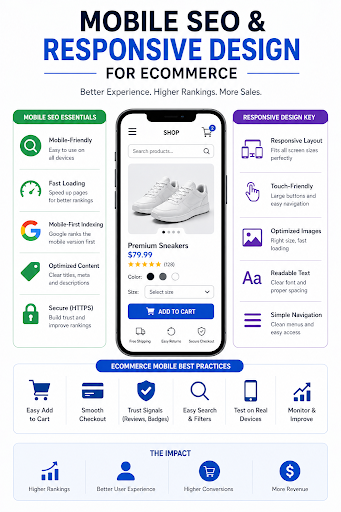
Mobile-First Indexing Requirements and Their Ecommerce Implementation Implications
Mobile-first indexing requires content parity between desktop and mobile versions, including structured data and metadata. Ecommerce sites must ensure responsive layouts, identical content, and optimized mobile performance for proper indexing.
Responsive Design Standards for Product Image Galleries and Filter Navigation
Responsive design ensures product galleries adapt across devices using flexible grids, scalable images, and touch-friendly filters. Implement CSS media queries, lazy loading, and collapsible navigation for seamless mobile browsing.
Tap Target Sizing, Font Legibility, and Viewport Configuration for Mobile Ecommerce
- Tap targets must be at least 48px for accessibility and usability
- Fonts should be legible without zoom, typically 16px or larger
- Viewport meta tags must ensure proper scaling and responsiveness across devices
Accelerated Mobile Page Considerations for Ecommerce Content and Blog Pages
Accelerated Mobile Pages improve load speed using lightweight HTML, restricted JavaScript, and caching. Use AMP primarily for blog content, ensuring canonical tags and consistent structured data with standard ecommerce pages.
HTTPS, Security, and Technical Compliance for Ecommerce SEO
Security signals, including HTTPS, are foundational ranking factors, and ecommerce sites must meet technical compliance standards that protect user data. This includes meeting SSL certificate requirements, managing redirect chains, addressing mixed-content issues, and maintaining technical hygiene practices for ecommerce sites.
SSL Certificate Configuration and HTTPS Implementation Standards for Ecommerce
SSL certificates encrypt data between the server and the browser, ensuring secure transactions. Implement HTTPS across all pages, use 301 redirects from HTTP, enable TLS protocols, and maintain valid certificates to meet security standards.
Redirect Chain Auditing and Resolution for Migrated or Restructured Ecommerce URLs
Redirect chains slow crawling and dilute link equity. Audit using crawling tools, replace multiple redirects with single-step 301 redirects, and update internal links to point directly to final destination URLs.
Mixed Content Error Detection and Remediation on HTTPS Ecommerce Pages
Mixed content occurs when HTTPS pages load HTTP resources, causing security warnings. Identify using browser tools, update resource URLs to HTTPS, and ensure all scripts, images, and assets load securely.
Security Header Configuration Including HSTS and CSP for Ecommerce Platforms
Security headers like HSTS enforce HTTPS connections, while Content Security Policy prevents malicious scripts. Configure headers at the server level to enhance protection, reduce vulnerabilities, and maintain compliance with modern web security standards.
Ecommerce Content Strategy and Blog SEO
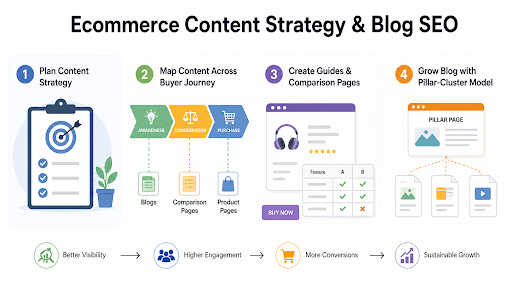
An ecommerce content strategy means that you can create helpful blogs while using the right keywords that people will search on Google. Always choose simple and focused topics, and add your other blogs to the relevant products. Publish your content consistently and make sure your website loads quickly and is easy to navigate.
Building a Content Strategy Around Ecommerce SEO Goals
Content Mapping Across the E-commerce Buyer Journey From Awareness to Purchase
Plan the content for each stage, such as learning blogs, comparison pages for choosing, and product pages for buying. Also, use the right keywords and links to guide visitors towards the purchasing step.
Structuring Buying Guides and Comparison Pages for Purchase Research
You can create buying guides with some simple features, pros and cons, and FAQ’s. You can also use comparison tables, clear keywords, and a strong call-to-action to help users choose and purchase confidently.
Optimizing Category Page Content and Depth for Ecommerce SEO
You can write unique category descriptions with the target keywords and user-focused details. This can also include filter options, helpful FAQ’s, internal links, and structured data to improve content relevance, search visibility, and engagement.
Ecommerce Blog Growth Through Pillar-Cluster Content Model
By creating a central pillar page with targeted keywords, you can link the smaller articles related to it. This can help the search engines to understand your site better and improve the rankings of your store.
Product Description Writing for SEO and Conversion
Writing unique product descriptions with clear details and the right keywords. In that you can clearly explain benefits, features, and use case studies to improve the search visibility, which will encourage the users to take action and purchase the product.
Writing Unique Product Descriptions with Natural Keyword Use
You should write original product descriptions in your own words and add the keywords naturally. Make sure to make your sentences clear, avoid overusing keywords, and make the content easy to read for better results.
Optimizing Product Specs, Tables, and Content Length for Better SEO
Use the clear and simple tables that show the product details, and keep the description short or detailed based on the product types, which helps the users to understand and improve search performance better.
Ecommerce Blog SEO and Informational Content
Internal Linking and Content Refresh Strategy for Ecommerce Blogs
Adding these contextual links from previous blogs to relevant product and category pages to guide users. Make sure to regularly update old content with new data, keywords, and insights to maintain SEO performance.
User-Generated Content and Reviews as SEO Assets
Adding user reviews, questions, and photos will give the real content of product pages. This will help build trust, add new keywords, and help search engines understand the product better, improving visibility.
Structured Data for Reviews and Star Ratings in Google Listings
Add structured data markup for product reviews so search engines can display star ratings in search results. This also improves credibility and encourages higher click-through rates on search pages.
How Q&A Content Improves Visibility in People Also Ask Results?
These Q&A sections target the real user queries, increasing the chances of coming up in “People Also Ask” boxes. The clear answer also improves the organic search results and boosts rankings.
UGC Moderation Guidelines for Trust and SEO Performance
Apply strict moderation to the users’ content by filtering spam, fake reviews, and many irrelevant posts. Make sure only the genuine feedback is published to maintain the trust and SEO quality signals.
Enhancing Product Pages with Fresh User Photos and Videos
Customer photos and videos always keep the product pages fresh and real. This helps the shoppers to trust the store more and increases its engagement.
Link Building and Authority for Ecommerce
Build an authority by getting trusted websites to link to your store through guest posts, collaborations, and some useful content. These strong links improve the reliability and search value.
Link-Building Strategies Specific to E-commerce Websites
Ecommerce link building primarily focuses on earning high-quality backlinks through digital PR, product reviews, Work with suppliers, partners, and relevant websites to get links pointing to your store. These methods will help to improve trust, drive traffic, and support stronger search rankings.
Using Digital PR to Scale Link Building for Ecommerce Stores
Digital PR helps to build backlinks by creating newsworthy content, product stories, or data insights that media sites and bloggers reference, helping ecommerce brands gain authority and visibility online.
Ecommerce Link Building via Supplier and Manufacturer Relationships
You can ask your suppliers to list your store on their websites, add you as an official seller, and link your products. This will help to build trust and improve search rankings.
Resource Page Outreach as a Link Building Strategy for Ecommerce
You can request that websites add your store to their helpful resource lists and also include your products in posts to earn backlinks, drive more traffic, and improve visibility.
Using Brand Mention Reclamation for Easy Ecommerce Backlinks
Make sure to find websites that can mention your brand without linking, then politely request that they add a clickable link. This quickly improves authority, traffic, and SEO performance with minimal effort.
Internal Linking Architecture for Ecommerce Authority Distribution
Building a structured internal linking system connects all the related products, categories, and content pages. This helps the search engine to crawl the pages effectively, spread the authority, and improve the visibility of important pages.
Distributing PageRank Through Category Hierarchy and Cross-Links
Organize the categories in a clear series and add relevant cross-links between related sections to pass link fairness efficiently, improving crawl paths, page authority, and overall ecommerce visibility.
Enhancing Ecommerce SEO with Breadcrumb Navigation Structure
The breadcrumb navigation shows users where they are on a website. It helps search engines understand page structure, improves easy browsing, and connects related categories and product pages better.
Optimizing Anchor Text for Ecommerce Internal Linking Strategy
You can use different but clear words for links instead of repeating the same keywords. Make sure links match the page’s topic so users on the search engines can understand the action better.
Related Products, Recently Viewed, and Upsell Modules as Internal Link Sources
Showing related products, recently viewed items, and upgrading helps users discover more options, keeps them browsing for longer, and improves site navigation and SEO performance naturally.
EEAT Signals and Ecommerce Domain Authority
EEAT helps ecommerce sites to build credibility through expert content, secure transactions, and authoritative backlinks. Strong EEAT signals improve domain authority, search rankings, and customer confidence in products.
Applying EEAT Principles in Ecommerce Health and Finance Stores
It will show expert-written content, trusted information, and secure checkout on health and finance ecommerce sites. Use reliable sources and clear authors to build trust and improve rankings.
How Author Pages and About Sections Improve Ecommerce Trust Signals?
The author and about pages show who is behind the content and what their experience is. This helps users to trust the website more and improves credibility in search engines.
Using Certifications, Awards, and Press Mentions as Trust Signals in Ecommerce
Showing certificates, awards, and media mentions on your website will also help establish trust. These help customers feel confident and make your store look more reliable and professional.
How Backlink Profiles Influence Ecommerce Domain Authority?
Good backlinks from trusted websites help your store look more reliable. They will help you to improve your website authority and bring more organic traffic.
Competitor Backlink Analysis for Ecommerce SEO
Check from where your competitors are getting backlinks, see what content works for them, and find missed opportunities. Use this information to improve your own link-building strategy.
Identifying Competitor Backlinks and Categorizing Link Types for SEO Strategy
By checking competitors’ backlinks with the help of SEO tools, you can see where their links come from and group them into directories, forums, or sponsored links to find better link-building ideas.
Ecommerce Domain Authority Benchmarking and Link Gap Analysis
You can compare your website’s authority against competitors’ to identify missing backlinks. Use this information to get better links, improve ranking, and compete more effectively in search results.
Transforming Backlink Analysis into Actionable Outreach Plans
Using competitor backlinks, you can also find good websites for your store. Focus on the best ones and contact them to get quality links and improve SEO.
Ecommerce SEO for Platforms, Measurement, and Growth
Ecommerce SEO means improving your online store so that it appears in search results. Track performance, use the right keywords, fix website issues, and improve pages to get more traffic and sales.
SEO on Ecommerce Platforms Including Shopify, WooCommerce, and Magento
Each ecommerce platform has unique SEO settings that affect URLs, speed, and indexing. Shopify relies on apps, WooCommerce uses plugins, and Magento allows advanced customization for better technical optimization and visibility.
Handling URL Structure Issues and Canonical Tags in Shopify
Shopify doesn’t allow full control over URLs, so using canonical tags is important. They help search engines avoid duplicate pages and rank the right page correctly.
Improving WooCommerce SEO with Yoast, Rank Math, and Links
Using SEO plugins like Yoast or Rank Math in WooCommerce to set titles, descriptions, and sitemaps. Also, use simple URLs to help search engines find pages easily.
Magento SEO Optimization: Layered Navigation and URL Control
Magento uses filters and category navigation to help users find products. Setting it up correctly avoids duplicate pages and helps search engines index your store better.
Headless Ecommerce Architecture and Its Implications for Crawlability and Indexing
Headless ecommerce separates design and backend systems, making websites faster and more flexible. But it needs a proper setup so search engines can still find and index pages easily.
Local and International SEO for Ecommerce Stores
Using hreflang tags and country-specific URLs in this way will show the right version of your store in each region. You can add local language, currency, and content to improve global search visibility and user experience.
Hreflang Setup Strategy for International Ecommerce Websites
The `hreflang` tags show users the right language or country version for your store. They help by avoiding duplicate content and improving search results in different regions.
International Ecommerce URL Structure: Subdomain vs Subdirectory vs ccTLD
Using the subdomains, subfolders, or country domains for international stores. Subfolders keep SEO strong; subdomains separate regions; and country domains target specific countries better.
Currency, Tax, and Language Localization and Their Impact on Ecommerce Indexing
Showing correct currency, language, and tax for each region helps users understand prices easily. It also helps search engines index the right version of your website.
Optimizing Local SEO Signals for Omnichannel Ecommerce Brands
When setting up your Google Business Profile, use the correct address and phone number, add local keywords, and collect reviews to help people nearby find your store easily.
Tracking Ecommerce SEO Performance Through KPIs and Reporting
To measure ecommerce SEO by tracking traffic, rankings, and sales from search engines. Using some analytics tools to understand what brings customers and improve website performance for better results and revenue growth.
Organic Traffic and Keyword Ranking Tracking Across Ecommerce Page Types
You can track how many visitors come from search and how keywords rank on product, category, and blog pages to find weak areas and improve search performance.
Tracking Organic Revenue Through GA4 and Google Search Console
Use GA4 and Search Console to see how many sales come from Google search. This helps understand which keywords bring customers and improve marketing results.
Structuring SEO Reports for Ecommerce Performance Tracking
Creating SEO reports showing traffic, rankings, and sales in simple charts. This helps clients and teams easily understand performance and make better decisions.
Scaling Ecommerce SEO With Automation and AI-Assisted Workflows
Ecommerce SEO can be scaled using automation tools and AI to manage many pages easily. It helps fix website issues, update content faster, and improve large store performance efficiently.
Scaling Ecommerce SEO Through Programmatic Pages and Automated Monitoring
Programmatic SEO creates many pages automatically for your store. Monitoring tools check website issues and alerts, which help keep everything working smoothly and ranking well.
AI-Driven Product Content Creation with EEAT Quality Control Standards
AI helps in creating product descriptions and titles very quickly. People then check the content to ensure it is accurate, trustworthy, and optimized for search engines.
Conclusion
Strong ecommerce performance depends on aligning search visibility with user intent, efficient site structure, and continuous optimization supported by data insights and modern automation techniques. For this, you need a reliable partner by your side. That’s exactly what we do at Think Shaw. We provide structured SEO services focused on improving search rankings, strengthening site performance, and driving measurable business outcomes through strategic optimization. Reach out today to unlock scalable growth and stronger digital performance!
FAQs
How long does ecommerce SEO take to show results?
Ecommerce SEO typically takes 3–6 months for noticeable improvements, depending on competition, site authority, and optimization quality. Larger stores or highly competitive niches may take longer to achieve stable rankings and traffic growth.
Is ecommerce SEO better than paid ads for online stores?
Ecommerce SEO delivers long-term, cost-effective traffic, while paid ads provide immediate visibility. A balanced strategy works best, using SEO for sustainable growth and ads for quick conversions and seasonal campaigns.
How many product pages should an ecommerce site optimize first?
Start by optimizing high-priority pages, including bestsellers, high-margin products, and pages with existing traffic. This ensures faster ROI before scaling SEO efforts across the entire product catalog.
What are common ecommerce SEO mistakes to avoid?
Common mistakes include duplicate product content, poor internal linking, ignoring technical issues, thin category pages, and a lack of keyword targeting, all of which negatively impact rankings and crawl efficiency.
How involved does my team need to be during SEO outsourcing?
Your team provides product knowledge, approvals, and collaboration on priorities. However, the agency handles execution, strategy, and reporting with minimal day-to-day dependency.
How long should I commit to an ecommerce SEO agency?
SEO is a long-term investment, so a minimum commitment of 6–12 months is recommended to see meaningful results and sustainable growth in organic performance.
What access do I need to give an SEO agency for my ecommerce store?
Typically, agencies require access to analytics tools, search console, CMS, and sometimes server-level data. Proper access ensures accurate audits, implementation, and performance tracking.