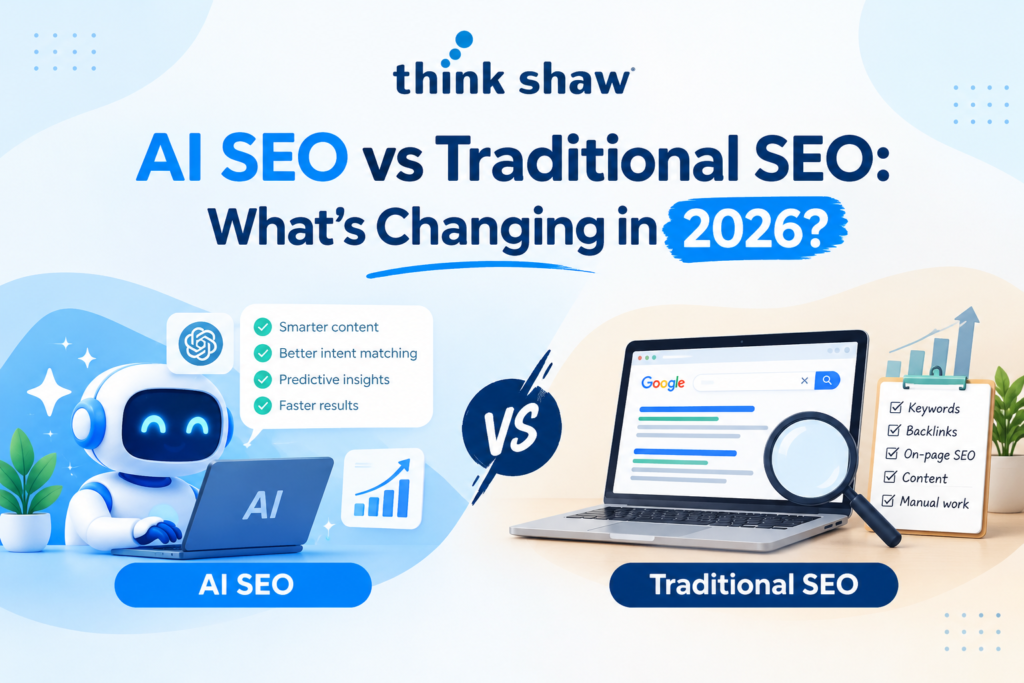
Search is changing faster than traditional SEO playbooks can keep up. In 2026, visibility is no longer shaped only by keywords, backlinks, and conventional search rankings. AI-powered search experiences are changing how search engines interpret content, understand user intent, generate answers, and surface information. This shift has created a growing distinction between AI SEO vs traditional SEO, with businesses needing to understand how established optimization practices fit into an increasingly AI-driven search environment. Rather than replacing foundational SEO, AI search is changing how those fundamentals are applied, from content structure and topical relevance to authority, context, and user-focused information. Understanding these changes can help marketers build search strategies that remain relevant as search continues to evolve.
AI SEO and Traditional SEO SummaryAI-driven search is expanding SEO beyond traditional rankings, keywords, and backlinks toward conversational search, content retrieval, citations, semantic relevance, and clearer information structures. Effective strategies now combine strong topic clusters, original expertise, structured data, extractable content, contextual internal linking, and ongoing content verification. Businesses can retain foundational SEO while adapting measurement, content planning, technical practices, and optimization methods to improve visibility across both conventional search results and emerging AI-powered search experiences. |
AI SEO vs Traditional SEO: What’s the Difference?
AI SEO and traditional SEO approach search visibility differently. Comparing their core methods makes it easier to understand how search intent, content structure, authority, technical optimization, and information retrieval are evolving as AI-powered search becomes more prominent.
| SEO Factor | Traditional SEO | AI SEO |
| Primary Search Environment | Primarily optimizes for conventional search engine results pages (SERPs). | Optimizes for AI-powered search experiences, answer engines, and generative search interfaces. |
| Content Retrieval | Search engines crawl, index, and rank pages against a query. | AI systems may retrieve, synthesize, and cite information from multiple sources when generating an answer. |
| Keyword Processing | Relies heavily on keyword relevance, placement, variations, and search intent. | Places greater emphasis on semantic relationships, entities, context, and natural-language concepts. |
| Content Structure | Uses headings, metadata, internal links, schema, and crawlable page structures to support indexing and ranking. | Uses clearly structured, context-rich content that makes individual facts, entities, relationships, and answers easier for AI systems to interpret. |
| Search Intent | Maps keywords to informational, navigational, commercial, or transactional intent. | Goes further by addressing conversational context, follow-up questions, multiple intents, and information needs within a query journey. |
| Authority Signals | Commonly emphasizes backlinks, topical relevance, site reputation, and other established ranking signals. | Places stronger practical importance on demonstrable expertise, trustworthy sourcing, consistent entity information, and content that can be confidently referenced. |
| Answer Optimization | Targets visibility through conventional organic listings and featured-result formats. | Targets inclusion within AI-generated answers, citations, summaries, and conversational search responses. |
| Content Goal | Earn rankings that drive users to the webpage. | Provide sufficiently clear, authoritative information to support both retrieval and potential citation within AI-generated responses. |
| Technical Foundation | Focuses on crawlability, indexation, site architecture, page experience, metadata, and structured data. | Retains these foundations while emphasizing machine-readable context, entity clarity, structured information, and content accessibility. |
| Turn your digital presence into a stronger growth channel with Think Shaw’s tailored marketing expertise, built around your business goals and market! |
How AI Search is Changing SEO in 2026
Search is Moving From Single Queries to Conversational Journeys
A single search can now develop into several connected prompts, with each interaction adding context or refining the user’s requirements. This changes how content should address information needs across a topic. Pages that anticipate logical follow-up questions can support longer search journeys without relying on isolated keyword-targeted pages.
Retrieval and Citation Are Becoming New Visibility Opportunities
Google AI search can retrieve relevant passages from different webpages and use selected sources when constructing generated responses. This creates an additional discovery pathway beyond standard organic listings. Content with precise claims, identifiable sources, and clearly presented supporting information can provide stronger retrieval signals when AI systems determine which information to incorporate.
Search Performance Requires More Than Traditional Ranking Data
Conventional SEO reporting often centers on rankings, impressions, clicks, and CTR. AI-generated search experiences can provide information without requiring a conventional result click, creating visibility that standard metrics may not fully capture. SEO measurement is therefore expanding toward broader search-surface monitoring and analysis of how content is represented within AI experiences.
AI is Increasing the Importance of Content Freshness and Verifiable Information
For rapidly changing subjects, outdated information can reduce the usefulness of content within AI-driven search experiences. Publishing dates, updated statistics, current specifications, source attribution, and verifiable claims provide clearer factual context. Maintaining these elements requires ongoing content audits so important information remains accurate rather than treating publication as the endpoint.
SEO Strategies Are Expanding Across Multiple Search Interfaces
Search visibility is increasingly distributed across traditional results and AI-powered interfaces. The same webpage may be discovered through organic listings, generated summaries, conversational responses, or other search features. This broader environment requires SEO teams to evaluate visibility across multiple interfaces instead of using conventional ranking position as the sole measure of search performance.
Key SEO Strategies That Are Changing With AI Search
AI search is reshaping how businesses approach SEO, making strategic optimization more important across modern search experiences. This infographic highlights the key strategies businesses can focus on from building stronger topic connections and adding original expertise to improving information structure, internal linking, structured data, and content verification for evolving AI-driven search.