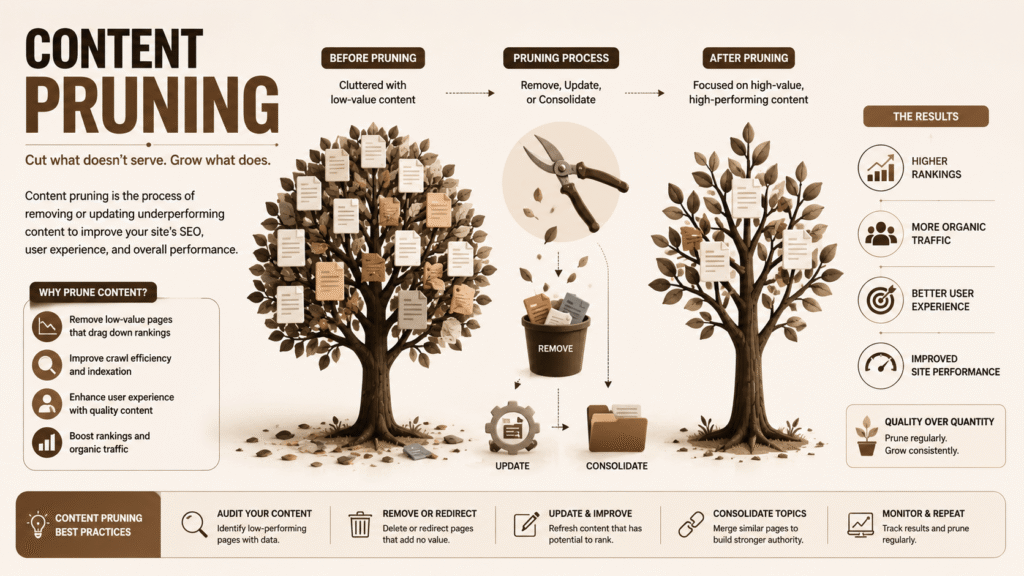
A website may publish hundreds of blog posts over time, but not every page continues delivering SEO value forever. Some blogs become outdated, lose rankings, attract little traffic, or compete with newer content on the same website. As search engines increasingly prioritize quality, relevance, and user intent, weak pages can undermine overall site performance rather than improve it. Content pruning is the process of updating, consolidating, redirecting, or removing underperforming content to strengthen organic visibility. When done correctly, it improves crawl efficiency, resolves keyword cannibalization, strengthens topical authority, and helps important pages rank more effectively in search engines.
Content Pruning Key Insights OverviewOutdated blog content reduces visibility, wastes crawl budget, and weakens topical authority when left unmanaged. Strategic pruning focuses on updating old posts, removing thin pages, merging overlapping content, and applying redirects to preserve link equity. A data-driven approach using traffic trends, engagement signals, and keyword analysis helps identify weak URLs. Regular audits improve rankings, reduce cannibalization, enhance user experience, and strengthen overall SEO performance across the website for long-term growth. |
Identifying the Hidden SEO Problems Caused by Old Blog Content
Old blog content can silently damage organic visibility over time. When businesses remove thin content from these old blogs, they often see stronger crawl efficiency and improved topical relevance across important pages. Here are the key hidden SEO problems caused by old blog content:
How Content Decay Reduces Organic Visibility
Content decay refers to the gradual decline of organic traffic and rankings over time. Unlike algorithm penalties, decay usually happens slowly as pages lose relevance, freshness, and engagement.
Every piece of content follows a lifecycle. It gains traction, reaches a peak, stabilizes, and eventually declines. Many websites focus heavily on publishing new content but neglect updating older pages during the decline stage. A consistent content refresh strategy helps preserve rankings before traffic losses become severe.
Several factors contribute to content decay, including:
- Outdated statistics, screenshots, or examples
- Competitors publishing more detailed content
- Search intent shifting over time
- Weak internal linking
- Keyword cannibalization between similar articles
- Lack of freshness signals
Site-Level Impact of Weak Content
Outdated and low-quality pages affect more than individual rankings. Large amounts of weak content dilute overall site quality signals.
Search engines evaluate websites holistically. When thousands of thin or outdated pages remain indexed, they create “quality debt,” making it harder for stronger pages to perform well. This issue becomes more serious as search engines increasingly prioritize semantic relevance and user satisfaction over simple keyword optimization.
Websites with excessive low-value content often experience:
- Reduced crawl efficiency
- Lower topical authority
- Slower indexing of new content
- Declining trust signals
- Reduced internal link effectiveness
Instead of helping SEO, outdated content can prevent valuable pages from reaching their ranking potential.
Keyword Cannibalization and Topical Confusion
Keyword cannibalization occurs when multiple pages target the same or very similar keywords. Instead of strengthening rankings, the pages compete against each other.
A common example is publishing multiple beginner guides covering nearly identical topics. Each page gains partial authority, but none becomes the strongest result. As a result, rankings fluctuate and overall visibility weakens.
To identify cannibalization:
- Search site:yourdomain + keyword in Google
- Review landing page changes in ranking tools
- Analyze overlapping keyword targets
- Check pages with similar search intent
Search engines prefer a single authoritative page rather than multiple competing articles. Consolidating overlapping blogs often produces significant ranking improvements.
Why Irrelevant Content Weakens Topical Relevance
Topical authority depends on maintaining strong semantic relationships between pages. Irrelevant or outdated content creates confusion about your website’s expertise.
Modern SEO focuses heavily on topical relevance. Search engines analyze how well pages connect within a subject area through contextual internal linking and content depth. Pages unrelated to your core expertise dilute those signals.
Semantic internal linking strengthens topical relevance by connecting related pages using contextual anchor text. When outdated or irrelevant pages remain indexed, they interrupt this topical structure and reduce clarity.
Quality and relevance now matter far more than publishing large volumes of content. A smaller website with highly focused content often outperforms a larger site filled with outdated blogs.
Understanding Crawl Budget Waste
Crawl budget refers to the number of pages search engines allocate resources to crawl on your website. Large websites with thousands of pages must manage crawl efficiency carefully.
Thin, outdated, broken, or low-value pages waste crawl resources. When search engines repeatedly crawl unimportant pages, they may delay indexing or recrawling important content.
Common crawl budget issues include:
- Soft 404 pages
- Broken URLs
- Outdated product pages
- Thin blogs with no engagement
- Duplicate content
For websites publishing content frequently, crawl inefficiencies can significantly delay visibility improvements.
E-commerce sites often face additional challenges when out-of-stock products remain indexed. These pages create poor user experiences and unnecessarily consume crawl resources.
Google Search Console’s Index Coverage and Crawl Stats reports help identify pages causing crawl inefficiencies.
Building a Data-Driven Content Pruning Strategy
Auditing Traffic Trends and Ranking Decline
The easiest way to identify decaying content is by analyzing traffic decline over time.
In Google Search Console, compare recent performance against the same period from the previous year. Look for:
- Declining impressions
- Falling CTR
- Position losses
- Reduced clicks
SEO tools like Ahrefs can also identify declining pages using traffic filters.
Patterns often reveal the cause of decline:
- Declining impressions and CTR usually indicate content decay
- Stable impressions but lower CTR may indicate SERP feature competition
- Sharp ranking losses may signal search intent changes
Tracking these patterns helps prioritize which pages need immediate attention.
Evaluating Engagement Metrics and User Behavior
Traffic alone does not determine content quality. User engagement metrics provide deeper insights into whether pages satisfy search intent.
Important engagement signals include:
- Bounce rate
- Average time on page
- Engagement rate
- Pages per session
- Conversion performance
Low engagement often indicates poor content quality, outdated information, or a mismatch with search intent.
Adding these metrics to an SEO content audit spreadsheet helps identify pages that require structural improvements rather than simple updates.
Analyzing Backlink Equity Before Removing Content
Before deleting any page, analyze its backlink profile carefully.
Pages with strong backlinks still hold SEO value even if traffic has declined. Removing these pages without redirects wastes link equity and creates broken links.
During content audits:
- Check referring domains
- Review backlink quality
- Identify historically valuable pages
- Document link equity before pruning
If a page has strong backlinks but weak performance, refreshing or redirecting it is usually safer than deleting it.
Categorizing Pages Into Keep, Update, Merge, or Remove
A successful pruning strategy depends on proper categorization.
Keep and Refresh
Pages that are still receiving traffic or align with current business goals should be updated with relevant improvements. Businesses that regularly update old blog posts can maintain freshness signals and improve long-term search visibility.
- New statistics
- Fresh examples
- Updated screenshots
- Improved formatting
- Stronger internal links
Rewrite
Pages targeting valuable keywords but no longer matching search intent may require full rewrites.
Merge and Consolidate
When multiple articles target similar keywords, consolidate them into a single comprehensive page and redirect weaker URLs.
Remove or Redirect
Pages with no traffic, backlinks, or business value may be removed or redirected.
A practical rule is reviewing pages with fewer than 10 organic visits per quarter and no upward trend.
Prioritizing High-Impact Pages
Not every page requires immediate action. Prioritize based on three factors:
- Business relevance
- Historical traffic potential
- Ranking difficulty
Pages that are strongly aligned with business goals and have previously achieved successful traffic levels should be updated first. Pages with low relevance and no SEO value become pruning candidates.
This prioritization prevents wasting resources on low-impact content.
Using Search Intent Analysis During Pruning
Search intent evolves constantly. A keyword that once favored blog guides may now favor forums, videos, or product pages.
Analyze current SERPs to determine:
- Dominant content formats
- User intent changes
- Competitor improvements
- Content depth expectations
If search intent changes significantly, minor edits are rarely enough. Pages may require structural rewrites to remain competitive.
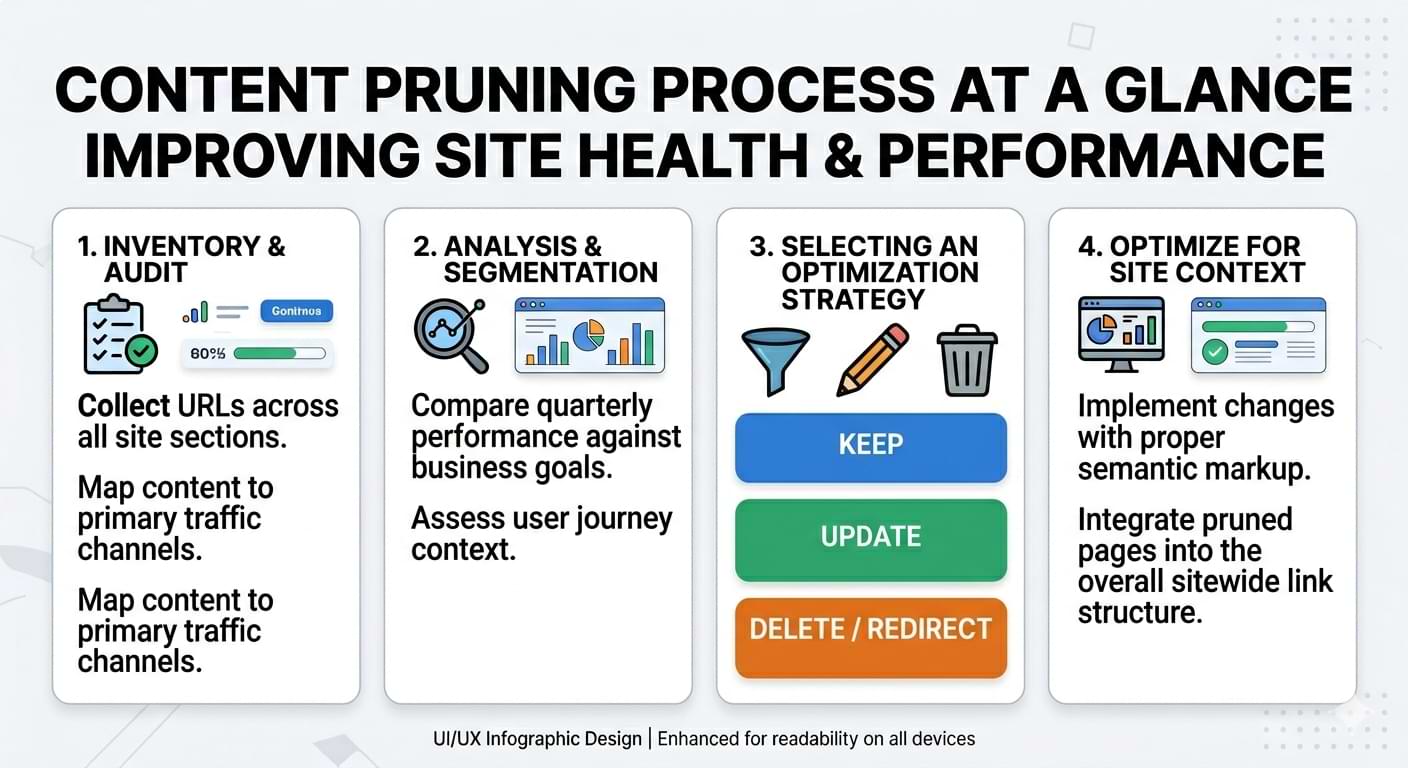
Content Pruning Process at a Glance
Advanced Methods to Clean Up Old Blogs Without Losing SEO Value
Content pruning should protect existing SEO value while improving overall site quality. Instead of deleting pages at random, advanced pruning focuses on preserving authority, maintaining relevance, and strengthening the content structure through strategic optimization.
The most effective cleanup methods include:
- Consolidating overlapping articles
- Refreshing evergreen content
- Re-optimizing pages for updated search intent
- Implementing 301 redirects correctly
- Improving semantic internal linking
- Removing low-quality pages carefully
These strategies help websites improve rankings without losing backlinks, traffic, or topical authority.
Consolidating Competing Articles Into Stronger Pages
Content consolidation is one of the most effective pruning techniques.
The process involves:
- Choosing the strongest URL
- Combining the best information from competing pages
- Expanding topical depth
- Implementing 301 redirects
- Updating internal links
Consolidation strengthens authority by focusing backlinks, rankings, and internal link equity into one authoritative resource.
Many pages stuck between positions eight and fifteen improve significantly after cannibalization issues are resolved.
Refreshing Evergreen Content With Updated Information
Refreshing content involves more than changing the publish date.
A proper refresh includes:
- Updating outdated data
- Expanding missing subtopics
- Improving readability
- Replacing broken links
- Enhancing metadata
- Adding stronger internal linking
Review competitor pages to identify missing topics your content does not cover. Updating evergreen articles regularly helps maintain freshness signals and ranking stability.
After updating, re-promote the content through email newsletters, social sharing, and internal linking to accelerate visibility improvements.
Re-Optimizing Older Blogs for Current Keyword Intent
Older pages often rank for unexpected keywords.
Use Google Search Console to identify:
- Queries generating impressions
- Long-tail variations
- Emerging keyword opportunities
Optimize older blogs around terms already showing visibility instead of targeting entirely new keywords.
If keyword popularity declines over time, shift optimization toward newer variations with stronger search demand.
Update:
- Title tags
- Meta descriptions
- Headings
- Internal anchors
- Supporting copy
Modern optimization should focus on natural language relevance instead of keyword repetition.
Implementing 301 Redirects Correctly
301 redirects preserve SEO value when removing or consolidating pages.
A proper 301 redirect:
- Transfers most link equity
- Prevents broken links
- Maintains user experience
- Preserves ranking signals
Redirects should always point to the most relevant replacement page rather than the homepage.
Important redirect practices include:
- Updating internal links after redirects
- Avoiding redirect chains
- Maintaining topical relevance
- Redirecting only when suitable replacements exist
For temporary situations, noindex tags may be safer than deletion.
Strengthening Internal Linking After Pruning
After removing or consolidating pages, internal linking structures must be updated.
Broken internal links reduce crawl efficiency and weaken authority distribution.
Strong semantic internal linking helps:
- Reinforce topical relationships
- Distribute authority effectively
- Improve crawl pathways
- Increase user engagement
Linking should always prioritize topical relevance rather than excessive anchor optimization.
Removing Low-Quality Pages Safely
Deleting pages without proper planning can create traffic loss and technical issues.
Before removing content:
- Check backlinks
- Identify internal links
- Review historical traffic
- Confirm business irrelevance
Pages with backlinks should usually be redirected rather than deleted.
Noindex tags provide a reversible alternative when uncertain about permanent removal.
Pruning works best when focused on genuinely low-value content rather than pages simply needing updates.
Measuring Ranking Growth and Maintaining Content Quality After Pruning
Measuring SEO Growth
Successful pruning should improve:
- Organic traffic
- Average rankings
- Crawl efficiency
- Engagement metrics
- Indexation quality
Track performance gradually rather than expecting instant results.
Useful monitoring metrics include:
- Organic sessions
- Keyword position changes
- CTR improvements
- Indexed page counts
- Crawl stats
Compare performance using consistent date ranges to avoid seasonal distortions.
Monitoring Crawl Efficiency and Site Health
After pruning, monitor crawl behavior through Google Search Console.
Improved crawl efficiency often appears as:
- Faster indexing
- Reduced crawl waste
- Higher-quality indexed pages
- Better crawl allocation
Large websites especially benefit from improved crawl prioritization after removing unnecessary pages.
Identifying Content Gaps After Cleanup
Pruning often reveals missing content opportunities.
After cleanup, analyze:
- Competitor coverage
- Frequently searched questions
- Missing topical clusters
- Supporting subtopics
These gaps create opportunities to strengthen topical authority further with higher-quality content.
The goal is not publishing more pages but publishing strategically relevant content.
Avoiding Over-Pruning and Traffic Loss
Over-pruning can damage rankings if valuable pages are removed unnecessarily.
Avoid deleting content solely because it has not been updated recently. Some evergreen pages maintain value for years.
Instead, evaluate:
- Search demand
- Link equity
- Business relevance
- User engagement
Larger websites should prune gradually in batches every 1–3 months. Smaller websites can perform audits once or twice yearly.
A staged approach reduces the risk of accidental traffic decline.
Establishing Long-Term Content Audit Cycles
Content pruning should become an ongoing SEO process rather than a one-time project.
Quarterly audits help identify pages losing more than 20% traffic year-over-year before major decline occurs.
Annual reviews for high-value pages help maintain freshness and competitiveness even before traffic drops appear.
Effective long-term strategies include:
- Building strong topical clusters
- Avoiding duplicate keyword targeting
- Updating evergreen pages regularly
- Monitoring search intent shifts
- Automating content audits where possible
Many successful businesses now divide SEO efforts between creating new content and updating existing pages.
Conclusion
SEO for healthcare websites is most effective when it focuses on clarity, accuracy, and structured optimization across content, local presence, technical setup, and user experience. A well-planned strategy helps remove digital friction, improve patient discovery, and strengthen long-term visibility in search results. Instead of isolated efforts, consistent optimization across all SEO layers delivers stronger outcomes. Think Shaw helps healthcare providers build and maintain high-performing SEO systems that improve rankings, increase patient engagement, and ensure sustainable organic growth in a competitive healthcare landscape.
FAQs
What is content pruning in SEO?
Content pruning is the process of updating, consolidating, redirecting, or removing underperforming pages to improve website quality and SEO performance.
How does this improve rankings?
Search performance improves when weak pages are removed or improved, keyword cannibalization is reduced, topical authority becomes stronger, and crawl efficiency increases.
Should old blog posts always be deleted?
No. Older content can often be refreshed or merged, especially when it still carries backlinks, traffic, or business relevance.
What is keyword cannibalization?
This occurs when multiple pages target the same keyword and end up competing against each other in search results.
How often should website audits be performed?
Large websites usually benefit from audits every 1–3 months, while smaller sites can manage with one or two reviews per year.