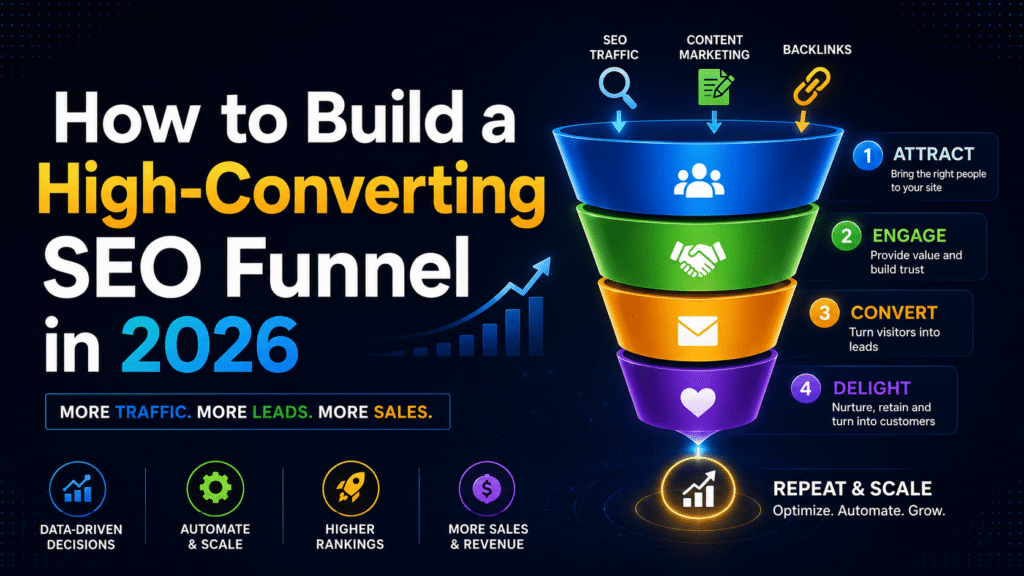
Most SEO campaigns generate traffic that never converts. Pages rank, visitors arrive, and then they leave with no action taken and no revenue generated. The missing piece is almost never more content. It is a deliberate funnel where every piece of content, every keyword, and every internal link works together to move a visitor from discovery to decision. Building that system in 2026 requires architecting content to serve the right intent, connect each stage to the next, and convert at the moment a visitor is ready.
Overview of High-Converting SEO Funnel BuildingA high-converting SEO funnel maps content and keywords to three buyer intent stages: awareness (TOFU), consideration (MOFU), and decision (BOFU). Each stage requires a specific content type, keyword intent, and conversion trigger. Built on a hub-and-spoke content architecture with deliberate internal linking between stages, the funnel moves visitors from discovery to conversion. In 2026, effective SEO funnels are also structured for AI search citation, with direct answer blocks, schema markup, and BOFU assets optimized for high-intent transactional queries. |
What makes an SEO funnel different from a content plan
A content plan publishes. An SEO funnel converts. An SEO funnel maps keywords and content types to three stages of buyer intent: awareness at the top, consideration in the middle, and decision at the bottom, with deliberate paths built between them.
In 2026, informational queries are increasingly resolved by Google AI Overviews without a click. Research tracking 300,000 keywords found that AI Overview presence correlated with a 58% lower average click-through rate for top-ranking pages. The real conversion opportunity lives in the middle and bottom stages, where buyer intent is highest and AI search is least dominant.
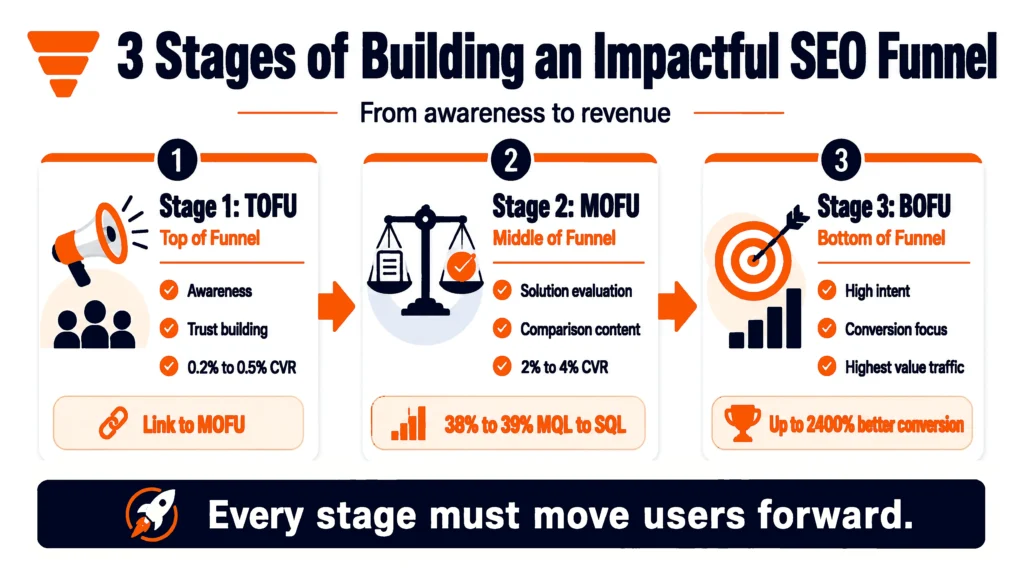
3 Stages of Building an Impactful SEO funnel
Building stage one: the top of the funnel
TOFU content targets users who are problem-aware but not yet solution-aware. The goal at this stage is entry, trust-building, and feeding users into the next stage. TOFU conversion rates typically fall between 0.2% and 0.5% because these visitors are exploring, not deciding.
What works at TOFU in 2026 is content with a distinct point of view, original data, or a specific angle that AI summaries cannot fully synthesize. Long-form guides and research-backed how-to content built around long-tail informational keywords still attract qualified traffic when they go beyond surface-level answers.
TOFU content must be structured for AI citation: place a direct answer within the first two sentences of each section, use question-framed H2 and H3 headings, and include FAQ and Article schema markup. Every TOFU page must also carry a contextual internal link to a relevant MOFU resource. Without that link, the page is a dead end.
Building stage two: the middle of funnel
MOFU content targets users who know their problem and are actively evaluating solutions. Conversion rates at this stage are significantly higher, between 2% and 4%, because intent has sharpened. The keyword language shifts to commercial investigation: “best SEO agency for ecommerce,” “SEO vs PPC for lead generation,” “SEO tool comparisons.”
The content types that work at MOFU are comparison guides, solution-focused landing pages, case studies with specific results, and in-depth feature breakdowns. A healthy MQL-to-SQL conversion rate sits between 38% and 39%. If that number falls below 25%, it signals that MOFU content is educating without guiding toward a decision.
Every MOFU page needs a clear path forward. Comparison guides link to service pages. Solution articles link to pricing pages or consultation CTAs. This connection between stages is where most funnels break down.
Building stage three: the bottom of funnel
BOFU content is where traffic becomes revenue. These pages target transactional and navigational queries like “hire SEO agency,” “SEO agency pricing,” or brand-vs-competitor comparisons. Search volume is low. Conversion intent is high.
Bottom-of-funnel keywords convert up to 2400% better than top-of-funnel alternatives. Comparison and review pages convert two to five times higher than general blog content, yet they remain the most neglected part of most SEO strategies. A 5-point lift in BOFU conversion can impact revenue by up to 18%.
BOFU pages must be built for conversion, not just ranking. Pages with a single offer convert 266% better than those with multiple offers. Four form fields convert 120% better than eleven fields. Reducing page load time to under 2.4 seconds can double a 10% conversion rate. These are not post-SEO additions. They are part of building the page correctly from the start.
Mapping keyword intent across each stage
The funnel only performs when each stage is fed the right keyword intent. Targeting the wrong intent type for a given stage is one of the most common reasons SEO funnels fail to convert.
- Informational intent (“how,” “what,” “why,” “guide”) belongs at TOFU. These users are learning.
- Commercial investigation intent (“best,” “vs,” “alternatives,” “review”) belongs at MOFU. These users are evaluating.
- Transactional and navigational intent (“hire,” “pricing,” “get a quote,” brand names) belongs at BOFU. These users are deciding.
Long-tail keywords reveal intent more clearly than head terms. “SEO agency” is broad and stage-ambiguous. “Best SEO agency for ecommerce startups” is MOFU. “SEO agency pricing for small businesses” is BOFU. Matching keyword specificity to funnel stage ensures content aligns with what the visitor actually needs at the moment they arrive.
Structuring the content architecture
The structural backbone of a high-converting SEO funnel is the hub-and-spoke model. A hub page targets a broad keyword and provides a strategic overview of a topic. Spoke pages target long-tail variations, cover subtopics in depth, and feed authority back to the hub through internal links.
This architecture builds topical authority, which is how search engines and AI systems decide which sources to trust and cite. A site with 20 tightly connected pages on SEO strategy signals more depth and expertise than one with 100 loosely related posts across different topics. Pillar pages typically target broader TOFU and MOFU keywords, while spoke pages drill into specific BOFU intent and long-tail commercial queries.
Keyword clustering must happen before content creation begins. Each page should target one intent cluster, not a mix of conflicting intents. One page, one intent stage, one conversion objective.
Building internal links that move users through the funnel
Internal links are the mechanism that turns a collection of pages into a functioning funnel. The linking logic should mirror the conversion path: TOFU content links forward to the most relevant MOFU page, MOFU content links forward to BOFU assets, and BOFU pages do not link backward. Pulling a buyer back up the funnel interrupts the decision moment.
Anchor text should be descriptive and keyword-aligned, not generic. “Click here” passes neither context to search engines nor intent to visitors. “SEO funnel content strategy” tells both the crawler and the user exactly what they will find. Important pages should also be reachable within three clicks from the homepage, as pages buried deeper in the crawl hierarchy rank with more difficulty and are less likely to be discovered.
Aligning each stage with AI search visibility
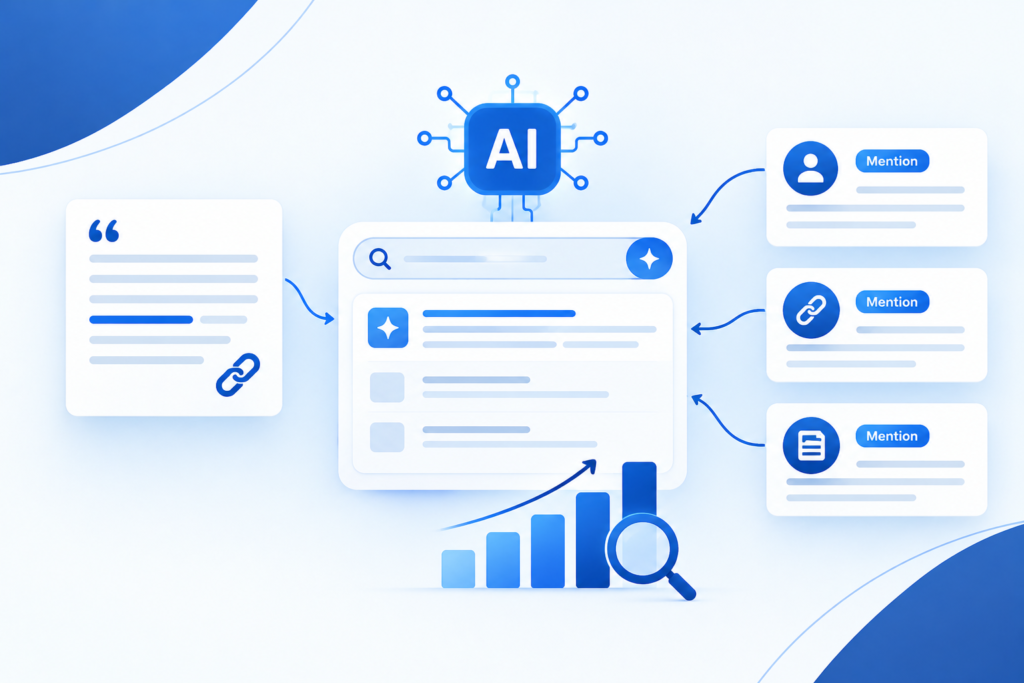
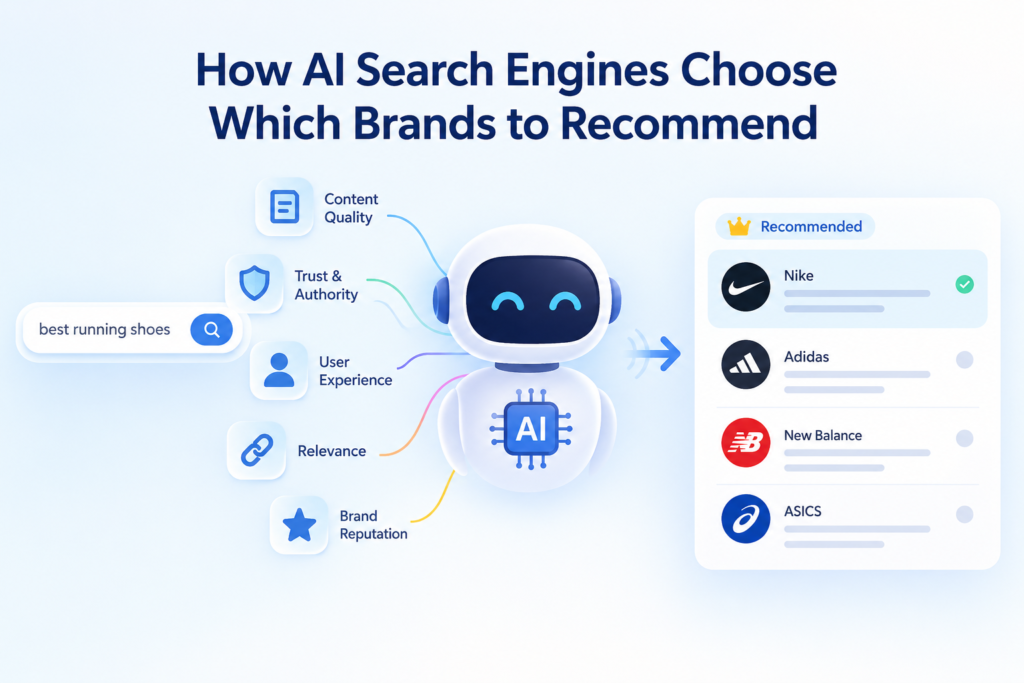
AI search has added a parallel visibility layer on top of the traditional funnel. Google AI Overviews, ChatGPT search, and Perplexity now synthesize answers and cite sources directly, so the funnel must serve both human visitors and machine retrieval systems.
At the TOFU stage, content that answers questions directly, uses structured headings, and includes FAQ and HowTo schema is more likely to be pulled into AI Overviews. At the MOFU stage, AI systems favor sources with original research, clear authorship, and structured comparisons that can be extracted and cited. At the BOFU stage, transactional queries are less frequently dominated by AI Overviews, which means BOFU is the most protected part of the funnel from AI disruption and where direct click-through remains strong.
Tracking whether the funnel is working
Tracking sitewide averages flattens stage-specific signals into numbers that tell you nothing actionable. Each stage has its own signal set.
- TOFU signals: organic impressions, clicks from informational queries, time on page, scroll depth, newsletter signups
- MOFU signals: return visit rate, content download completions, consultation requests, email engagement
- BOFU signals: form completion rate, service page conversion rate, cost per acquisition, MQL-to-SQL rate
Google Search Console segments keyword data by intent type to track which funnel stage is generating visibility. GA4 behavioral flow reports reveal where users exit the funnel and where the gaps in the conversion path actually exist.
Bottom line
A high-converting SEO funnel is built stage by stage: keyword intent mapped to each phase, content architecture connecting hub pages to clusters, internal links guiding visitors forward, and each BOFU page engineered for a single conversion action. In 2026, that funnel must also be readable by AI systems at every level, from structured TOFU content that earns citations to BOFU pages that capture intent the moment a buyer is ready to decide.
FAQs
Q1: What is an SEO funnel?
An SEO funnel is a content and keyword architecture that aligns each page with a specific stage of the buyer journey: awareness, consideration, or decision. It connects those stages through internal linking and intent-matched content to move organic visitors toward conversion rather than just accumulating traffic.
Q2: How do I map keywords to the right funnel stage?
Informational keywords (“how,” “what,” “why,” “guide”) belong at the top of the funnel, commercial investigation keywords (“best,” “vs,” “alternatives”) belong in the middle, and transactional keywords (“pricing,” “hire,” “get a quote”) belong at the bottom. Matching keyword intent to funnel stage ensures the content meets the visitor at the right moment.
Q3: What content types work best at each funnel stage?
TOFU works best with in-depth educational guides, research-backed blog posts, and structured how-to content. MOFU performs with comparison pages, solution guides, and case studies with hard metrics. BOFU converts through service pages, pricing pages, client results pages, and consultation landing pages with a single focused call to action.
Q4: Why does BOFU content convert so much better than TOFU?
BOFU visitors are vendor-ready. They have already researched their problem and evaluated options, so their intent is transactional. Bottom-of-funnel keywords convert up to 2400% better than informational alternatives because the visitor’s intent and the page’s goal are fully aligned at the point of action.
Q5: How should internal links be structured across funnel stages?
TOFU content should carry a contextual internal link to the most relevant MOFU resource. MOFU pages should link directly to BOFU service pages or landing pages. BOFU pages should not link back up the funnel, as this directional structure mirrors the conversion path and keeps visitors moving toward a decision.
Q6: How should an SEO funnel be structured for AI search in 2026?
TOFU content should answer questions directly at the start of each section and include FAQ and Article schema markup to improve AI Overview citation rates. MOFU content should include original data and structured comparisons that AI systems can extract and cite. BOFU pages benefit from clear transactional intent signals, which AI Overviews rarely dominate, preserving direct click-through.