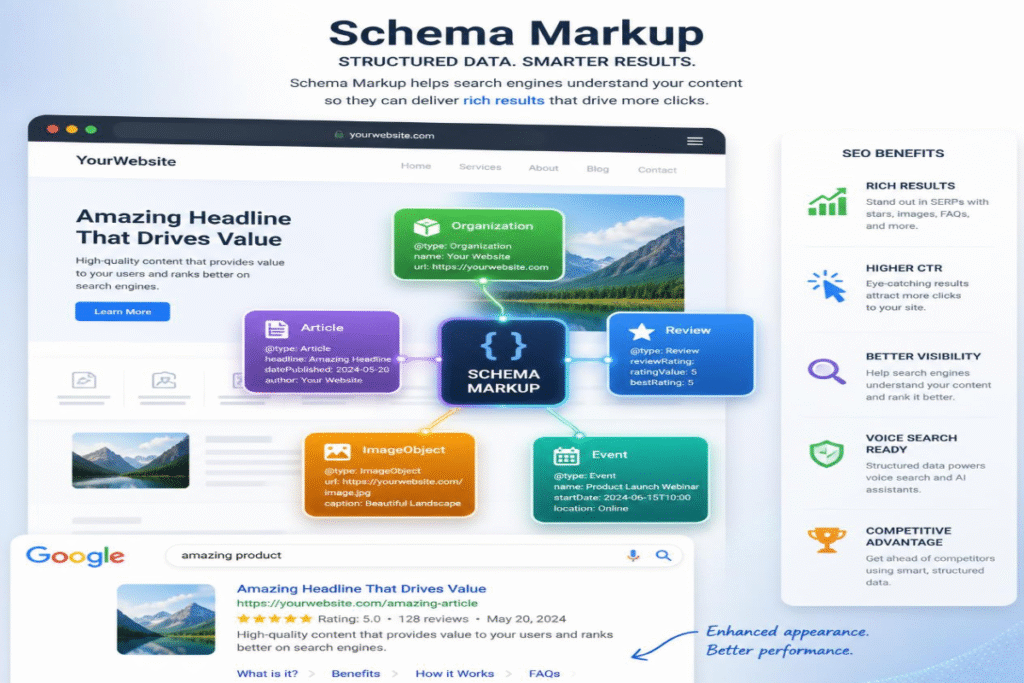
Search engines have become increasingly sophisticated, but they still rely on structured information to interpret and present ecommerce content accurately. This is where schema markup plays a crucial role. By adding standardized structured data to product pages and other key sections of an online store, businesses help search engines better understand their content, making it eligible for enhanced search features such as rich snippets, product details, ratings, and pricing information. Beyond traditional SEO, it is also gaining importance for AI-powered search experiences that prioritize well-structured, trustworthy information. For ecommerce businesses aiming to improve visibility, credibility, and organic performance, implementing the right schema types is no longer optional.
This Schema Markup guide explores the 12 essential types every ecommerce website should use to build a stronger foundation for long-term search success.
Schema Markup at a GlanceSchema markup is a fundamental component of modern ecommerce SEO, helping search engines and AI platforms accurately interpret products, pricing, reviews, business details, and site structure. Implementing essential schema types enhances eligibility for rich results, improves content discoverability, strengthens brand credibility, and supports better user experiences. A comprehensive structured data strategy not only boosts organic visibility today but also prepares ecommerce websites for the future of AI-driven and entity-based search. |
What Is Schema Markup and Why Does Every Ecommerce Website Need It?
Schema markup is a standardized form of structured data, developed through Schema.org, that helps search engines understand the context and meaning of webpage content. Instead of simply crawling text, search engines can identify key information such as products, prices, availability, reviews, and business details more accurately.
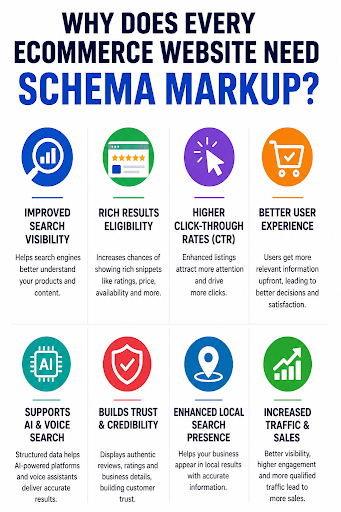
For ecommerce websites, this improves eligibility for rich results, enhances product visibility in search, and can increase click-through rates by displaying more informative listings. As AI-powered search experiences continue to evolve, schema markup also helps large language models and search engines interpret content with greater accuracy, making it an essential component of both modern SEO and Generative Engine Optimization (GEO).
The 12 Essential Schema Markup Types Every Ecommerce Site Should Implement
Moving forward in our Schema Markup guide, let’s now explore the 12 essential types that every e-commerce site should implement:
1. Product Schema
As per Google, Product Schema is one of the most important structured data types for ecommerce websites because it provides search engines with detailed information about individual products. It can include attributes such as the product name, description, images, SKU, brand, GTIN, color, size, and availability. When implemented correctly, Product Schema helps search engines better understand product pages and increases the likelihood of appearing in rich results. It also improves how AI-powered search platforms interpret product information, making it easier for shoppers to discover relevant products through both traditional and conversational search.
2. Offer Schema
Offer Schema communicates pricing and purchasing information associated with a product. It includes details such as the current price, currency, stock availability, item condition, and seller information. Since prices and inventory frequently change, keeping Offer Schema updated is essential for maintaining accurate search listings. Proper implementation helps search engines display real-time pricing and availability in search results, improving user trust while reducing the chances of visitors landing on outdated product pages.
3. Review Schema
This allows ecommerce websites to mark up individual customer reviews for products or services. It identifies the reviewer, review date, rating, and review content, providing search engines with valuable information about customer experiences. Genuine, visible reviews supported by Review Schema contribute to credibility and help users make informed purchasing decisions. Search engines require that marked-up reviews accurately reflect the content displayed on the page, making authenticity a critical factor in implementation.
4. Aggregate Rating Schema
It summarizes the overall rating of a product or business based on multiple customer reviews. Instead of highlighting a single opinion, it presents an average rating and the total number of reviews collected. This structured data can enable star ratings to appear in eligible search results, attracting more user attention and increasing click-through rates. For ecommerce businesses with consistent customer feedback, Aggregate Rating Schema serves as a strong trust signal that reinforces product quality and buyer confidence.
5. Organization Schema
Organization Schema provides essential information about the business behind an ecommerce website. It can include the company name, logo, official website, contact information, social media profiles, customer service details, and business identifiers. This schema helps search engines verify the legitimacy of a business and establish entity recognition across the web. Strong organizational data supports Google’s understanding of brand identity while contributing to the Experience, Expertise, Authoritativeness, and Trustworthiness (E-E-A-T) signals that influence search visibility.
6. Breadcrumb Schema
It helps search engines understand the hierarchical structure of a website by defining the navigation path leading to a specific page. Instead of displaying lengthy URLs, search engines may show breadcrumb links within search results, making listings easier to understand and navigate. For ecommerce websites with extensive product catalogs and multiple categories, Breadcrumb Schema improves crawlability, enhances user experience, and assists both search engines and AI systems in understanding relationships between products and categories.
7. FAQ Schema
FAQ Schema organizes frequently asked questions and their corresponding answers using structured data. It helps search engines recognize helpful informational content that addresses common customer concerns about products, shipping, returns, warranties, or purchasing decisions. While Google’s display of FAQ rich results has become more selective, implementing FAQ Schema remains valuable because it improves content organization and enables AI-powered search systems to better identify direct answers within ecommerce pages.
8. Local Business Schema
For ecommerce brands with physical stores, warehouses, or pickup locations, Local Business Schema provides important business information such as the business name, address, phone number, operating hours, geographical coordinates, and accepted payment methods. This structured data improves visibility in local search results and helps customers locate nearby stores. It also supports consistency across online business listings, strengthening local SEO while helping AI search platforms accurately identify business locations.
9. Article or Blog Schema
This plays a significant role in ecommerce SEO, making Article or Blog Schema valuable for educational content published on an online store. This schema identifies information such as the article headline, publication date, author, featured image, and publisher details. Structured blog content helps search engines understand educational resources related to products and industry topics. It can also improve eligibility for enhanced search features while supporting topical authority that benefits overall organic visibility.
10. Video Schema
Video Schema provides metadata about videos embedded on ecommerce pages, including the title, description, thumbnail, upload date, duration, and video location. Product demonstrations, installation tutorials, buying guides, and customer testimonials become easier for search engines to understand when properly marked up. Since video content often increases engagement and purchasing confidence, implementing Video Schema improves discoverability across video search results while helping AI systems interpret multimedia content more effectively.
11. SearchAction (Sitelinks Search Box) Schema
SearchAction Schema enables search engines to understand an ecommerce website’s internal search functionality. When supported, it may allow users to search a website directly from search results through a sitelinks search box, improving navigation and user convenience. Although Google has reduced the visibility of this feature in some cases, implementing SearchAction Schema still provides clear signals about site search capabilities and contributes to a better understanding of website structure for search engines.
12. ItemList Schema
It is designed to organize collections of related products, categories, featured products, or ranked lists in a structured format. It helps search engines understand the sequence and relationship between multiple items displayed on a page, such as category listings, best-selling products, seasonal collections, or buying guides. For ecommerce websites with extensive inventories, ItemList Schema improves content organization, supports efficient crawling, and enables search engines to interpret grouped products more accurately, enhancing both SEO performance and AI-driven content understanding.
Conclusion
A well-planned structured data strategy supports long-term digital growth by making ecommerce content easier to interpret across evolving search technologies. As search continues to become more intelligent and entity-driven, staying proactive with schema implementation can provide a lasting competitive advantage. If you’re ready to strengthen your ecommerce website with expert technical SEO solutions, Think Shaw specializes in creating customized structured data strategies that enhance search performance, maximize organic traffic, and drive qualified conversions.
Ready to future-proof your ecommerce website? Contact us today and let our team help you build a smarter, search-optimized online presence that delivers lasting business growth.
Schema Markup FAQs
How can I check if my schema markup is working correctly?
Use Google’s Rich Results Test or Schema Markup Validator to verify your structured data, identify errors, and ensure search engines can properly read your implementation.
Can schema markup be added without changing a website’s design?
Yes. Schema markup is typically implemented as JSON-LD within the page’s code, meaning it works behind the scenes without affecting the website’s visual appearance.
Can multiple schema types be used on a single webpage?
Yes. Many ecommerce pages combine several compatible schema types, provided each accurately represents visible content and follows Schema.org and search engine guidelines.
Is coding knowledge required to implement schema markup?
Yes. Many ecommerce platforms, SEO plugins, and structured data generators allow users to add schema markup without extensive programming experience, but you still need to have knowledge to implement it correctly.
Can schema markup support voice search optimization?
Yes. Well-structured data provides clear contextual information that can help search engines and AI assistants retrieve accurate answers for voice-based and conversational queries.