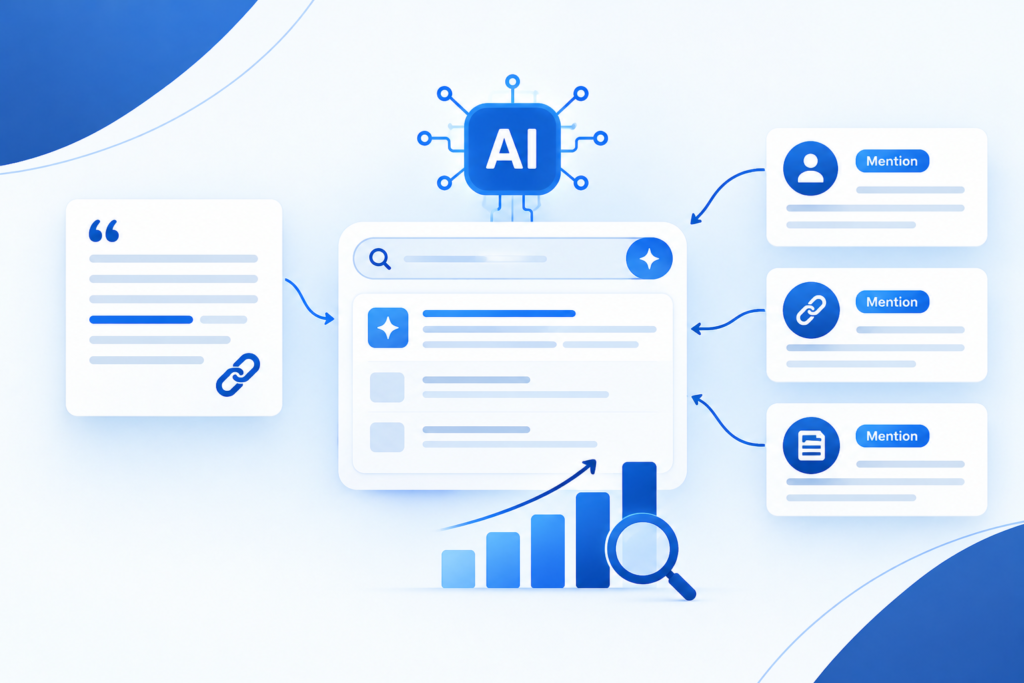
Citations and brand mentions influence AI search visibility by helping search systems identify entities, evaluate source relevance, and corroborate information across the web. When authoritative publications reference a brand alongside specific expertise, products, or services, they provide contextual signals that can strengthen the brand’s credibility. Unlinked mentions may also help establish entity associations when brand names appear consistently across relevant, trustworthy sources.
However, citations and mentions do not guarantee inclusion in AI-generated answers. Google’s AI search features rely on established SEO fundamentals, including crawlability, indexability, and helpful, reliable content. Businesses should therefore earn relevant third-party references, maintain consistent entity information, and publish evidence-backed content that answers specific user questions.
Summary of Citations and Mentions in AI SearchCitations and brand mentions can strengthen AI search visibility by establishing topical relevance, supporting claim attribution, and reinforcing consistent brand identity. Businesses can improve citation opportunities by earning credible third-party references, publishing evidence-backed technical resources, maintaining accurate brand and author profiles, and ensuring important pages are crawlable and indexable. Monitoring cited URLs and grounding queries helps identify content gaps, evaluate performance, and refine strategies without assuming guaranteed AI-generated answer inclusion. |
What Are Citations and Mentions in AI Search?
Citations and mentions in AI search are references that help establish connections between a brand, its expertise, and relevant information across the web. Citations occur when an AI-generated response attributes information to a specific source, typically through a linked webpage or referenced publication.
Mentions occur when a brand, organization, or expert is named in online content, whether or not the reference includes a hyperlink. Technically, these signals serve different purposes: citations identify sources supporting specific claims, while mentions can strengthen entity associations and provide contextual evidence of a brand’s relevance.
Their value depends on source credibility, topical alignment, factual consistency, and context. Neither guarantees AI visibility; inclusion also depends on retrieval, source selection, and the relevance of available content to the user’s query.
How Citations and Mentions Influence AI Search Visibility
Strengthen Topical Associations Through Relevant Brand Mentions
Mentions embedded in subject-specific discussions can help search systems associate a brand with particular topics and use cases. For example, a software company referenced in independent articles about API security may develop stronger contextual associations with that subject than through unrelated brand mentions. The key is semantic relevance: the surrounding text should accurately describe the company’s expertise rather than simply repeat its name.
Support AI Source Selection With Contextual Citations
AI search systems may retrieve webpages that provide relevant evidence for a user’s query. To make your content useful as a potential source, publish original research, detailed technical documentation, and case studies that directly address specific questions. Organize information clearly, explain how findings were obtained, and make supporting evidence accessible. These practices improve content usefulness and discoverability, although citation selection varies by platform and does not guarantee inclusion in AI-generated answers. Google’s guidance on AI features in Search confirms that foundational SEO practices and helpful, reliable content remain important for eligibility in AI search experiences.
Reinforce Brand Relevance Through Consistent Third-Party References
Inconsistent descriptions across external publications can create ambiguity about a brand’s services, specialization, or identity. Maintain accurate organization names, official website references, product terminology, and descriptions across relevant industry profiles and editorial coverage. This consistency helps search systems interpret references to the same entity more reliably. Prioritize independent sources with genuine editorial relevance instead of pursuing large volumes of repetitive directory listings or low-quality mentions.
Improve Claim Attribution Through Source-Specific Citations
Connect important factual and technical claims to the authoritative sources that support them. For example, an article explaining encryption standards should cite the relevant official specification rather than a general industry webpage. Accurate, claim-level references help readers verify statements and distinguish documented facts from interpretation. When other publishers reference your original research, clear sourcing also makes your evidence easier to assess and attribute. However, adding outbound citations alone does not guarantee that AI systems will cite your content. Google’s link best practices explain how descriptive anchor text gives readers and search engines useful context about linked pages.
Build Query-Level Relevance Through Topically Aligned Mentions
A brand mention becomes more contextually useful when the surrounding discussion matches the questions prospective users ask. If a company specializes in enterprise data migration, relevant references should explain migration challenges, integration requirements, or data integrity—not merely identify the company. Map external coverage to specific query themes, then assess whether the cited pages appear for those themes in AI search reports. Bing Webmaster Tools’ AI Performance report provides grounding-query and page-level citation data for this analysis.
| Give your next digital campaign a sharper direction with tailored strategies that connect your business goals to meaningful opportunities for growth! |
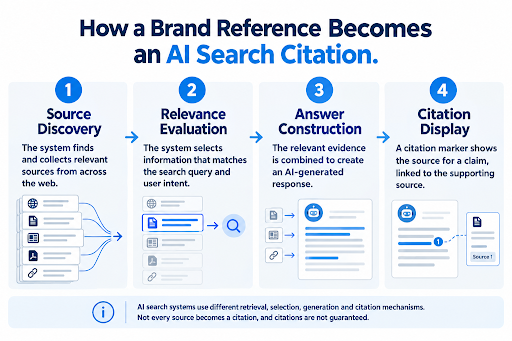
How a Brand Reference Becomes an AI Search Citation
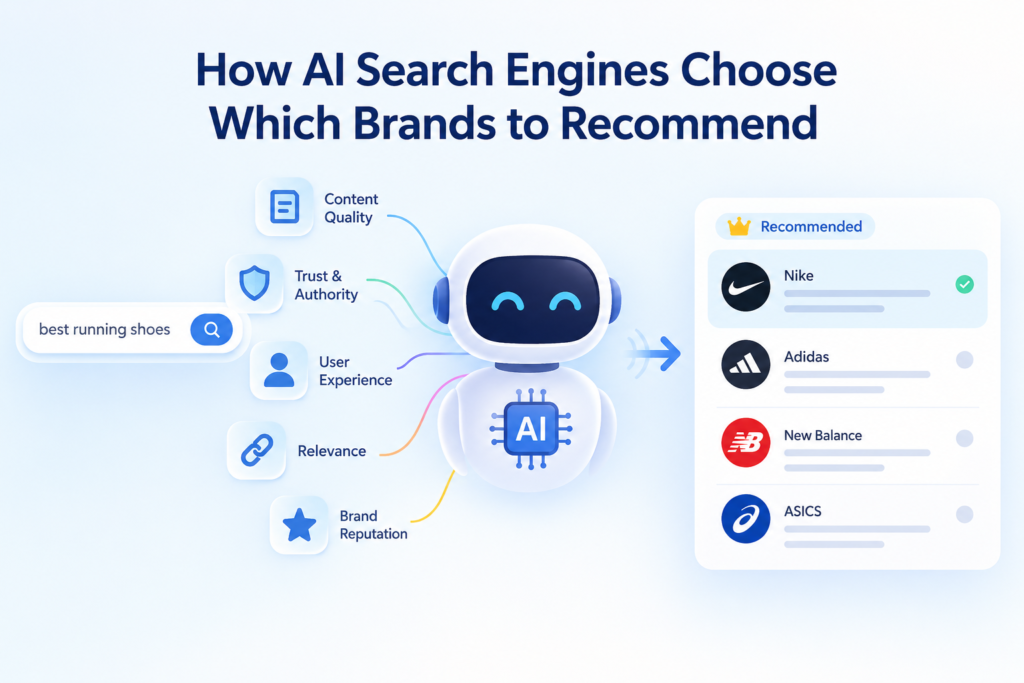
AI search systems may discover accessible webpages, assess their relevance to a query, and use selected information when generating an answer. Depending on the platform, a supporting source may then appear as a citation alongside a claim. This simplified model illustrates how a webpage can become a cited source, but retrieval and citation processes differ across AI systems. A brand mention alone does not guarantee that a webpage will be selected or cited.
How to Build Citations and Mentions for Greater AI Search Visibility
Identify Citation Gaps Across Competing Sources
Analyze which third-party sources appear in AI-generated answers for your target queries. Compare their referenced evidence with your own resources to identify missing research, data, or technical explanations. Prioritize gaps where your expertise can provide verifiable information that existing sources do not adequately cover.
Establish Verifiable Brand and Author Credibility
Maintain accurate brand descriptions, author biographies, professional credentials, and links to published work across relevant platforms. These details help readers and publishers verify expertise, assess credibility, and identify reliable sources. Consistent information supports brand recognition but does not guarantee AI-generated citations. Google’s guidance on creating helpful, reliable, people-first content explains the importance of originality, clear authorship, and demonstrable expertise.
Make Important Resources Easy for Search Systems to Discover
Ensure research pages return successful HTTP responses, permit crawling, and have appropriate indexing permissions. Maintain consistent canonical URLs, XML sitemaps, and relevant internal links. Follow Google’s crawling and indexing documentation to understand how search engines discover and process website content. These technical measures help search engines discover eligible resources, although crawlability and indexability alone cannot guarantee AI citations.
Turn Expert Knowledge Into Citable Technical Assets
Publish original datasets, methodology documents, implementation guides, and detailed comparisons. Include measurement conditions, publication dates, version details, and limitations where relevant. Link technical claims to supporting evidence so publishers can verify findings and reference your resources accurately in relevant discussions.
Monitor Citation Performance and Refine Your Outreach
Use AI visibility reporting to identify cited URLs and associated query themes. Bing Webmaster Tools’ AI Performance report provides citation and grounding-query insights for supported experiences. Analyze trends over consistent reporting periods to identify content gaps, but avoid attributing citation changes to individual campaigns without supporting evidence.
Conclusion
Building meaningful citations and brand mentions can strengthen your digital presence as AI-driven search continues to evolve. Think Shaw helps businesses develop strategic SEO campaigns that support online visibility, brand credibility, and sustainable growth. By combining technical expertise with data-driven marketing strategies, Think Shaw can help your business strengthen its search presence and compete more effectively in an increasingly competitive digital landscape.
| Make your brand more discoverable across AI search experiences with smarter citation strategies and expert guidance from Think Shaw! |
FAQ’s About Citations and Mentions in AI Search Visibility
Do unlinked brand mentions help with AI search visibility?
Unlinked mentions can provide contextual information about a brand, but their independent impact on AI visibility is not established. Their usefulness depends on the surrounding content, source quality, and how accurately the reference identifies the brand.
Which types of websites should businesses prioritize for AI search citations?
Prioritize relevant industry publications, professional associations, research organizations, and specialist websites with editorial standards. Choose sources that address your expertise and audience rather than evaluating opportunities solely by domain authority or backlink metrics.
How can businesses identify missing brand citations in AI answers?
Create a fixed set of relevant queries and test them across supported AI search platforms. Record whether your brand appears, which sources are cited, and which competing resources receive attribution. Repeat tests periodically to identify patterns.
Can structured data help AI systems connect citations to a brand?
Structured data can clarify relationships among an organization, its website, authors, and published content. Use appropriate Schema.org properties, such as Organization, Person, and sameAs, where accurate. Structured data does not guarantee AI citations or improved visibility.
How can businesses distinguish valuable AI citations from vanity metrics?
Evaluate citation relevance, the specific page cited, associated query intent, and referral traffic where measurable. A citation supporting a high-intent query may be more commercially useful than numerous references unrelated to your services. Track outcomes alongside citation frequency rather than treating counts as proof of performance.