Healthcare decisions increasingly begin online. Before scheduling appointments or visiting a facility, many patients research symptoms, compare providers, read reviews, and explore treatment options through search engines. This shift has made SEO an essential growth channel for healthcare organizations seeking stronger visibility and consistent patient acquisition. However, a healthcare SEO guide requires more than ranking for broad medical keywords. It involves understanding patient behavior, strengthening local visibility, improving the quality of medical content, and creating seamless digital experiences. A structured SEO for clinics approach helps healthcare providers improve discoverability while supporting trust, engagement, and appointment conversions.
Healthcare SEO Growth OverviewHealthcare SEO depends on aligning patient search behavior with strong local visibility, high-quality medical content, and a well-structured website experience. Success comes from optimizing Google Business Profiles, building trustworthy treatment pages, improving mobile performance, and ensuring that technical SEO, such as crawlability and schema markup, is properly implemented. Continuous monitoring of traffic, conversions, and underperforming pages helps maintain long-term growth. When combined, these strategies improve discoverability, strengthen patient trust, and increase appointment conversions across competitive healthcare search environments. |
Understanding How Patients Search for Healthcare Services Online
Patient search behavior shapes how healthcare organizations should structure their digital presence and content strategy.
Search Behavior Behind Symptoms, Treatments, and Specialist Queries
Most healthcare searches begin with concerns rather than provider names. Patients frequently search for symptoms, treatment possibilities, specialist recommendations, or nearby facilities depending on the urgency of care. Understanding these patterns helps healthcare websites align content with patient intent. The table below highlights how healthcare search intent typically shifts throughout the patient journey.
| Search Intent | Example Search | Content Type That Supports Visibility |
| Symptom Research | “persistent shoulder pain causes.” | Educational symptom page |
| Treatment Discovery | “physical therapy for shoulder pain” | Service or treatment page |
| Specialist Search | “orthopedic doctor near me” | Specialty page |
| Appointment Intent | “book orthopedic consultation” | Appointment-focused page |
The Growing Impact of Local and Mobile Healthcare Searches
Healthcare searches are strongly influenced by proximity because patients often prefer nearby facilities for convenience, accessibility, and emergency needs. This has significantly increased the importance of local SEO for doctors. Healthcare websites should prioritize mobile usability because patient expectations for accessibility are high. A slow-loading or poorly structured mobile experience may cause users to leave before taking action.
Key local search behaviors often include:
- Searching providers based on location convenience
- Reviewing ratings and patient feedback
- Comparing treatment availability nearby
- Looking for immediate contact or appointment access
Local visibility depends heavily on how effectively healthcare organizations align digital information with patient location-based expectations.
Factors That Influence Online Healthcare Decision-Making
Healthcare decisions involve a higher level of trust than in many other industries because users associate provider quality with personal well-being. Patients typically evaluate credibility signals before deciding whether to contact a healthcare provider. Several factors influence this process, including provider expertise, service transparency, online reviews, educational resources, and website professionalism. Patients often compare multiple providers before making a final decision.
A website that clearly explains specialties, treatment approaches, physicians’ credentials, and patient expectations tends to build greater confidence. On the other hand, incomplete information, outdated designs, or unclear navigation can reduce trust. A professional presentation also contributes to authority. Medical websites that appear organized, reliable, and informative generally drive higher engagement and stronger conversion rates.
Building a Strong Local Search Presence for Better Patient Reach
A strong local search presence improves discoverability when patients actively search for nearby healthcare services.
Optimizing Google Business Profiles for Medical Visibility
A Google Business Profile often serves as the first interaction between healthcare providers and potential patients. Searchers frequently view location details, contact information, reviews, and operating hours before visiting a website.
Important profile optimization areas include:
- Accurate business name, address, and contact information
- Updated operating hours and emergency availability
- Healthcare-specific categories and specialties
- Appointment booking links where applicable
- Updated facility photographs and service descriptions
Healthcare providers with multiple locations should maintain separate profiles for each facility to improve local relevance and visibility.
Structuring Location and Service Pages for Higher Relevance
Healthcare websites often miss ranking opportunities because treatment information is grouped on broad pages rather than in specialized content sections. Dedicated service pages help search engines understand specific offerings more accurately.
Effective service pages typically include:
- Treatment overviews and patient expectations
- Conditions commonly treated
- Available procedures or consultations
- Provider expertise information
- Clear appointment pathways
Well-structured service architecture improves both patient navigation and search visibility.
Strengthening Online Reputation Through Patient Feedback
Patient feedback strongly influences both local visibility and appointment decisions. Before selecting providers, many individuals review patient experiences to understand service quality, communication standards, and reliability.
Healthcare organizations can strengthen credibility by:
- Encouraging post-visit patient feedback
- Responding professionally to reviews
- Monitoring common concerns for service improvement
- Maintaining transparency across digital platforms
Online reputation functions as both a trust-building factor and a visibility signal, particularly for local healthcare searches.
Creating High-Quality Medical Content That Supports Visibility and Trust
Strong medical content improves discoverability while helping patients make informed healthcare decisions.
Developing Treatment and Service Pages Around Patient Concerns
Healthcare content should prioritize patient concerns rather than relying exclusively on institutional messaging. Patients usually seek practical answers before scheduling consultations, including symptoms, procedures, treatment expectations, and recovery considerations. Treatment pages become more valuable when they answer common patient questions clearly and professionally. Instead of generalized descriptions, content should explain how services address real healthcare concerns.
Effective treatment pages often include information regarding:
- Symptoms or conditions treated
- Treatment process and consultation expectations
- Preparation requirements, if applicable
- Recovery or follow-up considerations
- Frequently asked patient concerns
Content clarity helps reduce uncertainty while improving engagement among users researching treatment options.
Aligning Content With Medical Accuracy and Search Quality Standards
Healthcare websites are held to higher standards of content quality because medical information directly influences personal decisions. Search engines prioritize trustworthy healthcare resources that demonstrate expertise and factual accuracy. Medical content should remain clinically accurate, professionally reviewed, and regularly updated to maintain credibility. Healthcare organizations benefit from demonstrating clear expertise throughout service pages and educational resources.
Authority signals often include:
- Physician or specialist involvement in content review
- Transparent provider credentials
- Accurate treatment descriptions
- Clear explanations supported by medical expertise
Trustworthy medical content strengthens patient confidence while improving long-term visibility potential.
Using Educational Content to Improve Engagement
Educational content supports healthcare SEO by helping providers appear during the early stages of patient research. Many individuals spend time researching symptoms, treatment options, preventive care, or post-treatment expectations before scheduling appointments. Rather than focusing entirely on promotional messaging, educational resources help position healthcare organizations as trusted information sources.
Common educational content opportunities include:
- Preventive care guidance
- Chronic condition management tips
- Recovery recommendations after procedures
- Seasonal healthcare awareness topics
- Symptom-based educational resources
Publishing meaningful educational material improves engagement without overwhelming users with excessive medical complexity.
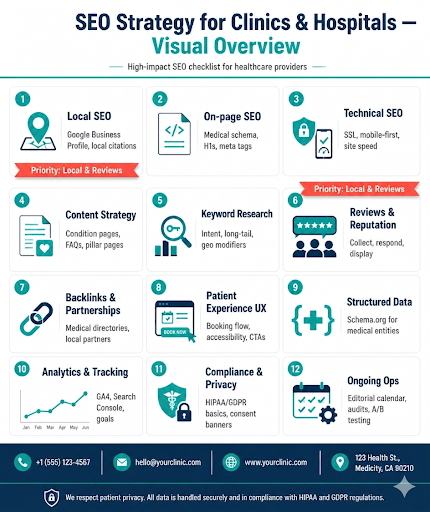
SEO Strategy for Clinics and Hospitals: Visual Overview
Improving Website Experience to Support Search Rankings and Appointments
Website usability directly affects both patient engagement and search performance.
Enhancing Website Speed and Mobile Accessibility
Healthcare users expect immediate access to information, particularly during urgent situations. A slow website may increase abandonment rates before patients explore services or contact providers. Website performance improvements contribute to stronger user experiences and higher engagement levels. Mobile responsiveness is especially important because healthcare searches often occur on smartphones.
Performance optimization often includes:
- Faster page loading speeds
- Mobile-friendly navigation systems
- Reduced technical barriers during browsing
- Optimized images and backend performance
A fast, accessible website creates smoother experiences for patients seeking healthcare information quickly.
Simplifying Navigation and Appointment Booking Paths
Patients should reach important information without unnecessary complexity. Complicated navigation structures can discourage action, especially when users struggle to locate treatments, departments, or appointment details. Healthcare websites benefit from intuitive menu organization and simplified user journeys. Appointment scheduling options should remain easy to identify across important service pages.
Strong appointment pathways generally include:
- Clearly visible scheduling buttons
- Simplified contact forms
- Direct phone accessibility
- Organized service navigation
- Accessible provider information
Reducing friction between research and action improves appointment conversion rates.
Strengthening Technical Website Elements for Search Visibility
Technical SEO helps search engines interpret healthcare websites more effectively while improving visibility. Several backend elements contribute to stronger performance, including metadata optimization, structured website architecture, internal linking, and crawlability improvements.
Healthcare websites should prioritize:
- Clear title tags and meta descriptions
- Organized heading structures
- Internal linking between services and resources
- Structured healthcare-related data markup
- Routine technical audits
Strong technical foundations support long-term search visibility while improving usability across healthcare websites.
Strengthening Technical SEO for Healthcare Website Performance
Technical SEO ensures that healthcare websites are properly crawled, indexed, and understood by search engines, so that important service pages can appear in relevant search results.
Improving website crawlability and indexing
Crawlability and indexing determine whether search engines can access and store your website pages in their database. If the structure is unclear or important pages are blocked, they may not appear in search results even if the content is high quality. A clean site structure with logical URLs, proper internal paths, and updated indexing signals ensures that all treatment and service pages remain discoverable.
Using schema markup to improve healthcare search visibility
Schema markup is a structured data format that helps search engines better understand healthcare content, such as services offered, clinic locations, doctors, and specialties. When implemented correctly, it enhances search listings with additional details, making results more informative and increasing the likelihood of clicks from potential patients.
Strengthening internal linking and metadata structure
Internal linking connects related pages within the website, helping both users and search engines navigate content more efficiently. It distributes authority across important pages and strengthens overall site relevance. Alongside this, well-optimized metadata such as titles and descriptions improves how pages are interpreted in search results and increases visibility for targeted healthcare queries.
Measuring SEO Performance and Optimizing for Continuous Growth
SEO requires continuous tracking and refinement to ensure long-term visibility and consistent patient acquisition.
Tracking organic traffic and patient conversion trends
Monitoring organic traffic helps identify which pages attract users from search engines and which topics perform well. However, traffic alone is not enough. Conversion tracking shows how many visitors actually take meaningful actions, such as booking appointments or filling out contact forms. When both metrics are analyzed together, healthcare providers can clearly understand which pages contribute to real patient growth and which need optimization.
Identifying underperforming healthcare pages
Not all pages perform equally, and some may receive low traffic or poor engagement despite being important. These pages often indicate issues such as weak content depth, unclear structure, or low search relevance. Instead of leaving them unchanged, they should be updated with more accurate information, improved structure, and stronger keyword alignment to restore visibility and performance.
Maintaining SEO through updates and audits
SEO performance depends heavily on consistency. Regular content updates ensure that medical information remains accurate and aligned with current search behavior. Technical and content audits help detect broken links, indexing issues, or outdated pages before they affect rankings. This ongoing maintenance keeps the website optimized and ensures steady long-term growth.
Conclusion
A strong SEO strategy can transform how healthcare providers attract and convert patients online by improving visibility, trust, and appointment flow. From local optimization to high-quality medical content and technical performance, every element contributes to long-term digital growth. Think Shaw helps healthcare organizations build structured SEO systems that improve rankings and patient engagement. With the right approach, SEO for clinics and hospitals can consistently reach the right audience, increase appointments, and maintain a strong online presence in an increasingly competitive healthcare space.
FAQs
Why is SEO important for healthcare providers?
SEO improves online visibility, helping patients discover healthcare services, treatment information, and nearby providers more efficiently.
How long does healthcare SEO take to show results?
Healthcare SEO improvements generally take several months, depending on competition, website quality, and the consistency of optimization efforts.
What type of healthcare content performs best online?
Treatment pages, educational resources, preventive care topics, and symptom-related content often generate stronger engagement.
Why are patient reviews important for local visibility?
Patient reviews improve trust, strengthen credibility, and influence local healthcare search rankings and appointment decisions.
Does website speed affect appointment conversions?
Fast websites improve accessibility, reduce abandonment rates, and enable smoother appointment scheduling for healthcare users.