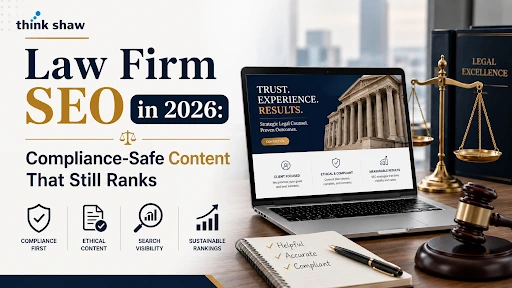
Law Firm SEO operates under constraints no other industry faces: every claim, testimonial, and comparison on a legal website is also a regulated communication under state bar advertising rules. SEO for Lawyers succeeds when it builds genuine authority and search visibility without triggering Rule 7.1 violations for misleading claims or Rule 7.2 issues around endorsements. Attorney SEO in 2026 leans heavily on Google’s EEAT and YMYL standards, since legal content directly affects a person’s finances, freedom, or safety. Legal SEO done correctly treats compliance not as a limitation on ranking potential, but as the foundation that makes a law firm’s content trustworthy enough to rank in the first place.
| Expert Overview of Law Firm SEO |
| Law Firm SEO operates under constraints no other industry faces: every claim, testimonial, and comparison on a legal website is also a regulated communication under state bar advertising rules. SEO for Lawyers succeeds when it builds genuine authority and search visibility without triggering Rule 7.1 violations for misleading claims or Rule 7.2 issues around endorsements. Attorney SEO in 2026 leans heavily on Google’s EEAT and YMYL standards, since legal content directly affects a person’s finances, freedom, or safety. Legal SEO done correctly treats compliance not as a limitation on ranking potential, but as the foundation that makes a law firm’s content trustworthy enough to rank in the first place. |
Why Law Firm SEO Cannot Be Separated From Bar Compliance
Most industries treat SEO and legal review as separate processes, but for a law firm, they are the same process. Every page a firm publishes is simultaneously a search asset and a regulated advertisement, subject to state bar Rules of Professional Conduct that govern truthfulness, testimonials, and solicitation. A firm that optimizes aggressively without legal oversight risks not just a Google penalty, but a bar complaint, which makes SEO for Law Firms fundamentally a collaboration between marketing and compliance rather than a marketing task alone.
- Rule 7.1 prohibits false or misleading communications about a lawyer’s services, which directly limits how results, outcomes, and comparisons can be phrased on site
- Rule 7.2 governs how testimonials and endorsements can be used, which affects how client reviews and case results are displayed
- Rule 7.3 restricts direct solicitation, which shapes how remarketing, chat widgets, and lead capture language must be written
- Most states require attorney name and contact information to appear on any page functioning as an advertisement, including blog content and landing pages
Google Treats Legal Content as YMYL, and That Changes Everything
Legal topics fall squarely into Google’s Your Money or Your Life category because they can materially affect a person’s finances, safety, or freedom. This means Attorney SEO is held to a stricter quality bar than most other industries, and thin, generic, or unverifiable content simply will not compete, regardless of how well it targets keywords.
- Pages need clear demonstration of who wrote them and what qualifies that person to speak on the topic
- Generic AI-generated legal explainers without attorney review tend to underperform, since accuracy and specificity carry more weight in YMYL evaluation
- Outdated legal information (old statutes, expired deadlines, superseded case law) actively damages trust signals and should be audited on a regular schedule
- Sites lacking clear firm information, bar admissions, and contact transparency struggle to rank regardless of content quality
Building EEAT Without Overstating Credentials
Expertise, Experience, Authoritativeness, and Trustworthiness form the backbone of Legal SEO, but building these signals has to stay inside advertising rules that restrict terms like specialist or expert unless a state-recognized certification actually supports the claim.
| EEAT Signal | Compliance-Safe Way to Build It |
| Expertise | List verifiable bar admissions, law school, and years in practice rather than unverifiable superlative claims |
| Experience | Reference general practice history and case types handled, avoiding specific outcome guarantees or implied results |
| Authoritativeness | Publish attorney-authored content, speaking engagements, and published articles rather than relying on self-declared authority |
| Trustworthiness | Maintain accurate contact information, clear disclaimers, and transparent firm details on every page |
Attorney Bio Pages Are Doing More SEO Work Than You Think
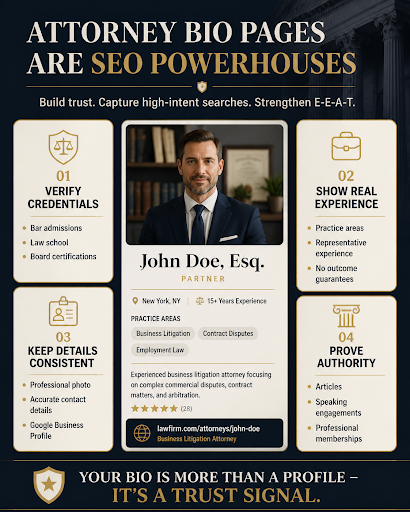
For most law firms, individual attorney bio pages carry disproportionate SEO weight, since they combine E-E-A-T signals with high-intent searches like a person looking for a specific type of lawyer by name or specialty area.
- Include verifiable bar admissions, law school, and any board certifications exactly as officially recognized, without embellishment
- List actual practice areas and representative experience without implying guaranteed outcomes for prospective clients
- Add a professional photo and consistent contact details matching the firm’s Google Business Profile and other directories
- Link to published articles, speaking engagements, or professional association memberships that support authority without overstating it
Content Strategy That Ranks Without Risking a Bar Complaint
Content for law firms has to answer real legal questions clearly enough to build authority, while staying far away from anything that could read as legal advice tailored to an individual’s specific situation, or a guarantee of outcome.
- Write educational content explaining general legal concepts and processes rather than case-specific advice or predicted outcomes
- Include clear disclaimers stating that content is for general informational purposes and does not constitute legal advice
- Avoid absolute language such as we always win or guaranteed results, which most jurisdictions explicitly prohibit as misleading
- Use client results and case studies only where permitted, and only with proper disclaimers noting that past results do not guarantee future outcomes
- Keep legal content current, since laws, deadlines, and procedures change, and outdated advice creates both an SEO liability and a professional one
Local SEO for Law Firms: Winning Location-Based Searches
Most legal searches carry strong local intent, whether someone is searching for a personal injury attorney in a specific city or a family law firm near their home, which makes local optimization central to any Law Firm Search Engine Optimization strategy.
- Keep name, address, and phone number identical across the website, Google Business Profile, and legal directories such as Avvo or Justia
- Maintain accurate practice area categories on the Google Business Profile so the firm surfaces for the right type of legal search
- Build separate location pages for firms operating across multiple offices, rather than one generic contact page covering every location
- Encourage client reviews where bar rules permit solicited feedback, and respond professionally to all reviews, positive or negative
Reviews and Testimonials: Where Compliance Meets Conversion
Client reviews influence both search rankings and a prospective client’s decision to call, but the legal industry has stricter rules around testimonials than almost any other sector, making this an area where marketing and compliance teams need to align before publishing anything.
- Confirm with firm counsel which forms of testimonials or endorsements are permitted under the specific state’s advertising rules before featuring them prominently
- Avoid selectively curating only outcome-based praise that could be read as an implied guarantee of results
- Where permitted, feature reviews that speak to communication, professionalism, and client experience rather than case outcomes specifically
- Include any state-required disclaimers alongside testimonials, such as language clarifying that results vary by case
AEO Readiness for Legal Searches
As more people ask AI assistants direct legal questions such as do I need a lawyer for a small claims case, Legal SEO increasingly depends on whether a firm’s content is structured clearly enough for these tools to extract and cite accurately.
- Structure FAQ content with clear, direct answers to common legal questions, followed by appropriate disclaimers about seeking individualized advice
- Use accurate schema markup for attorney profiles, practice areas, and business information so answer engines surface correct, verifiable details
- Avoid ambiguous phrasing that could be misinterpreted by an AI tool as specific legal advice rather than general information
- Periodically check how AI assistants describe the firm and its practice areas, correcting any inaccurate or outdated information promptly
Common Compliance Mistakes That Undermine Both SEO and Ethics
- Using unverified superlative claims such as best or top rated without a legitimate, disclosed basis for the statement
- Publishing case results or testimonials without required disclaimers about outcomes varying by case
- Allowing outdated legal content (old deadlines, repealed statutes) to remain live and unreviewed for years
- Treating attorney bio pages as an afterthought rather than a primary SEO and trust-building asset
- Launching content or marketing campaigns without any review from firm counsel familiar with the applicable bar rules
Conclusion
Compliance-safe SEO is not slower SEO; it is the strategy that builds durable visibility, client trust, and long-term authority. By pairing accurate, attorney-reviewed content with strong E-E-A-T signals, local optimization, and clear AEO structure, your firm can compete confidently without crossing ethical lines. Think Shaw helps law firms create search strategies that respect bar rules while targeting the queries that matter most. Ready to make your legal marketing legally legit and algorithm-proof? Let us cook up a compliance-first SEO plan that gets your firm seen, trusted, and shortlisted.
Frequently Asked Questions About Law Firm SEO and Compliance
Can a law firm use client testimonials on its website?
Most states permit testimonials under certain conditions, typically requiring disclaimers that outcomes vary by case and prohibiting testimonials that create unjustified expectations about results. Firms should confirm the specific requirements of their state bar before publishing any client testimonial prominently.
Does calling a lawyer a specialist violate advertising rules?
In most jurisdictions, the term specialist can only be used if the attorney holds an actual certification from an accredited specialty organization recognized by the state bar. Using it without that credential is one of the more common compliance mistakes in legal marketing.
How does Google’s YMYL classification specifically affect law firm rankings?
YMYL content faces stricter quality evaluation, meaning thin or generic legal content tends to underperform compared to well-sourced, attorney-reviewed material with clear authorship and current information. Firms that treat content accuracy and attribution seriously tend to see stronger, more stable rankings over time.
Is it safe to publish blog content about specific case outcomes?
Generally, case results can be discussed only with appropriate disclaimers clarifying that past results do not guarantee future outcomes, and language should avoid implying a guarantee for prospective clients. Firm counsel should review any case result content before publication to confirm compliance with jurisdiction-specific rules.
Do all law firm pages need attorney contact information, even blog posts?
Most states require that any communication considered attorney advertising, which can include blog content and landing pages, list the name and office address of at least one attorney responsible for the content. This requirement is often overlooked on blog posts specifically, creating unnecessary compliance risk.
How often should legal content be reviewed for accuracy?
Legal content should be reviewed at minimum annually, or immediately after any relevant statutory or procedural change, since outdated information both damages search trust signals and creates professional liability concerns. Firms with high content volume often benefit from a rolling review schedule rather than a single annual pass.