Search is changing as AI becomes part of how people discover information online. In 2026, Google reported that AI Overviews reach more than 2.5 billion monthly active users, while AI Mode has surpassed 1 billion monthly active users. This shift makes it increasingly important for websites to communicate information in formats that search systems can process. Structured data for AI uses standardized properties to describe page content, identify entities, and specify relationships between them.
This blog explains how structured data works, which schema types suit different webpages, and how to implement and validate markup correctly.
Structured Data for AI Search: Overview and EssentialsStructured data helps search engines interpret website content through standardized types, properties, and entity relationships. Formats such as JSON-LD, Microdata, and RDFa enable websites to describe organizations, products, services, articles, and other content. Appropriate schema selection supports clearer information interpretation and potential search enhancements. Accurate implementation, consistent data, and validation through Google’s Rich Results Test, Schema Markup Validator, and Search Console help maintain technical SEO quality and search eligibility. |
What Is Structured Data, and How Does It Help Search Engines Understand Website Content?
Why Is Structured Data Important in Modern Search?
Structured data can make eligible pages easier for search engines to interpret and may enable supported search enhancements, such as rich results. However, adding markup does not guarantee better rankings, inclusion in AI-generated answers, or increased traffic. Search engines determine eligibility according to their own systems and requirements. Markup should therefore complement useful page content and sound technical SEO rather than serve as a standalone visibility strategy.
What Are the Main Formats Used to Add Structured Data?
Website owners can add structured data using JSON-LD, Microdata, or RDFa. JSON-LD stores the markup in a script block, separate from the visible HTML elements, while Microdata and RDFa attach descriptive attributes to existing HTML. Google recommends JSON-LD when practical because it is generally easier to implement and maintain. The choice of format depends on the website’s architecture, content management system, and development workflow.
How Does Structured Data Give Meaning to Website Content?
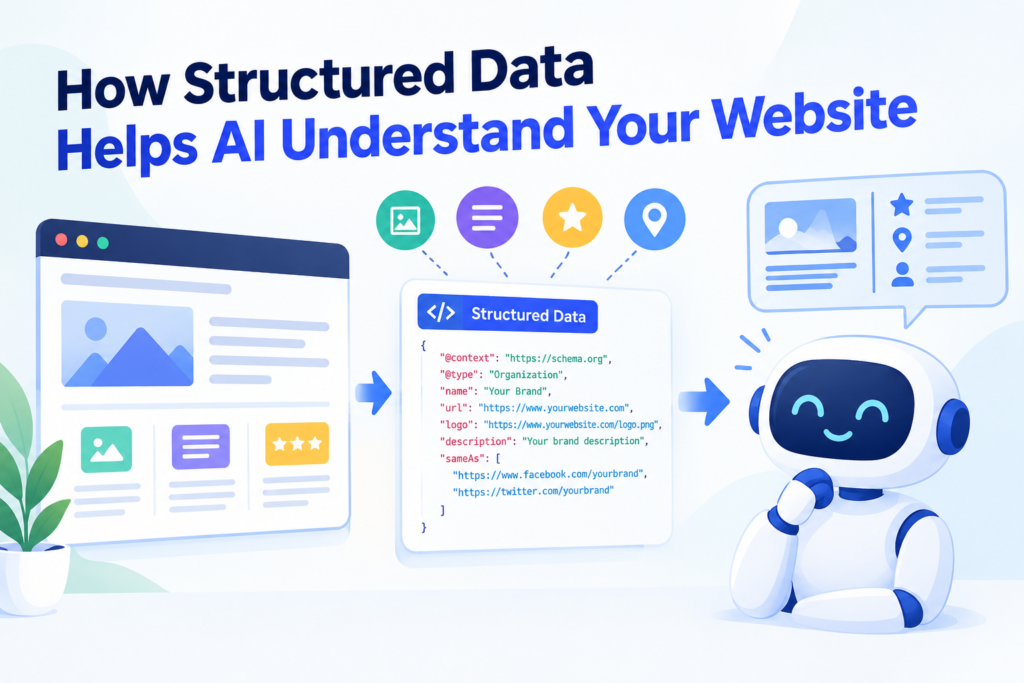
Webpages often present information in formats designed for human readers, leaving some details implicit. Structured data expresses those details through predefined types and properties. For example, a Product object can contain a name, a brand, and an offers property describing its availability and price. Each property has a defined meaning, allowing compatible systems to interpret these details according to a consistent vocabulary.
| Structured data works best when it supports a technically sound SEO strategy. Think Shaw combines SEO expertise with data-driven optimization to build a stronger foundation for organic search visibility. |
How Does Structured Data Help AI Search Engines Interpret and Connect Information?
Structured data gives search systems explicit details about website entities and their relationships, supporting a stronger technical SEO strategy.
- Entity identification: A schema type defines the kind of entity being described. For example, Organization identifies a business entity, while Service describes a specific service offering.
- Relationship mapping: Properties such as author, publisher, and provider specify how entities relate to a piece of content or a service. A business can be identified as the provider of a particular service without treating the two as the same entity.
- Entity disambiguation: The url property identifies a relevant webpage, while sameAs can reference an external page that clearly represents the same entity. These properties can help distinguish a business from other organizations with similar names when the references are accurate.
- Cross-page entity references: A stable @id can identify the same organization across multiple schema objects. This allows related pages to reference one business entity instead of creating disconnected descriptions of it.
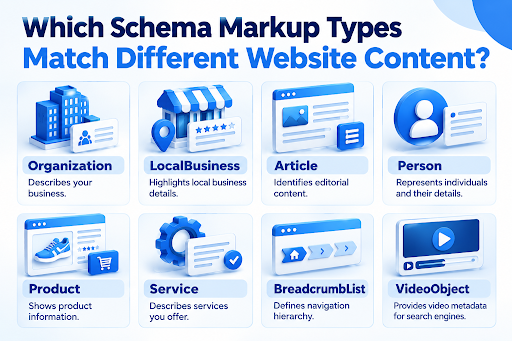
Which Schema Markup Types Match Different Website Content?
Schema markup types serve different content needs. Organization and Local Business describe businesses, while Article and Person identify editorial content and individuals. Product and Service represent offerings, BreadcrumbList defines navigation hierarchy, and VideoObject provides video metadata for search engines.
How Can You Implement and Validate Structured Data for AI Search Optimization?
Select Schema Types That Match Each Page’s Purpose
Before adding markup, identify the page’s primary purpose and the search feature it may qualify for. Review Google’s documentation to understand eligibility requirements and required properties. Each schema type should reflect information genuinely available on the page. A well-planned technical SEO strategy can help establish the technical foundations needed to implement structured data appropriately.
Create Accurate Markup and Connect Related Entities
Generate JSON-LD that follows the selected type’s property definitions and Google’s applicable guidelines. Add the markup through your CMS, page template, or development workflow, and confirm that it appears in the rendered page when required. Populate properties with verified values instead of placeholders, and ensure prices, dates, availability, and other changeable fields remain current. Avoid marking up hidden, misleading, or unsupported information.
Test Structured Data and Monitor Search Performance
Run eligible markup through Google’s Rich Results Test to check support for the intended rich result, and use the Schema Markup Validator to examine broader Schema.org syntax. Correct errors and investigate warnings that affect the intended implementation. After publishing, use Google Search Console’s URL Inspection tool to review indexing information and relevant enhancement reports to identify eligibility issues. Monitor impressions, clicks, and other available performance metrics over time. Retest the markup after significant template or content changes.
Conclusion
A well-structured website gives your SEO strategy a stronger technical foundation as search continues to evolve. At Think Shaw, we recognize the value of combining accurate structured data with a website strategy built around clarity, relevance, and long-term search performance. Thoughtful implementation helps create a more reliable digital presence while keeping your website aligned with changing search requirements. The real advantage lies in building a technically sound website that continues to serve your audience and supports sustainable organic growth.
| A search-ready website needs more than accurate markup. Think Shaw helps businesses strengthen their digital presence through strategic SEO to support sustainable organic growth. |
FAQs About Structured Data for AI Search
Does structured data help AI search engines cite your website?
Structured data may clarify entities and relationships, but AI citations depend on multiple factors, including content relevance, source selection, accessibility, and the search system’s retrieval methods.
Can structured data improve visibility in ChatGPT search results?
Structured data can provide contextual information, but visibility in ChatGPT search depends on factors such as crawlability, relevant content, source selection, and system-specific retrieval processes.
Does schema markup directly improve Google rankings?
Google does not guarantee ranking improvements from structured data. Eligible markup can enable supported search enhancements, but rankings depend on broader relevance and quality signals.
Can AI understand website content without structured data?
Yes. AI systems can interpret accessible webpage text and other content without schema markup. Structured data provides additional explicit context when supported and processed by those systems.
What is the difference between schema markup and structured data?
Structured data is information organized in a defined format, while schema markup uses a vocabulary such as Schema.org to describe entities and their attributes.