Modern content marketing is no longer driven by assumptions, intuition, or publishing frequency alone. With search ecosystems becoming increasingly AI-driven, bloggers must understand not only what users click, but also what they actually engage with after landing on a page. This is where GA4 content analysis has become one of the most valuable tools for publishers, marketers, and SEO professionals looking to scale content performance strategically.
In this guide, we understand how, unlike old analytic tools, Google Analytics 4 works to track user interactions more accurately across devices and sessions. Therefore, allowing bloggers to evaluate content quality through real engagement signals instead of vanity metrics such as raw pageviews alone.
Strategic GA4 Data-Driven Content InsightsModern blogging success depends on engagement quality, reader behavior, and strategic content optimization rather than traffic alone. Strong editorial decisions come from analyzing engagement rates, scroll depth, landing page performance, search intent alignment, and conversion patterns. Data-driven workflows help identify high-performing topics, improve weak content sections, refresh declining pages, and build stronger topical authority. Integrating behavioral insights with SEO strategy enables bloggers to create scalable, AI-ready content ecosystems focused on retention, visibility, and sustainable long-term growth. |
Why Content Planning Needs Analytics in 2026
The blogging landscape has changed dramatically over the last few years. AI-generated search summaries, zero-click searches, and personalized search experiences mean that ranking alone is no longer enough. Blogs that succeed today are those that maintain strong engagement signals after users arrive on the page.
Google’s modern ranking systems increasingly evaluate user satisfaction indicators such as engagement time, scrolling behavior, repeat visits, and conversion interactions. According to recent SEO performance research, engagement metrics now act as strong indicators of content relevance and intent alignment.
This makes analytics-driven publishing essential because it helps answer critical questions such as:
- Which blog topics hold user attention the longest?
- Which pages drive newsletter signups or conversions?
- What search intents are underperforming?
- Which traffic sources generate meaningful engagement?
- What content should be updated, expanded, merged, or removed?
Without these insights, bloggers risk publishing content that attracts traffic but fails to generate authority, trust, or business outcomes.
Understanding the GA4 Shift
GA4 introduced a fundamentally different way of measuring user behavior. Instead of relying heavily on sessions and pageviews, it tracks events and engaged interactions.
Some of the most important engagement-focused changes include:
- Engagement Rate replacing traditional bounce rate
- Active engagement time instead of passive session duration
- Event tracking for user interactions
- Cross-device user behavior analysis
- Funnel-based content journey tracking
- Predictive audience insights
These changes provide much deeper visibility into how readers interact with blog content.
For bloggers, this means content planning can now be based on measurable reader behavior rather than assumptions about what “should” work.
The Most Important GA4 Metrics for Bloggers
Using analytics effectively starts with understanding which metrics actually matter. Many bloggers still focus too heavily on traffic volume, even though engagement quality has become more important in modern SEO performance evaluation.
Engagement Rate
One of the most valuable metrics in GA4 is engagement rate. A session is considered engaged when users stay for more than 10 seconds, trigger a key event, or visit multiple pages.
For blogs, engagement rate reveals whether readers genuinely found the content useful.
Typical 2026 benchmarks include:
- 55–75% engagement rate for strong informational content
- Below 50% often signals poor intent alignment
- Higher engagement generally correlates with stronger SEO performance
Pages with low engagement often indicate:
- Weak introductions
- Poor keyword targeting
- Misaligned search intent
- Thin content
- Weak readability structure
This is one of the most actionable GA4 engagement metrics because it directly influences future topic selection.
Average Engagement Time
GA4 measures how long users actively interact with content rather than simply leaving a browser tab open.
Recent GA4 research suggests that:
- Long-form blogs should ideally maintain 2–4 minutes of engagement time
- Extremely short engagement periods often indicate dissatisfaction or content mismatch
If a 2,000-word article averages only 25 seconds of engagement, the topic or structure may need improvement.
Bloggers can use this metric to:
- Identify weak sections
- Improve readability
- Add visuals or examples
- Adjust content depth
- Optimize introductions
Scroll Depth
Scroll tracking has become increasingly important in 2026 because it helps identify how far readers move through an article before leaving.
GA4 automatically tracks deep scrolling behavior, while advanced tracking setups can measure multiple depth thresholds.
This insight helps bloggers discover:
- Which sections lose reader’s attention
- Whether introductions are too long
- Where readers abandon articles
- Which formats sustain attention best
Content with high scroll completion often performs better in search visibility and audience retention.
Landing Page Performance
Landing page reports remain one of the most important tools for content planning.
Strong landing page analysis helps bloggers identify:
- High-converting content themes
- Pages with strong organic engagement
- Underperforming SEO topics
- Content requiring refreshes
Modern GA4 content performance analysis focuses less on traffic volume alone and more on post-click quality indicators.
A page generating moderate traffic but exceptional engagement may deserve expansion into a broader content cluster.
How GA4 Helps Decide What to Blog About Next
The biggest advantage of analytics-driven blogging is predictive topic selection. Instead of guessing future content opportunities, bloggers can use behavioral patterns to identify proven audience interests.
Identify High-Engagement Topics
Start by sorting blog posts according to:
- Engagement rate
- Average engagement time
- Scroll completion
- Conversion events
- Returning user sessions
Patterns usually emerge quickly.
For example:
- Tutorials may outperform opinion articles
- Comparison posts may generate longer engagement
- Industry explainers may attract more returning visitors
These insights help shape future editorial calendars.
Analyze Search Intent Alignment
Low engagement often signals poor search intent matching.
For example:
- Users searching for “best CRM software” expect comparisons
- Users searching “how CRM works” expect educational content
When blogs fail to satisfy the expected intent, engagement metrics decline.
Modern GA4 SEO insights allow bloggers to compare:
- Organic traffic sources
- Landing page engagement
- Query-based performance
- Conversion behavior
This helps refine both content structure and topic targeting.
Use Content Decay Analysis
One of the most valuable 2026 strategies involves identifying content decay.
Some posts lose traffic because:
- Information becomes outdated
- Competitors publish stronger resources
- Search behavior changes
- AI summaries reduce clicks
GA4 helps detect declining:
- Engagement
- Organic entrances
- Conversion rates
- Returning visits
Instead of constantly publishing new articles, bloggers can prioritize:
- Updating high-potential older posts
- Expanding thin articles
- Consolidating overlapping content
- Improving outdated statistics
This often produces stronger SEO returns than creating entirely new content.
Building Better Content Clusters With GA4
Topical authority remains one of the strongest ranking factors in 2026. GA4 helps bloggers identify which topic clusters generate the strongest user journeys.
Using Explorations and funnel reports, bloggers can analyze:
- Which articles lead to additional pageviews
- Which topics generate conversions
- Which categories keep users engaged longer
Research on GA4 Explorations shows that advanced content journey analysis can uncover patterns hidden from standard reports.
For example:
- A beginner SEO guide may frequently lead users to technical SEO tutorials
- A fitness article may drive supplement-related searches
- A SaaS comparison post may lead to demo signups
These pathways help bloggers build stronger internal linking systems and more effective content hubs.
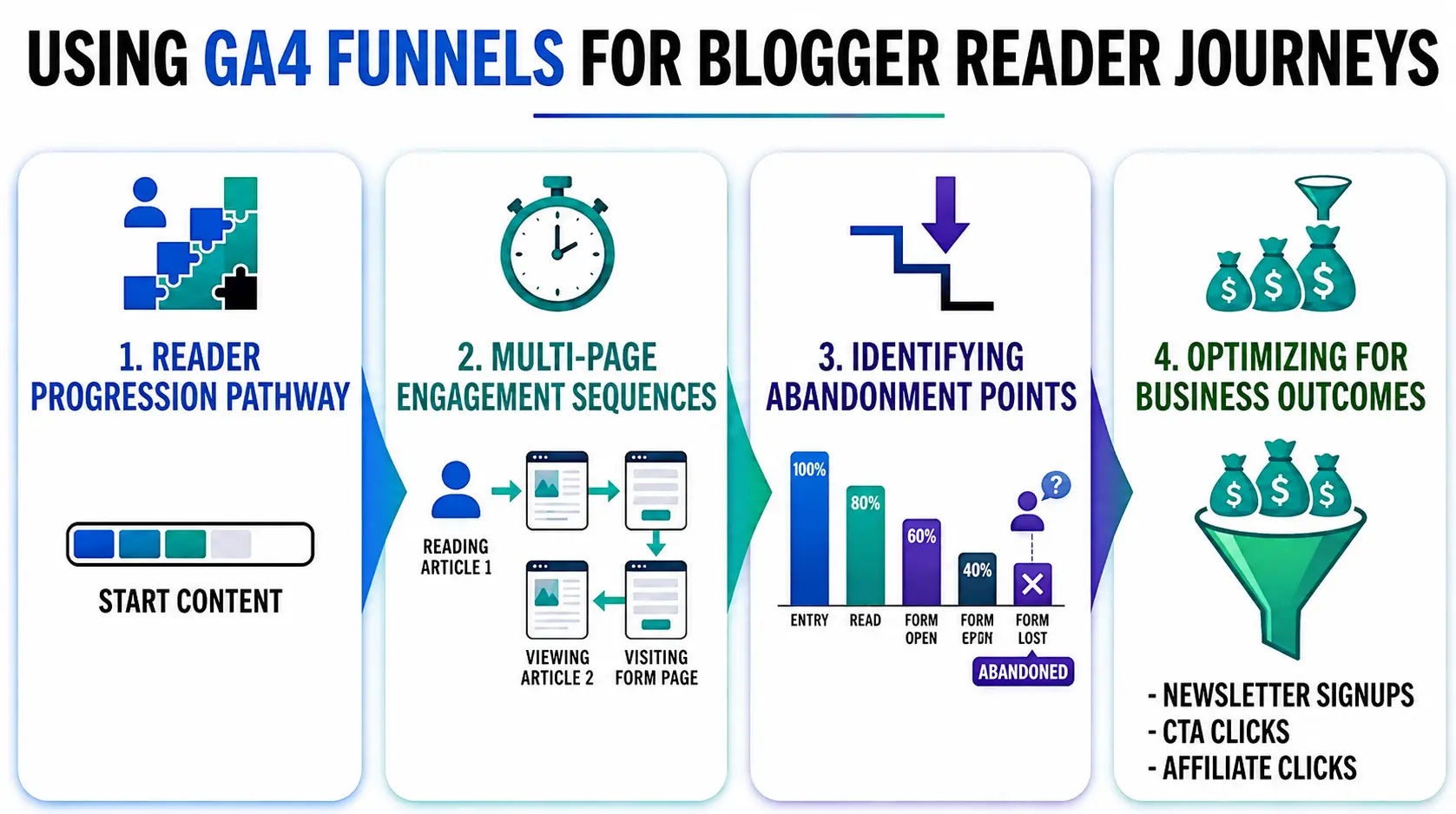
Using GA4 Funnels to Understand Reader Behavior
Funnels are no longer just for e-commerce sites.
In 2026, bloggers increasingly use funnel analysis to understand:
- Reader progression
- Conversion pathways
- Subscriber journeys
- Multi-page engagement sequences
GA4 funnels can reveal:
- Which articles generate newsletter signups
- Which CTAs convert best
- Where readers abandon journeys
- Which content paths generate affiliate clicks
This allows bloggers to prioritize content that contributes to measurable business outcomes rather than simply traffic.
Integrating Search Console With GA4
One of the most powerful combinations for bloggers is integrating Google Search Console with GA4.
This combination enables deeper visibility into:
- Search queries
- Landing page behavior
- Click-through rates
- Engagement after organic visits
This integration helps identify situations where:
- High-ranking pages have poor engagement
- Strong engagement pages need SEO improvements
- Certain keywords drive low-quality traffic
These combined insights are critical for strategic content planning in competitive niches.
The Growing Importance of Engagement Signals in AI Search
The rise of AI-powered search systems has changed content evaluation significantly.
Recent industry research suggests that pages with stronger engagement signals are more likely to appear in AI-generated search experiences and summaries.
This means bloggers must optimize for:
- Readability
- User satisfaction
- Information completeness
- Content structure
- Interaction depth
Pages that hold attention and encourage deeper exploration increasingly outperform pages optimized purely for keywords.
This is why GA4 for bloggers has become less about reporting and more about strategic publishing decisions.
Common Mistakes Bloggers Make With GA4
Despite GA4’s capabilities, many bloggers still misuse analytics data.
Focusing Only on Pageviews
Traffic alone does not indicate quality.
A page generating 50,000 visits with weak engagement may perform worse than a page generating 5,000 highly engaged visits.
Ignoring Intent Mismatch
Low engagement often reflects poor keyword alignment rather than weak writing.
Overlooking Returning Visitors
Returning users are strong indicators of authority and trust.
Neglecting Event Tracking
Custom events help measure:
- Affiliate clicks
- Form submissions
- Video engagement
- Download activity
Without event tracking, content ROI becomes difficult to evaluate accurately.
Depending Solely on Default Reports
Many advanced insights require:
- Explorations
- Funnel analysis
- Segment comparisons
- Custom dashboards
Standard reports alone rarely provide enough depth for strategic planning.
Building a Data-Driven Editorial Process
The most successful blogs in 2026 operate with a continuous analytics feedback loop.
A modern workflow typically includes:
- Publishing content
- Tracking engagement patterns
- Evaluating search intent alignment
- Identifying high-performing themes
- Updating or expanding successful topics
- Removing or consolidating weak pages
- Improving internal linking
- Monitoring conversions and retention
This iterative process creates compounding topical authority over time.
Analytics-driven publishing also reduces wasted effort because future content decisions rely on proven audience behavior rather than assumptions.
Conclusion
As digital publishing becomes more competitive, businesses need smarter strategies that connect content performance with measurable growth outcomes. Leveraging advanced analytics and audience behavior insights can help brands create more focused, scalable, and conversion-oriented content ecosystems for long-term visibility. At Think Shaw, we help businesses transform analytics data into high-impact content strategies that improve engagement, strengthen search presence, and support sustainable digital growth in evolving search environments.
FAQs
How does GA4 differ from older analytics platforms for tracking blog success?
GA4 uses an event-based model to track active user interactions and post-click quality signals rather than relying on raw, passive pageviews.
What causes a blog post to have a low engagement rate in GA4?
Low engagement typically signals weak introductions, thin content, poor readability structures, or a fundamental misalignment with search intent.
How can I use GA4 to determine which blog topics to write about next?
You can identify top-performing content themes by sorting historical pages by high engagement rates and conversion events.
How does GA4 help improve blog performance?
GA4 identifies high-performing topics, weak content sections, and user behavior patterns for smarter optimization.
Why does engagement time matter in blogging?
Longer engagement time indicates readers are consuming and finding value in your content.