
Ecommerce brands can lose product visibility even when their category pages rank well in traditional search results. AI shopping tools evaluate product information across multiple sources, making attributes such as specifications, pricing, availability, compatibility, customer reviews, and merchant reliability important to product discovery. Inconsistent product data, incomplete schema markup, outdated inventory feeds, and poorly structured product descriptions can make it harder for AI systems to identify suitable products and match them to specific shopping queries. To improve eligibility for AI-generated recommendations, ecommerce teams need to align their product feeds with on-page content, implement accurate Product and Offer structured data, maintain crawlable product URLs, and strengthen supporting evidence through credible reviews and authoritative brand mentions. These technical and content signals help AI systems interpret product relevance, verify details, and present products for appropriate purchase decisions.
Strategies for Winning AI Shopping RecommendationsEcommerce brands can improve AI shopping visibility by maintaining accurate product data, complete structured markup, consistent product feeds, and verifiable product information. Understanding how AI systems interpret queries, retrieve products, filter options, and generate recommendations helps brands align listings with shopper requirements. Crawlable product pages, accessible HTML content, accurate XML sitemaps, and canonical URLs support product discovery. Regular audits, credible reviews, and clear product differentiation further strengthen visibility and help shoppers make informed purchasing decisions. |
Why AI Shopping Visibility Matters for Ecommerce Brands
Product Discovery Beyond Conventional Search Rankings
AI shopping interfaces can introduce products through conversational answers, generated buying guides, and product comparisons rather than conventional search listings alone. Ecommerce brands therefore need to understand visibility across different discovery environments, where a product may be considered based on its suitability for a shopper’s specific requirements rather than its organic ranking position alone.
Influence Over AI-Generated Product Comparisons
When shoppers compare products, AI systems may summarise differences in price, dimensions, materials, technical specifications, warranty coverage, and intended use. Google’s Product Data Specification explains how structured product attributes, identifiers, and variant details support accurate product listings. Accurate, differentiated product information gives shoppers clearer evidence for evaluating alternatives. Brands that communicate meaningful product distinctions can compete more effectively during consideration, particularly in categories where several products offer similar core functions.
Reaching Shoppers With Specific Purchase Requirements
Conversational shopping queries often combine several constraints, such as a maximum budget, device compatibility, required capacity, installation dimensions, or a particular use case. Visibility for these detailed queries creates opportunities to reach shoppers with defined purchasing criteria. Product relevance depends on satisfying the stated requirements, not simply matching broad category terms.
Building Trust Through Verifiable Product Information
AI-assisted shopping can expose inconsistencies between product claims, published specifications, customer feedback, and merchant policies. Clear evidence, including manufacturer documentation, recognised certifications where applicable, transparent warranty conditions, and consistent product details, helps shoppers assess whether a product meets their needs. Verifiable claims are especially important for technical products where incorrect information can lead to unsuitable purchases.
How AI Shopping Recommendations Work and What Influences Product Selection
Query Interpretation and Shopping Intent Classification
AI shopping systems process natural-language queries to identify product categories, explicit constraints, and inferred preferences. A request for a dishwasher under £600 establishes a price ceiling, while a preference for quiet operation may require interpreting noise specifications. These signals help define the criteria for retrieving relevant products.
Product Retrieval From Available Data Sources
Depending on the platform, AI systems may retrieve candidate products from search indexes, merchant feeds, product catalogues, or connected retail databases. Retrieval depends on which sources the system can access and how product information is indexed. Missing attributes or inaccessible product pages can limit the candidates available for consideration.
Candidate Eligibility Filtering and Relevance Ranking
Product selection can involve two distinct operations: filtering out items that fail essential requirements and ranking the remaining candidates by relevance. For example, a product exceeding a specified budget may be excluded, while eligible alternatives may be compared by feature suitability, availability, or other platform-specific signals. The exact criteria vary between systems.
Evidence-Based Product Summaries and Recommendation Generation
AI systems may generate product recommendations using retrieved product records, merchant descriptions, specifications, and other available evidence. Some platforms cross-reference multiple sources, while others rely primarily on a single catalogue or feed. Source inconsistencies, unsupported claims, or outdated information can affect the accuracy of generated summaries and product comparisons.
| Strengthen your ecommerce visibility with tailored SEO strategies that attract qualified shoppers, improve product rankings, and support sustainable online sales growth! |
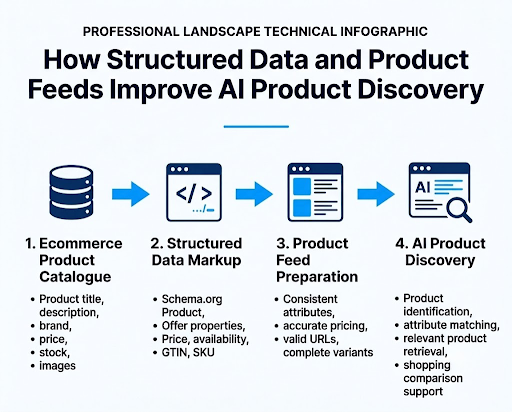
How Structured Data and Product Feeds Improve AI Product Discovery
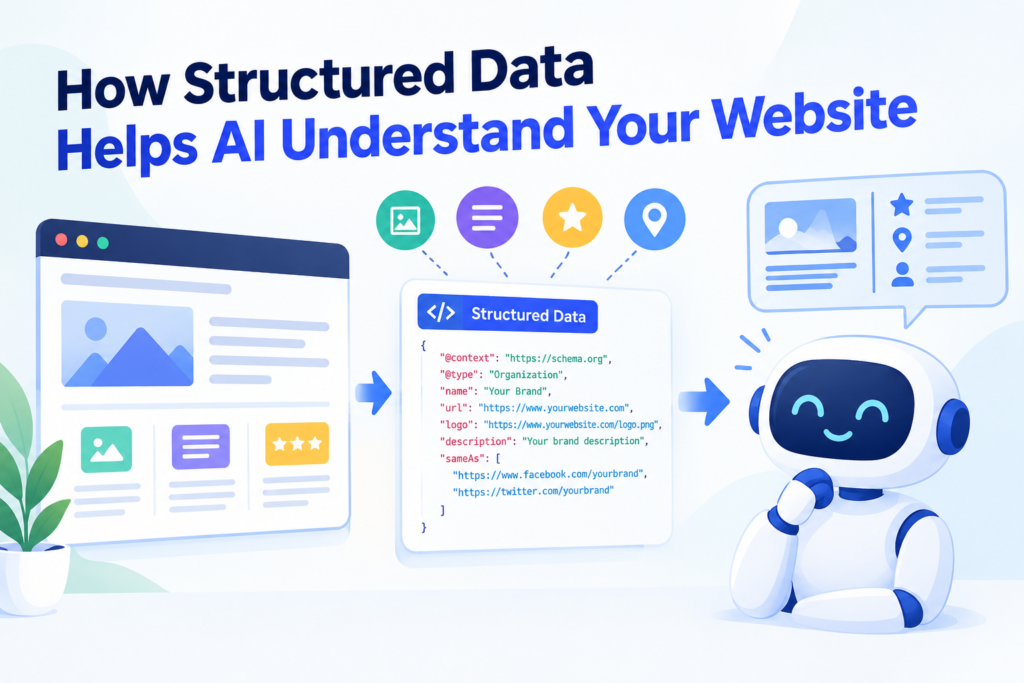
Ecommerce product discovery depends on how accurately shopping platforms can interpret product information across accessible data sources. Structured data markup communicates details such as product identifiers, pricing, availability, and variants within website code, while product feeds organise these attributes into machine-readable records. Google’s Product Structured Data documentation explains how product markup can communicate details such as price, availability, shipping, and review ratings to supported search experiences. When both sources provide consistent, complete information, compatible systems can identify products more accurately, match relevant attributes to shopping queries, and support clearer product comparisons.
How to Strengthen Ecommerce Website Accessibility for AI Crawlers
Configure Robots.txt and Crawl Directives Correctly
Review robots.txt rules to ensure relevant product and category pages are accessible to permitted crawlers. Treat crawl access and indexation separately: robots.txt controls crawling, while meta robots tags and X-Robots-Tag headers communicate directives such as noindex when the crawler can access the URL. Google’s robots.txt guide explains that robots.txt controls crawler access but is not a reliable method for preventing URLs from appearing in search results. Verify rules against each platform’s documented crawler requirements.
Build Crawlable Product Pages With HTML Links
Connect category pages, subcategories, and product detail pages through standard HTML anchor elements with descriptive href attributes. Avoid relying exclusively on JavaScript event handlers, interactive filters, or search forms to expose product URLs. Although some crawlers can render JavaScript, conventional links provide a dependable discovery path for crawlers with limited rendering capabilities.
Render Essential Product Information in Accessible HTML
Check both the initial HTML response and the JavaScript-rendered DOM to confirm that product names, descriptions, specifications, and other essential content are available to supported crawlers. If critical information appears only after client-side execution, crawlers without JavaScript rendering may miss it. Server-side rendering or static rendering can improve access to this content.
Maintain Accurate XML Sitemaps and Canonical URLs
Include preferred, indexable product URLs in XML sitemaps and update entries when URLs change, or products are removed. Google’s sitemap documentation explains how to submit sitemaps while clarifying that submission does not guarantee crawling or indexing. Use canonical tags to identify preferred versions of duplicate or similar pages, and ensure internal links consistently point to those URLs. Sitemaps support URL discovery, while canonical tags communicate URL preferences; neither guarantees crawling, indexing, or AI recommendation inclusion.
Conclusion
Winning visibility in AI-driven shopping requires an ecommerce strategy built for how customers discover, evaluate, and choose products. Think Shaw helps businesses strengthen their digital presence through tailored SEO strategies and data-driven marketing solutions designed to support sustainable growth, improve online visibility, and build a stronger competitive position as ecommerce continues to evolve.
| Partner with Think Shaw to strengthen your ecommerce SEO strategy, improve AI shopping visibility, and build a competitive digital presence that supports sustainable growth! |
FAQ’s About AI Shopping Recommendations
How can ecommerce brands measure their visibility in AI shopping results?
Ecommerce brands can track product mentions, recommendation frequency, linked product pages, referral traffic, and conversions from supported AI platforms. Regular testing with relevant shopping queries helps identify visibility changes and potential content gaps.
Can small ecommerce businesses compete for AI shopping recommendations?
Yes. Smaller ecommerce businesses can compete by serving specific product niches, maintaining accurate product information, demonstrating specialist expertise, and publishing useful buying guidance. Results depend on platform coverage, product relevance, competition, and other selection factors.
Do customer reviews influence AI shopping recommendations?
Customer reviews can provide information about product performance, durability, usability, and common limitations. Their influence varies by platform, but authentic, detailed feedback can help shoppers evaluate products beyond manufacturer-provided descriptions.
Does AI shopping visibility directly increase e-commerce sales?
AI shopping visibility can introduce products to relevant buyers, but increased exposure does not guarantee sales. Purchase outcomes depend on pricing, product suitability, customer trust, landing-page experience, availability, and the overall buying process.
How often should ecommerce brands audit their product information?
Audit product information whenever prices, stock levels, specifications, or product variants change. Conduct scheduled checks to identify discrepancies between product pages and external listings, particularly for large catalogues with frequently updated inventory.