Online visibility is undergoing a major shift. Traditional SEO still plays a role, but the way people look for information is changing as AI platforms become a primary starting point for research. According to Semrush, over 2.5 billion questions are asked every month just with ChatGPT. It is also predicted that AI-driven traffic will surpass standard search by 2028.
Since so many people are using AI tools instead of search engines, a big question comes up: when someone asks a question about your field, does your company show up in the answer?
This can’t be assessed through keyword rankings. AI systems mix data from different places, make their own summaries, and show different results based on the context. If their output is probabilistic, the answer can vary with every query.
Because of this, AI visibility is a different factor from standard SEO, and it needs to be measured in its own measurement methods. In this blog, we’ll talk about how AI visibility works, how to optimize for AI search by using the right performance metrics, and the tools that help you keep track of your visibility on the most popular AI platforms.
AI Visibility In ShortAI visibility depends on how well platforms can access, interpret, and reference your content. Measuring crawlability, brand inclusion in AI answers, schema recognition, semantic clarity, and knowledge graph presence reveals performance. Improving structure, technical hygiene, data quality, and topical authority strengthens how consistently AI systems surface your brand across queries. |
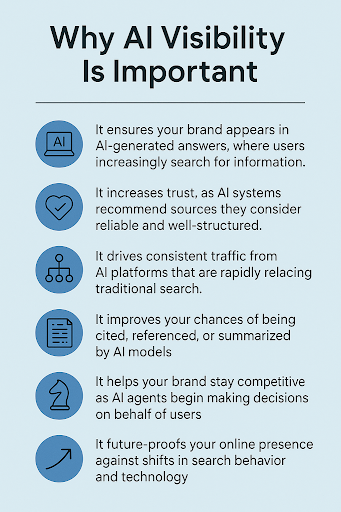
Why AI Visibility Is Important?
Take a look at the infographic below to see why AI visibility matters:
How To Measure Your AI Visibility?
1. AI Crawlability & Index Presence
Check how easily AI crawlers can find, load, and understand your pages. If your site is easy to crawl, AI systems can grab your content without a hitch. When your pages show up in the index, they will appear in AI-generated answers. But if something is broken, like resources are blocked or there are technical issues, your visibility will reduce.
2. AI Answer Inclusion & Query Performance
Keep track of how often AI platforms mention your brand in direct and conversational responses. This includes citations, references, and brand mentions in answers that are written in a natural way. If you include all these parameters, AI routinely chooses your content when real users interact with it, which shows that it is relevant and authoritative.
3. Correctly Understand AI Snippet
Evaluate to see how well AI can summarize your key points from your content. Clear interpretation means your structure and wording support machine understanding. Misinterpretations reveal clarity or formatting issues that reduce visibility in AI-generated answers.
4. Structured Data & Schema Recognition
Make sure that AI algorithms can read your schema markup. Schemas help AI to understand things easily, like FAQs and instructions, and give your right information in the answers.
5. Semantic Understanding & Embedding Quality
Quality embeddings can tell you just how well AI models grasp your data. When the information is clear semantically, AI can answer questions much better. When those signals for embedding are poor, then it gets a lot tougher to see you in answers from conversational or contextual AI.
6. Authority Signals and Inclusion in the Knowledge Graph
Search for your brand name in the AI models’ knowledge graphs. AI-generated explanations and decision-making replies are more likely to employ content that is very authoritative and clearly connected to the field.
7. Examples Of AI Visibility Tools That You Can Use
| Tool Name | What It Measures (Unique Category) | How to Measure Using This Tool |
| Perplexity | AI search visibility, citation frequency | 1. Search your brand/domain.
2. Check sources for citations. 3. Monitor appearance frequency and industry queries. |
| Peec AI | It provides cross-platform AI visibility (ChatGPT, Bing, Claude, Perplexity). | 1. Type your domain or keywords.
2. Compare visibility across AI platforms. 3. Identify which queries bring your content versus competitors. |
| Google Knowledge Graph API | Entity Recognition & Authority Signals | 1. Type your brand or URL.
2. Verify entity existence (ID, type, description). 3. Review relevant concepts to boost entity associations. |
| Screaming Frog (JS Mode) | AI Crawlability and Content Accessibility | 1. Crawl with JavaScript rendering.
2. Review which content loads correctly. 3. Fix blocked resources or rendering issues. |
| OpenAI Embedding Playground | Semantic Understanding & Topic Relevance | 1. Paste your content into the embedding tool.
2. Create and compare embeddings to subjects. 3. Identify gaps in semantic clarity or relevance. |
| ChatGPT / Gemini / Claude Prompt Testing | Snippet Interpretation Accuracy | 1. Ask the model to summarise your content.
2. Check if key points appear accurately. 3. Note down misinterpretations and refine content. |
How To Improve Your AI Visibility?
This is an important part of modern AI Search Engine Optimization. Here, visibility depends on how AI systems read and interpret your content:
Content Strategies
- Build topic authority through structured content: Create interconnected pillar pages and subtopics that show depth. This will allow AI to better comprehend your expertise and rank your content higher.
- Optimise for AI Search (AEO) and generative answers: Content should have distinct parts, direct answers, and a logical structure so AI assistants can extract information for responses.
- Use data-backed, research-driven content: Use unique data, surveys, benchmarks, and charts to demonstrate value and improve chances of being cited by AI systems.
- Add natural-language and conversational queries: You can use question-style headings and conversational phrasing to match user queries. It will improve AI alignment and long-tail search visibility.
- Update your content regularly: To keep your content in AI ranking and generation cycles, update your data, examples, and insights often to show that it is new.
- Use multi-format content (text + visuals + video): In your content, merge text with diagrams, infographics, and short videos to support multimodal AI understanding and expand visibility across search surfaces.
- Strengthen author credibility and E-E-A-T signals: Highlight expert authors, real experience, citations, and transparent sourcing to increase AI trust and boost authoritative visibility.
Technical Strategies
- Add structured data/schema markup: Need better extraction and answer inclusion? Add schema categories such as FAQ, How to, and Author to help AI interpret meaning.
- Improve crawlability and content architecture: Use clear URL structures, internal links, and well-organized sitemaps to help AI crawlers grasp content linkages and index everything more efficiently.
- Optimise page speed and Core Web Vitals: Improve loading speed, stability, and responsiveness to meet AI ranking standards and ensure your pages perform well across devices.
- Make graphics and data machine-readable: Give multimodal AI meaningful alt text, labelled tables, and clear figure captions to understand and reuse your visual content.
- Use vector search and semantic embeddings: Implement semantic search internally to strengthen content relationships, improving how AI models interpret meaning and topical relevance across pages.
- Make sure your AI results are optimized for zero-click and no-click: Make short, snippet-ready information chunks that are easy for AI to interpret. This will make sure that users can see them even if they don’t click through.
- Keep it up to date technically (repair errors, broken links, and duplicates): To make sure that AI crawlers trust and rank your site higher, you should frequently check for errors, broken links, schema problems, and duplication.
Conclusion
The above-mentioned dual strategies convert your website from a source of information into a trusted asset consistently recognised and utilised by AI models across platforms. Also, this prepares your brand for upcoming AI agents that rely on clean, machine-readable knowledge sources to make decisions. So no need to wait, apply these techniques to strengthen your SEO for AI search and ensure your brand remains visible across AI-driven platforms.
FAQ’s
How Do AI Models Find and Rank My Brand?
They get things the same way people do: by looking at what is available to the public online. They look at your website, articles, reviews, directories, and any other mention of your brand to get a clear image of who you are. These systems are more likely to reference you if your brand looks consistent, trustworthy, and well-supported across diverse sources.
Does Social Media Activity Affect AI Visibility?
Social media has an indirect effect on how visible AI is. Instead of ranking social postings like search engines, AI models analyze them to assess brand trustworthiness, consistency, and relevancy. Popularity, expert opinions, viral content, and positive engagement boost your brand’s entity profile, making AI systems more likely to reference you.
How Long Does It Take for AI Models to Recognise New Changes on My Website?
It will take a couple of weeks to a few months to figure out changes on your website. Also, it depends on how quickly search engines recrawl your pages, how clearly your updates are structured, and how often your site is cited online.