Choosing the right SEO agency can have a lasting impact on your business’s online visibility, lead generation, and long-term growth. While reputable agencies use ethical, data-driven strategies to improve search performance, others rely on unrealistic promises, vague reporting, or outdated tactics that can do more harm than good. With search engines continuously refining their algorithms to reward quality and user-focused experiences, partnering with an agency that follows best practices is more important than ever. Hence, understanding the warning signs before signing a contract can help you avoid costly mistakes and protect your website’s credibility.
In this guide, we’ll explore the most common SEO agency red flags to watch for, along with the essential questions you should ask to confidently choose an SEO agency that aligns with your business goals.
Strategic Hiring and SEO Evaluation OverviewSelecting an SEO agency requires more than comparing prices or promises. Businesses should assess transparency, ethical practices, ownership safeguards, reporting standards, strategic fit, and contractual clarity. Sustainable SEO performance depends on qualified demand, conversion quality, revenue contribution, customer value, and reliable measurement, not superficial visibility gains. A well-vetted partner provides clear accountability, protects brand assets, manages risk responsibly, and builds a scalable search strategy aligned with long-term commercial priorities. |
What Are the Biggest Red Flags When Hiring an SEO Agency?
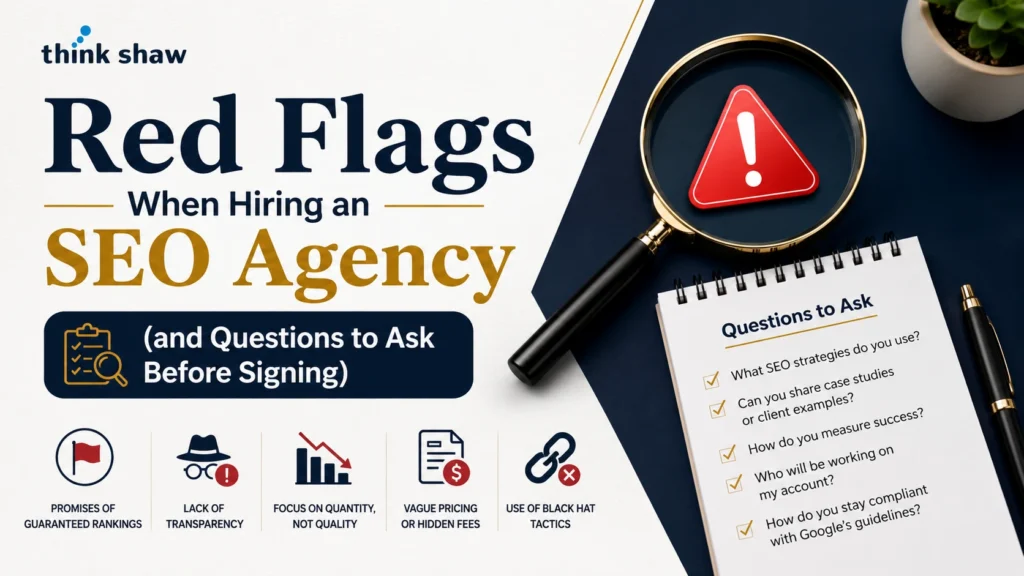
SEO directly affects your website’s visibility, traffic, and reputation; hence, working with the wrong provider can lead to wasted marketing budgets, lost rankings, or even search engine penalties. If an agency exhibits any of the following SEO agency red flags, it’s worth taking a closer look before signing a contract.
| Red flag | Why it matters | What a credible agency should provide |
| Guaranteed #1 rankings, fixed traffic gains, or AI Overview placement | Search results are not under an agency’s control; guarantees often mask irrelevant keyword targeting, manipulative tactics, or misleading sales claims. Google specifically warns that nobody can guarantee a #1 ranking. | Forecast ranges, assumptions, scenario planning, and outcome-focused goals rather than rank guarantees |
| Claims of a “special relationship” with Google or “priority submission” | Google identifies both claims as warning signs; they imply access or influence the agency does not have. | When hiring an SEO agency, see if they provide a clear explanation of standard tools and processes, including Search Console, crawling, content, technical work, and digital PR |
| Vague or “proprietary” methodology | An agency does not need to disclose every operational detail, but it should clearly explain what it will do, why it matters, and how it will measure progress. Google advises caution when an SEO will not clearly explain its intended work. | A documented 90-day roadmap, prioritised backlog, deliverable volumes, responsible owners, and implementation dependencies |
| No ownership or access to core accounts | If the agency owns Google Search Console, Analytics, CMS, tag manager, call tracking, or ad accounts, the client can lose historical data and operational control when the relationship ends. Search Console contains owner-level data and controls that affect how a site appears in Google. | Client-owned accounts, with the agency added through role-based access; during an initial audit, Google recommends granting read-only Search Console access. |
| Large quantities of cheap backlinks without a sourcing explanation | Google classifies links created primarily to manipulate rankings as link spam. “We have a network” or “we build hundreds of links monthly” without placement, relevance, and editorial standards is a serious warning sign. | Link methodology, quality criteria, example placements, relevance standards, disclosure of paid placements, and a report of live URLs |
| AI content at scale with no editorial, SME, or quality-control process | Google’s concern is not AI alone; it is scaled content made primarily to manipulate rankings rather than help users. Agencies that promise hundreds or thousands of pages with little review may expose a site to scaled-content-abuse risk. | A content workflow covering search intent, original research or expertise, editorial review, factual validation, brand voice, and performance refreshes |
| Rankings-only or vanity-metric reporting | A rankings report can look positive while organic leads, qualified traffic, revenue, and conversion rates stagnate. Position tracking is useful diagnostically, but it is not a business outcome. | Reporting that connects visibility to clicks, non-brand traffic, conversions, assisted conversions, qualified leads, revenue, and implementation progress |
| No conversion tracking or measurement plan | Without agreed conversion events, attribution setup, and baseline data, the agency cannot credibly demonstrate commercial impact or make prioritisation decisions. A report full of impressions may hide weak lead generation. | A measurement specification before work begins: primary conversions, lead-quality signals, CRM feedback, revenue attribution, and dashboard access |
| A generic strategy delivered before discovery | If the agency does not ask about margins, ideal customers, sales cycle, geography, technical stack, competitors, compliance, or past SEO history, it is likely selling a templated package rather than a business-specific strategy. | Discovery workshops, stakeholder interviews, competitor and SERP analysis, a technical baseline, and a prioritised opportunity model |
| A low price that cannot support the promised scope | “Full-service SEO” at an implausibly low retainer often means automated work, outsourced low-quality content, skipped technical implementation, or risky links. The issue is not simply price; it is whether staffing and deliverables are economically credible. | A transparent scope showing the planned hours, deliverables, specialist involvement, exclusions, and expected client-side effort |
| No named strategist or a senior-sales-to-junior-delivery bait-and-switch | You may be sold by an expert but assigned to a high-volume account manager or inexperienced production team. This creates weak strategic accountability and slow decision-making. | The names and roles of the strategist, technical SEO lead, content lead, and account owner, plus confirmation of who attends review calls |
| No verifiable case studies, references, or evidence of work | Testimonials alone are easy to manufacture or overstate. Google recommends checking an SEO’s references and asking former clients whether the provider was useful, easy to work with, and produced positive results. | Relevant examples with starting context, constraints, work completed, time period, outcome metrics, and references where appropriate |
| A long lock-in contract with weak exit rights | SEO needs time, but a long non-cancellable term without service-level reviews can protect the vendor more than the buyer. Automatic renewals and burdensome cancellation procedures are additional contract risks. | Clear deliverables, 90- or 180-day performance reviews, ownership clauses, sensible notice periods, and an exit/handover process |
| Surprise charges and an undefined scope | A monthly fee without quantities or scope makes under-delivery difficult to identify; content production, development support, digital PR, tools, and reporting may later appear as add-ons. | A proposal that distinguishes included work, optional work, third-party costs, one-off fixes, content production, development, and link/digital-PR costs |
| Tool outputs presented as certainty | Third-party SEO tools estimate data; Google says such tools do not have its internal ranking data and cannot guarantee performance. Treat their outputs as directional inputs, not proof or certainty. | Transparent use of first-party data from Search Console and Analytics, supplemented by third-party tools with stated limitations |
| AEO/GEO/AI-search claims with no definition, evidence, or measurement | “We’ll get you into ChatGPT/AI Overviews” is a marketing claim unless the agency can define the relevant surfaces, explain its content and entity strategy, state what it can and cannot influence, and show measurement limitations. Google’s hiring guidance encourages clients to check whether AEO/GEO advice aligns with official guidance. | An evidence-based AI-search plan that prioritises useful, crawlable content, strong entities and sources, technical accessibility, and transparent visibility tracking, not guaranteed citations |
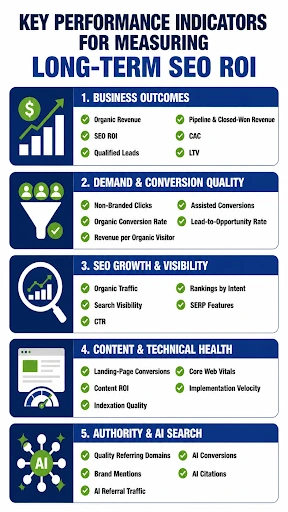
Key Performance Indicators For Measuring Long-Term SEO ROI
Long-term SEO ROI should be measured with a KPI stack that links search visibility to qualified demand, conversions, revenue, and customer value, not rankings or organic traffic alone. Organic revenue, conversion quality, customer acquisition cost, and customer lifetime value are the strongest indicators of whether SEO is generating durable business value.
The central SEO agency warning signs test is simple: long-term SEO is working when it increases the volume and value of qualified, attributable demand at an acquisition cost and lifetime value that improve the business, not merely when traffic, rankings, or published-page counts rise.
What Questions Should You Ask Before Signing with an SEO Agency?
Some common questions to ask
Wondering how to choose an SEO agency? Well, begin by asking these important questions to learn whether the company is a green flag or red
What business problem will SEO solve for us, and which outcomes will define success?
Ask the agency to tie SEO to your actual priorities: qualified leads, ecommerce revenue, demos, pipeline, bookings, repeat purchases, or geographic expansion, not generic traffic growth. A strong answer starts with your customers, competitors, sales cycle, margin priorities, and conversion paths; Google says a credible SEO should be interested in what makes your business unique and how customers find you.
Which audiences, products, services, markets, or page groups will you prioritise first, and why?
This tests whether the agency can make commercial trade-offs rather than simply handing over a giant keyword list. Ask for the prioritisation criteria, such as conversion potential, current rankings, technical feasibility, revenue opportunity, search demand, content gap, and competitive difficulty.
What will the first 90 days look like?
Request a phased plan covering discovery, measurement setup, technical audit, issue prioritisation, content opportunities, implementation, and reporting. It should distinguish recommendations from completed work and clearly state which tasks require your developers, writers, legal team, product specialists, or internal approvers.
What is your approach to AI-search, AEO, or GEO work?
Ask them to define the specific visibility opportunities they mean, the work they will perform, the evidence supporting it, and the limits of measurement. Google advises evaluating whether AEO/GEO recommendations align with its official guidance, rather than accepting unverified claims or tool-driven certainty.
Deliverables and Process
What exactly is included in the retainer each month?
Get quantities and boundaries in writing: audits, technical tickets, content briefs, articles, content refreshes, internal-linking work, digital PR, link acquisition, dashboards, meetings, and project management. Avoid vague terms such as “ongoing optimisation” unless they are translated into deliverables, hours, or a documented backlog.
Who will work on our account, and who makes strategic decisions?
Request the names and roles of the strategist, technical SEO, content lead, outreach/digital PR specialist, analyst, and account manager. Also ask who will attend calls, how many accounts the lead strategist handles, and whether any work is outsourced.
What do you need from our team to succeed?
A credible agency will identify dependencies such as CMS access, development capacity, brand guidelines, product data, subject-matter expert interviews, compliance approval, analytics access, and turnaround times. An agency that says it needs nothing from you may be planning generic, low-context work.
How will you handle a redesign, CMS migration, international expansion, or major site change?
The agency should explain technical discovery, URL mapping, redirects, staging checks, analytics annotation, crawl/indexation monitoring, and post-launch validation. Google notes that involving SEO early in a redesign or launch can help make the site search-friendly from the outset.
Content and Links
How do you develop content that is genuinely useful, not merely optimised for keywords?
Ask for their process for intent analysis, topic selection, expert input, original research, fact-checking, editorial review, conversion alignment, and post-publication updates. This matters because Google defines scaled content abuse as producing many pages mainly to manipulate rankings rather than help users.
How do you use AI in research, drafting, editing, and quality assurance?
Look for clear human accountability: editorial review, factual validation, originality checks, brand and compliance review, and subject-matter expertise where needed. Avoid agencies that promise high-volume AI content without a credible value-add process, since Google specifically lists using generative AI to create many pages without user value as an example of scaled content abuse.
Measurement and Reporting
Which KPIs will you report, and how do they connect to revenue or lead quality?
Insist on a balanced measurement framework: organic clicks and impressions, non-brand growth, rankings where relevant, conversions, conversion rate, assisted conversions, qualified leads, CRM stages, pipeline, and revenue. Rankings and traffic should be diagnostic metrics—not the sole definition of success.
Can we see a sample report and dashboard before signing?
The report should show completed work, findings, performance movement, business impact, risks, next priorities, and blockers—not just a keyword-ranking spreadsheet. Ask how they separate correlation from causation and explain adverse performance changes.
Risk and Compliance
Do you follow Google Search Essentials and Google’s spam policies?
Ask for a direct written confirmation, plus examples of tactics the agency refuses to use. Google advises asking potential SEOs whether they follow Search Essentials.
How do you assess and manage risk when making technical changes?
Ask about backups, staging environments, rollback procedures, code review, redirect testing, monitoring, site-speed checks, and post-deployment QA. This is essential when the agency has access to templates, server files, structured data, internal linking, or CMS settings.
Proof and Communication
Can you show relevant case studies and connect us with references?
Ask for businesses that resemble yours in model, market maturity, technical complexity, budget range, and goals. Google explicitly advises checking references and asking past clients whether the agency was useful, easy to work with, and achieved positive results.
What changed in each case study, and what was the agency’s direct contribution?
A credible case study explains the baseline, strategy, implementation, timeframe, obstacles, and commercial result. Be cautious of charts that omit seasonality, paid-media influence, product launches, brand campaigns, migrations, or pre-existing demand.
How often will we meet, who is our day-to-day contact, and what happens between meetings?
Establish reporting cadence, response-time expectations, escalation paths, meeting attendees, and decision-making authority. Google’s SEO agency checklist recommends asking how you can expect to communicate and whether the provider will share changes and detailed reasoning.
Commercial Terms
What does the price include, exclude, and require from us?
Separate agency fees from content production, development, digital PR, paid placements, tools, travel, translation, photography, and one-off migration work. Ask for a scope document that makes it possible to assess delivery each month.
What are the contract term, renewal conditions, cancellation rights, and handover requirements?
Confirm notice periods, renewal triggers, early-termination rules, payment obligations, and the process for transferring documentation, files, dashboards, and unfinished work. SEO needs time, but a contract should not make it unnecessarily difficult to leave a poor-performing provider.
Conclusion
Choosing an SEO partner is ultimately about finding a team that understands your business, communicates clearly, and turns search opportunities into measurable growth. Think Shaw delivers tailored SEO, PPC, and digital marketing strategies designed around your goals, not generic templates or empty promises. Ready to build a stronger, more sustainable search presence? Contact us today for a tailored SEO consultation.
FAQs About Hiring an SEO Agency
Should I hire a local or remote SEO agency?
Location matters less than proven expertise, communication quality, industry understanding, and access to the right specialists. Local knowledge is most valuable for location-dependent businesses.
How much does SEO agency pricing typically cost?
Costs vary by market, competition, scope, website scale, and expertise required. Evaluate the proposed workload, specialists involved, and expected business value, not monthly price alone.
Can SEO work alongside PPC campaigns?
Yes. PPC data can reveal high-converting search terms, landing-page insights, and market demand, while SEO builds sustained visibility that may reduce long-term paid-media dependency.
What should an SEO onboarding process include?
Effective onboarding typically includes stakeholder discovery, access setup, analytics review, technical assessment, competitor research, goal alignment, reporting configuration, and a prioritised implementation roadmap.
Can SEO support brand awareness as well as leads?
Yes. Informational content, category visibility, digital PR, expert resources, and broader non-branded search exposure can strengthen awareness before users are ready to convert.