Shopify collection pages act as high-intent landing pages that can drive qualified traffic and support faster purchase decisions. Unlike individual product pages, collection pages target broader commercial search terms, making them critical for ranking category-level queries and guiding shoppers toward relevant options. When optimized well, Shopify collection SEO improves crawlability, strengthens internal linking, and creates a smoother path from search to conversion. Yet many Shopify stores overlook them, leaving thin content, weak metadata, and poor user experience to limit both visibility and sales.
In this guide, we’ll look at how to optimize Shopify collection pages for search performance and customer action, with practical strategies that help category pages rank competitively while also converting more visitors into buyers.
Shopify Collection SEO OverviewShopify collection pages work best when they are built as strategic category landing pages that support both search visibility and buying decisions. Strong performance depends on matching each page to clear intent, using unique metadata and copy, improving internal linking and crawl efficiency, and creating a smoother shopping experience through better filters, product presentation, mobile usability, trust signals, and ongoing testing to increase qualified traffic and conversions. |
Why Shopify Collection Pages Matter for SEO and Conversions?
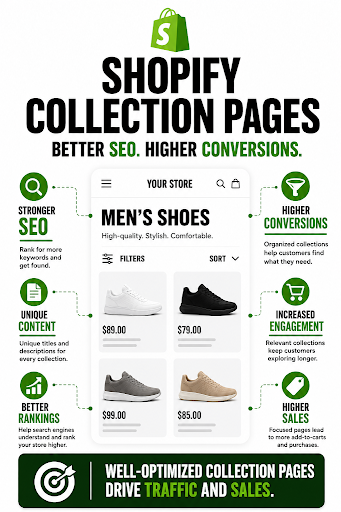
Shopify collection pages sit at the intersection of search intent and shopping behavior, which makes them unusually valuable. They target broader, higher-volume commercial queries than most product pages, capture users who are still comparing options, and channel authority through internal linking and category architecture. This collection page SEO helps:
- Rank for category-level terms with stronger aggregate demand.
- Reduce choice friction by grouping relevant products in a scannable format.
- Convert better when filters, metadata, copy, and Shopify UX align with buyer intent.
- Often outperform isolated product pages as scalable Shopify collection SEO and revenue assets.
How to Optimize Shopify Collection Pages to Rank Higher?
To make Shopify collection pages rank higher, optimize them as true category landing pages, not just product grids. Here’s how you can do that:
Map one primary intent to each collection page
Collection pages rank best when each page targets a distinct commercial theme, such as product type, use case, or audience, because that gives search engines a clear reason to surface the page for a specific query instead of splitting relevance across overlapping URLs.
Use keyword-focused titles, URLs, and metadata
A descriptive collection title, clean URL handle, and unique meta title and description help search engines understand the page topic and improve click-through potential in results, especially for broad commercial searches.
Write a unique collection copy with real informational value
Thin or duplicated text weakens relevance, while original copy helps explain what the category includes, who it serves, and how products differ, which strengthens topical depth without relying on keyword stuffing.
Improve internal linking to build authority and discovery
Shopify internal linking collections from navigation, related categories, blog content, and key site pages helps search engines crawl them more easily and signals that these pages are central to the store’s structure.
Control faceted navigation and duplicate URL issues
Filtered and parameter-based pages can create index bloat or duplicate intent, so collection SEO works better when the main canonical version remains clear, and crawl paths stay focused on high-value URLs.
Strengthen UX signals that support SEO performance
Fast load times, mobile usability, intuitive filtering, and clear product organization keep users engaged, and better engagement improves the page’s ability to satisfy search intent at scale.
Use structured data for search visibility, not as a ranking shortcut
Schema does not directly improve rankings, but it can enhance how pages appear in search and make listings more useful, which can indirectly support traffic and conversions.
Prioritize high-value collections first
Shopify and ecommerce SEO guides consistently treat collection pages as major commercial opportunities, so focusing on collections with strong demand, margin, or product depth usually produces the best return on Shopify collection SEO effort.
How to Make Shopify Category Pages Convert Better?
To make Shopify category pages convert better, treat them as decision-making pages rather than simple product archives. Here’s what you need to do:
Surface products quickly above the fold
When ecommerce category optimization is done, category pages convert better when shoppers see relevant products early, rather than scrolling past oversized banners or excessive copy, because immediate product visibility reduces abandonment and supports faster product discovery.
Use intuitive filters and sorting
Filters for size, color, price, or use case help users narrow options efficiently, while sorting by popularity, newness, or price supports different buying behaviors and reduces decision fatigue.
Keep filter systems simple, not overloaded
Too many filter choices can overwhelm users, so clearer groupings, limited options, reset buttons, and unavailable-option handling make browsing feel controlled rather than confusing.
Merchandise bestsellers and high-performing products first
Featuring top products, trending items, or revenue-driving SKUs works because shoppers often use collection pages to compare quickly, and stronger defaults help guide them toward proven choices.
Improve product card clarity
Strong thumbnails, visible pricing, concise product details, and meaningful labels such as “bestseller” or “new” make scanning easier, which matters because shoppers often decide at grid level before opening a product page.
Add trust signals near the browsing experience
Reviews, shipping details, returns information, and social proof reduce uncertainty at category level, especially for first-time visitors who are not yet ready to commit to a specific product.
Optimize mobile-first behavior
Collection pages often lose conversions on mobile when filters are hard to use or layouts feel cramped, so responsive grids, thumb-friendly controls, and simplified navigation are critical for keeping shoppers engaged.
Align page copy with shopper intent
Short, action-oriented copy, clear value propositions, and category-level guidance help users understand what the page offers without distracting from the products themselves.
Test and refine continuously
Shopify CRO guidance consistently recommends A/B testing layouts, CTAs, proof elements, and product ordering because small interface changes can meaningfully affect conversion behavior over time.
Conclusion
Strong collection pages do more than support rankings; they shape how customers experience your store and how confidently they move toward purchase. That is why sustainable Shopify growth often comes from improving the pages that connect discovery, consideration, and revenue. At Think Shaw, we help brands turn underperforming category pages into strategic ecommerce assets through Shopify collection SEO, content, UX, and conversion-focused optimization.
Get in touch with us today to optimize your Shopify store for growth.
FAQs For Shopify Collection SEO
Is pagination bad for Shopify collection page SEO?
Pagination is not inherently bad, but it must be handled cleanly. Poor pagination can dilute crawl efficiency, while logical page sequencing helps search engines and users navigate larger inventories more effectively.
Are automated Shopify collections better than manual collections?
Automated collections are better for scale and consistency, especially with large catalogs. Manual collections work better when merchandising decisions depend on seasonality, campaigns, or curated product selection.
Should sold-out products stay on collection pages?
It depends on demand and restocking plans. Temporarily unavailable products can preserve user expectations and page continuity, but permanently unavailable items should usually be removed or redirected strategically.
Should Shopify collection pages include FAQs or supporting content?
They can, when the content answers real buyer questions. Supporting content works best when it removes hesitation, clarifies category differences, or addresses practical concerns near the decision stage.
How do you measure collection page success in Shopify?
Success should be measured through organic traffic, click-through rate, engagement, product clicks, conversion rate, and revenue contribution. Looking at both SEO and commercial metrics gives a fuller performance picture.