Small businesses, such as boutique clothing stores, local bakeries, or independent consultants, increasingly need more than a social media page to be found online. This is where the two most searched platform names come up: Shopify and WordPress. However, both ecosystems are so vast, packed with themes, plugins, and pricing tiers, that many owners get overwhelmed and either delay launching or pick blindly. Remember that choosing the wrong one often means rebuilding the site later, losing SEO progress, or overpaying for tools you will never use. Therefore, we have this guide, in which we’ll break down what actually matters for small businesses when deciding between the two in 2026.
Overview: Shopify vs WordPressFor most small businesses in 2026, Shopify offers a better choice for product-focused online stores that want simple setup and low maintenance, while WordPress offers greater flexibility for service businesses, content-heavy websites, and advanced SEO strategies. In the end, the right choice depends on whether your priority is streamlined e-commerce or deeper customization and content control. |
Why Shopify or WordPress Platforms Matter for Small Businesses in 2026
The Shift Toward Online Buying
U.S. retail e-commerce sales reached $340.2 billion in the second quarter of 2026, making up 17.1% of total retail sales and growing 3.8% from the previous quarter, per the U.S. Census Bureau. This is actually a direct signal that platform choice affects your real revenue.
Paid Ad Costs Are Pushing Businesses Back to Owned Websites
As social media and search ad costs continue climbing in 2026, small businesses are relying more on their own website to convert repeat visitors organically. This makes the platform’s built-in SEO and content tools a direct factor in reducing long-term marketing spend.
Small Businesses Are Closing the Tech Gap
Small business technology and AI adoption rose from 6.3% to 8.8% within six months, per the SBA Office of Advocacy, meaning owners who delay building a capable website risk falling behind faster-moving competitors.
A Website Sets the First Impression
For many customers, a small business’s website is their first real interaction with the brand, and it helps to shape their trust and purchase intent before a product or service is even discussed.
AI-Powered Search Is Changing Discovery
Customers are increasingly finding businesses through AI-generated answers rather than traditional search results, making structured content and clear site architecture more important than ever.
| Still Weighing Shopify Against WordPress for Your Business?
Our team looks at your products, content goals, and budget, then tells you plainly which platform fits your work best. |
Shopify or WordPress: Which One Should You Go For?
The right platform depends on your business type, technical comfort, and long-term goals, and neither is universally “better.”
| Factor | Shopify | WordPress (+ WooCommerce) |
| Setup & Ease of Use | It is fully hosted, with guided setup, and minimal technical skill needed | Requires separate hosting; more setup steps, more flexibility |
| Best Suited For | Product-based businesses focused on selling online, e.g., clothing brands, jewelry sellers, home decor stores, food and beverage brands, subscription box businesses | Content-heavy, service-based, or blog-driven businesses, like consultants, law firms, real estate agents, coaches, digital marketing agencies, niche bloggers |
| Customization | You can do theme/app-based customization. Some limits without developer help | Highly customizable via thousands of plugins and themes |
| SEO & Content Control | It has solid built-in SEO tools, less flexible URL/content structure | Deep SEO control, ideal for content marketing and blogging |
| Payment Processing & Transaction Fees | Built-in Shopify Payments; using external gateways which adds a 0.5–2% extra transaction fee per sale | No added platform fees; costs depend entirely on the payment gateway (e.g., Stripe, PayPal) you connect |
| Maintenance | Platform handles updates, security, and hosting itself | The owner (or agency) manages updates, backups, security |
| Scalability | Scales well for growing product catalogs and traffic spikes | Scales well but depends on hosting quality and plugin management |
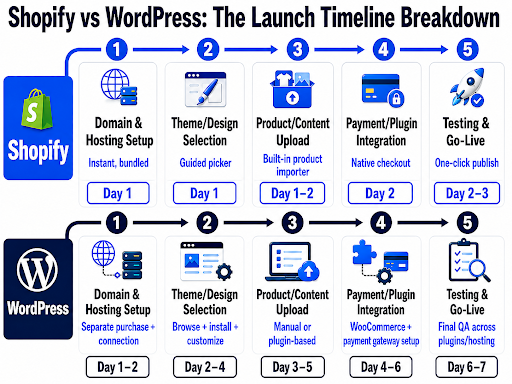
How Long Does Each Platform Really Take to Launch?
Launch speed is often the deciding factor for small business owners who want to start selling or publishing sooner rather than later. Here’s how the average setup timeline compares across both platforms, stage by stage.
Conclusion
Eventually, your final choice comes down to whether your business is built around selling products, publishing content, or a mix of both, and how much hands-on management you’re prepared to take on. So, whichever way you decide to go, don’t miss out on reaching out to Think Shaw. We offer end-to-end website design and development support across both Shopify and WordPress, according to how your business actually operates.
| Ready to stop guessing and start building a proper website strategy?
|
FAQs- About Shopify or WordPress for Small Businesses
Can I migrate a WordPress site to Shopify without losing SEO rankings?
Yes, with proper 301 redirects and URL mapping, though some ranking fluctuation during transition is common and expected.
Is it required to renew my domain and hosting separately every year?
Yes, whether you build on Shopify or WordPress, domain registration and hosting typically renew annually. Make sure to set reminders to avoid accidental downtime.
Which platform costs less to run month-to-month, Shopify or WordPress?
Shopify bundles hosting into one subscription, while WordPress costs vary based on hosting, plugins, and how much support you need.
Can I manage my store or site from a mobile app on either platform?
Yes, Shopify offers a dedicated mobile app for store management, while WordPress relies on browser-based or third-party apps.
Do I need business hosting insurance or backups regardless of which platform I choose?
Yes, regular backups and basic site insurance are recommended for any small business website, no matter which platform you use.