
Ever feel like you’re shouting into the void with every new blog post? While we’ve all been taught to chase individual keywords, search engines in 2026 have moved on, leaving traditional blogging. The problem is that isolated, linear posts often get lost in the shuffle of AI-driven results, losing the semantic depth required by modern algorithms.
The solution? Topic clusters. By organizing content into “hubs” and “spokes,” you build a web of internal links that passes authority checks, rather than letting posts compete against each other for the same traffic. This guide breaks down why the “old way” is failing and shows you how to structure your 2026 strategy to dominate the SERPs. Come, let’s dive in.
SEO Strategy Overview and InsightsTopic clusters are transforming SEO in 2026 by replacing isolated blogging with structured content ecosystems built around pillar pages and interconnected subtopics. This approach strengthens topical authority, improves crawlability, enhances user engagement, and supports AI-driven search visibility. Unlike traditional blogging, topic clusters reduce keyword cannibalization while creating scalable internal linking structures that improve semantic relevance. Businesses using cluster-based strategies gain stronger rankings, wider keyword reach, and sustainable organic growth in increasingly competitive search environments. |
What Are Topic Clusters and How Are They Different From Traditional Blogging?
The image below helps you know how topic clusters work more effectively than traditional blogging:
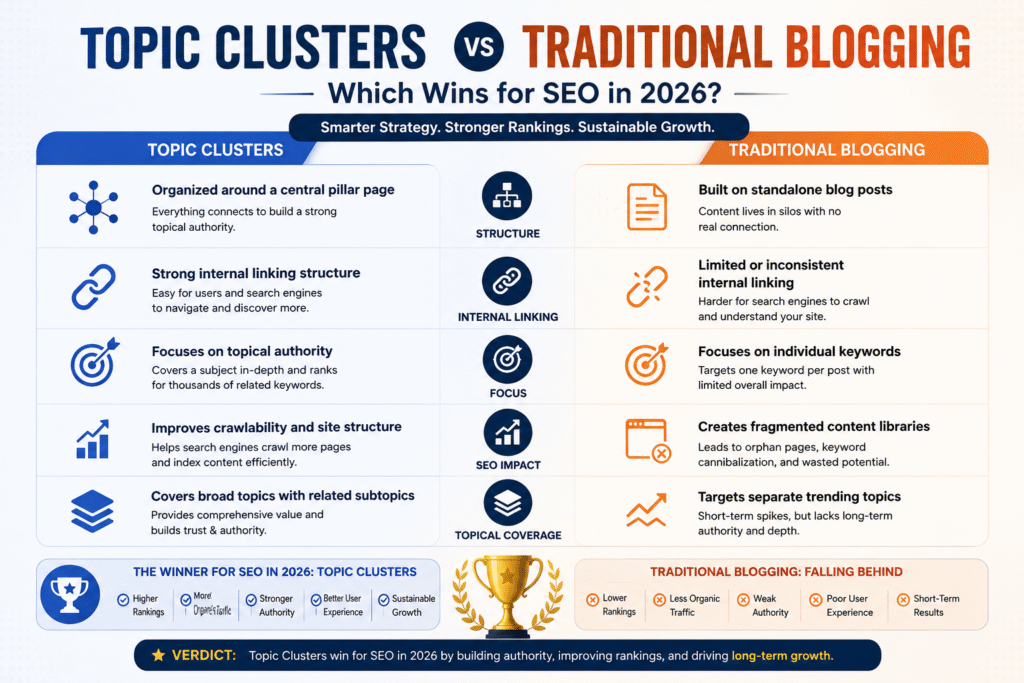
Let’s decode the topic clusters to understand how their integration affects your blogging strategy. It’s basically a strategic “hub-and-spoke” model for your website architecture. Instead of publishing isolated blog posts that compete for attention, this framework organizes content to build undeniable topical authority. Traditional blogging, on the other hand, usually focuses on publishing standalone articles targeting individual keywords or trends. While this method can generate short-term traffic, it frequently creates disconnected content libraries and weak topical authority.
The system relies on two main components:
The Pillar Page: This is your “home base,” a comprehensive, high-level resource that covers a broad core topic in depth.
Cluster Content: These are the “spokes,” specific, detailed articles that dive into subtopics mentioned on the pillar page.
By connecting these pieces through a deliberate internal linking strategy, you create a semantic web that signals to search engines exactly how your content is related. This structure doesn’t just improve the user experience by making information easy to find; it also boosts SEO by distributing “link equity” across the entire cluster. When one page performs well, it lifts the visibility of every other page in the group, proving to search engines that your site is a definitive expert on the subject.
Advantages of Topic Clusters in SEO 2026
Stronger Topical Authority
Topic clusters help websites establish expertise across an entire subject instead of relying on single-page rankings. Search engines now reward domains that comprehensively cover a topic through multiple related pages.
Better Internal Linking Structure
The cluster model creates strategic internal linking between pillar pages and supporting content. This improves crawl efficiency, distributes authority more effectively, and strengthens semantic relationships between pages.
Improved User Experience
Visitors can easily navigate between related topics within a cluster. This encourages longer sessions, lower bounce rates, and deeper engagement across the website.
Higher Visibility in AI Search
AI-driven search systems prefer structured and context-rich content ecosystems. Topic clusters provide clearer contextual signals, making them more likely to appear in AI-generated summaries and search overviews.
Reduced Keyword Cannibalization
Each cluster page targets a specific subtopic while supporting the broader pillar topic. This prevents multiple pages from competing for identical search intent.
Easier Content Scalability
Topic clusters allow businesses to continuously expand content within a structured framework. Every new cluster page strengthens the authority of the entire ecosystem rather than functioning independently.
Why Traditional Blogging Is Losing SEO Value in 2026
Traditional blogging is losing SEO value because modern search engines prioritize topical authority, semantic relevance, and interconnected content over isolated keyword-focused posts. AI-driven search systems now favor structured topic ecosystems that provide deeper contextual coverage, making standalone blogs less effective for long-term rankings, visibility, and organic traffic growth.
Why Topic Clusters Align With Modern Search Algorithms
Search engines in 2026 rely heavily on semantic understanding and topical relevance. Google’s algorithms now analyze how thoroughly a website addresses a subject and whether its content demonstrates contextual expertise. According to HubSpot, topic clusters help search engines map relationships between pages, improving their ability to interpret authority and trustworthiness. This is especially important as AI-generated search experiences continue replacing traditional keyword-based ranking systems. Topic clusters also support E-E-A-T principles by showing expertise through comprehensive coverage. Instead of publishing scattered articles across unrelated topics, websites build concentrated authority in specific subject areas.
Measuring Impact of Clusters vs Standalone Blogs
Measuring the performance of topic clusters requires a different approach than evaluating standalone blog posts. Traditional blogs are usually measured individually through page-level traffic or rankings, while topic clusters are evaluated as a connected content ecosystem.
One of the most important metrics for topic clusters is combined organic traffic growth. Instead of tracking a single article, businesses measure the total traffic generated by the pillar page and all related cluster pages together. This helps identify whether the entire topic ecosystem is building authority over time.
Another key metric is keyword footprint expansion. Topic clusters typically rank for a much wider range of related queries because they cover multiple search intents and semantic relationships. According to Backlinko, strong topic clusters can rank for thousands of related keywords while continuously expanding search visibility.
Conclusion
With AI and semantic search dominating 2026, topic clusters are no longer optional; they’re the key to lasting authority. While traditional blogging misses the mark, structured ecosystems drive sustainable growth. Don’t leave your rankings to chance; Think Shaw delivers expert SEO and content strategies tailored for competitive markets. Ready to build real search authority? Let’s transform your content into a results-oriented powerhouse that actually ranks.
It’s time to enhance your content into a high-authority SEO asset. Visit Think Shaw to transform your website into a high-performance search powerhouse.
FAQs
How long does it take for a topic cluster strategy to show SEO results?
Most websites begin noticing measurable improvements in keyword visibility and organic engagement within 3–6 months. However, competitive industries may require longer timelines depending on content quality, publishing consistency, and domain authority.
Can small businesses benefit from topic clusters?
Yes. Topic clusters are highly effective for small businesses because they help build authority within niche markets. Even smaller websites can compete more effectively by focusing deeply on a specific subject area instead of publishing scattered content.
Do topic clusters only work for large websites?
No. Topic clusters work for businesses of all sizes. A small website can start with one pillar page and a few supporting articles, then expand gradually as the content strategy grows.
How often should pillar pages be updated?
Pillar pages should be reviewed regularly to ensure information remains accurate, relevant, and aligned with search trends. Updating statistics, examples, and internal links helps maintain ranking performance and content freshness.
Are topic clusters useful for e-commerce websites?
Yes. eCommerce brands use topic clusters to organize buying guides, product education, category content, comparison pages, and FAQs. This helps improve search visibility while supporting customer decision-making.
Can existing blog posts be converted into topic clusters?
Absolutely. Older blog posts can be reorganized under relevant pillar pages with improved internal linking and updated content structures to strengthen overall topical relevance.