Artificial intelligence has transformed modern SEO workflows, enabling faster keyword clustering, content generation, SERP analysis, and topical optimization at scale. As businesses increasingly rely on AI for SEO content, maintaining editorial quality and search compliance has become essential for sustainable rankings. However, search engines now evaluate AI-assisted content through advanced quality systems focused on E-E-A-T, semantic relevance, originality, user intent satisfaction, and spam detection. Simply publishing mass-generated AI content without human oversight can trigger ranking declines, indexing issues, or algorithmic devaluation.
The safest and most effective SEO strategy combines AI efficiency with human expertise, editorial review, factual validation, and experience-driven insights. By integrating AI tools into a controlled content workflow, businesses can improve scalability, maintain search compliance, enhance topical authority, and create high-performing content that aligns with modern search engine quality standards.
AI Human SEO OverviewAI-driven SEO enables rapid scaling of keyword research, content creation, and topical structuring, but search engines evaluate quality through E-E-A-T, semantic relevance, intent matching, and originality signals. Risks include thin content, duplication patterns, crawl inefficiencies, and weak engagement metrics. Effective strategies combine retrieval-based validation, entity-centric structuring, intent modeling, fingerprint detection, and behavioral analysis with human editorial oversight to ensure accuracy, topical authority, and stable organic visibility in evolving algorithmic ranking systems. |
The Core Reasons AI-Written Content Fails Google Quality Standards
Lack of Original Information Gain
AI-generated pages frequently fail to introduce statistically unique entities, proprietary datasets, original SERP correlations, or experience-based insights. Without meaningful informational expansion, search algorithms may classify the content as derivative, reducing semantic distinctiveness, crawl prioritization, and competitive ranking potential.
Weak Search Intent Satisfaction
AI-written content often misinterprets query intent signals by over-optimizing for keyword frequency instead of behavioral relevance. This creates mismatches between SERP expectations and page delivery, negatively affecting interaction depth, query refinement patterns, session continuity, and long-click engagement metrics.
Inaccurate or Fabricated Technical Data
Automated content generation models can produce non-existent benchmarks, incorrect schema implementations, outdated API references, or fabricated statistical correlations. These inconsistencies undermine source reliability and increase the likelihood of algorithmic suppression of quality in sensitive niches. Following structured AI content guidelines helps reduce factual inconsistencies and improve overall content reliability in search-sensitive industries.
Repetitive Semantic and Structural Patterns
Large-scale AI publishing often produces duplicated syntactic frameworks, repetitive n-gram distributions, and uniform heading hierarchies across URLs. These detectable content similarities reduce semantic uniqueness and can negatively influence crawl efficiency, index prioritization, and quality assessment systems.
Absence of Real Experience and Expertise Signals
Machine-generated content frequently lacks operational evidence such as implementation workflows, testing environments, performance observations, failure scenarios, or process-level insights. Without experiential validation, content may appear theoretically accurate yet algorithmically weak in expertise-driven ranking evaluations. The relationship between EEAT and AI has become increasingly important as search engines evaluate expertise, credibility, and real-world validation within automated content workflows.
SEO Penalty Risks Associated With Thin and Repetitive AI Content
Scaled Content Abuse Detection
Search algorithms analyze publishing velocity, semantic redundancy, template repetition, and URL expansion behavior to detect scaled-content abuse. Abnormal automation patterns can trigger algorithmic trust degradation, reducing organic visibility across entire content clusters and domain sections.
Near-Duplicate Content Clustering
Near-duplicate AI pages often share overlapping entity vectors, semantic embeddings, and contextual structures, causing search engines to cluster URLs into equivalent-intent groups. This consolidation weakens ranking differentiation, fragments the distribution of authority, and reduces opportunities for independent indexing across competing search queries.
Low Content Utility Scoring
Pages with weak analytical depth, limited contextual enrichment, and minimal actionable insights often receive lower utility evaluations from ranking systems. Insufficient relevance in problem-solving can reduce consistency in engagement, query-satisfaction alignment, and long-term organic ranking stability across competitive search environments.
Internal Linking Signal Dilution
Excessive interlinking among repetitive AI-generated pages can disperse PageRank across low-value URLs, weakening the concentration of topical authority. This fragmentation reduces the efficiency of internal relevance signaling and limits the reinforcement of rankings for strategically important conversion-focused or pillar content pages.
Low-Confidence Content and SERP Instability
Search engines may assign reduced confidence scores to AI-generated pages lacking strong engagement consistency, contextual uniqueness, and authority validation. These low-trust signals can cause fluctuating rankings, unstable SERP positioning, temporary deindexation patterns, and inconsistent query-level visibility across algorithm refresh cycles.
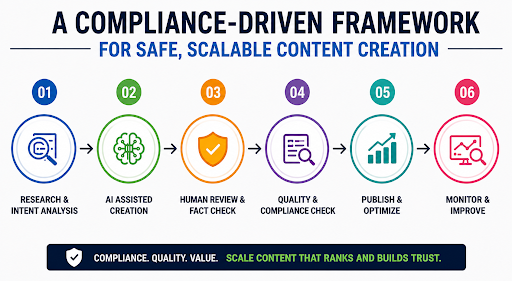
A Compliance-Driven Framework for Safe, Scalable Content Creation
A compliance-driven content framework integrates AI-assisted generation, human editorial validation, semantic optimization, E-E-A-T alignment, and risk controls to ensure efficient, scalable, policy-compliant, search-safe, high-quality content production across SEO ecosystems.
Proven Methods for Using AI in SEO Without Triggering Penalties
Retrieval-Based AI Content Verification
Retrieval-based AI content verification uses semantic search pipelines, vector databases, and embedding similarity models to validate generated outputs against authoritative indexed sources before publication. Implementing frameworks for safe AI content usage allows businesses to scale SEO production while maintaining originality, factual accuracy, and algorithmic trust. This framework improves factual grounding, strengthens entity consistency, minimizes unsupported assertions, and enhances contextual reliability across large-scale SEO content operations targeting competitive search ecosystems.
Semantic Intent Optimization Before Content Creation
Semantic intent optimization analyzes query modifiers, entity associations, click-pattern behavior, and SERP feature distributions before AI content generation begins. This process enables precise topical targeting, improves contextual alignment with user expectations, strengthens semantic relevance scoring, and reduces mismatches between generated content structures and algorithmically interpreted search intent categories.
Entity-Centric AI Content Structuring
Entity-centric AI content structuring organizes content around semantically connected entities, topical nodes, and contextual relationships instead of isolated keywords. Using NLP entity extraction, co-occurrence modeling, and knowledge graph alignment improves topical comprehensiveness, strengthens semantic relevance signals, and enhances search engine interpretation of subject authority across competitive content ecosystems.
Scalable Content Fingerprint Validation Systems
Scalable content fingerprint validation systems use embedding comparisons, cosine similarity scoring, syntactic pattern analysis, and semantic hash detection to identify overlapping AI-generated structures before indexing. These frameworks help maintain large-scale content uniqueness, prevent semantic duplication conflicts, and protect domain-level quality consistency across automated publishing environments.
Post-Index User Behavior Signal Monitoring
Post-index user behavior signal monitoring evaluates engagement metrics such as dwell-time distribution, rapid SERP returns, interaction depth, session continuity, and query reformulation frequency after indexing. Analyzing these behavioral indicators helps identify weak AI-generated pages, optimize contextual relevance, and maintain stable ranking performance across evolving algorithmic quality evaluation systems.
Conclusion
AI-powered SEO is no longer about automated content production alone; it now requires precision-driven optimization, semantic intelligence, and strategic quality control to achieve sustainable organic growth. Modern AI copywriting SEO strategies require a balance of automation efficiency, human editorial oversight, and semantic optimization to achieve long-term organic performance.
At Think Shaw, we specialize in creating AI-assisted SEO strategies that prioritize search compliance, topical authority, and long-term ranking stability. Our approach combines technical SEO expertise, intelligent content engineering, and performance-focused optimization to help brands safely and competitively scale organic visibility in evolving search environments.
Transform your SEO with AI-powered strategies from Think Shaw for scalable, safe, high-ranking growth! Contact Us today!
FAQ’s
How can I ensure AI content passes quality evaluation?
Ensure AI content passes quality evaluation by applying editorial human review, semantic relevance checks, entity-level validation, factual verification against trusted sources, and structural SEO auditing for intent alignment, uniqueness, and contextual depth before publishing.
Can AI content be safely scaled for large websites?
Yes, AI content can be scaled safely using controlled generation pipelines, strict similarity thresholds, human editorial oversight, entity-based structuring, and continuous SEO audits to prevent duplication, indexing issues, and ranking dilution.
How can AI content be optimized for search intent accuracy?
AI content improves search intent accuracy through query classification models, SERP feature analysis, entity mapping, and contextual embedding alignment, ensuring outputs match informational, transactional, or navigational intent structures precisely and consistently.
Does publishing AI content affect crawl prioritization?
Yes, publishing large volumes of low-value AI pages can affect crawl prioritization by consuming crawl budget inefficiently, reducing bot frequency for priority URLs, and delaying discovery of high-authority or conversion-focused pages.
What role do entities play in AI SEO optimization?
Entities improve AI SEO by strengthening knowledge graph connections, enhancing semantic indexing, and clarifying topical relationships between brands, concepts, and attributes, enabling search engines to interpret context, authority, and relevance more accurately.