High-performing landing pages rely on structured persuasion architecture that aligns messaging, user intent, and behavioral triggers to maximize conversion rates. A strong landing page copy framework integrates psychological models such as AIDA, PAS, and BAB with a UX hierarchy, ensuring above-the-fold clarity, scannability, and frictionless call-to-action pathways. It also leverages value proposition framing, CTA optimization, and microcopy refinement based on heatmap analysis, scroll depth data, and A/B testing iterations.
When applied correctly, these systems transform static content into data-driven conversion engines that align user-intent signals with persuasive copy structures at every stage of the funnel, improving acquisition efficiency and reducing bounce rates through continuous optimization loops and iterative CRO testing cycles.
Conversion Copy Frameworks OverviewLanding page success depends on structured copy frameworks that align user intent, UX hierarchy, and psychological triggers to drive conversions. Models like AIDA, PAS, BAB, FAB, and 4P guide attention, emotion, value perception, and action. Combined with intent mapping, trust signals, CTA optimization, and cognitive load reduction, they create frictionless user journeys. Strategic landing page structure and message-match continuity ensure clarity, relevance, and improved conversion performance across every stage of the funnel. |
What Landing Page Copy Means and Why It Matters?
Landing page copy is the intentionally engineered text layer of a high-converting landing page, designed to influence decision-making under conditions of constrained attention and high intent. It serves as a behavioral interface between traffic sources and conversion goals, translating user-intent signals into structured persuasion pathways.
From a technical CRO standpoint, it is built on message-match continuity, ensuring semantic consistency between keyword/ad group intent and on-page framing to minimize pogo-sticking and bounce probability. It also uses cognitive load reduction principles by prioritizing progressive disclosure, in which information is sequenced from the high-level value proposition to granular proof elements.
Key components include semantic framing (problem–solution alignment), outcome quantification (specific metrics and ROI indicators), and trust scaffolding (risk reversal, guarantees, and social validation). Microcopy near interactive elements further reduces interaction anxiety and increases the probability of form completion by clarifying the consequences of actions in real time.
Proven Copywriting Frameworks That Turn Visitors into Customers
Attention-to-Action Copy Sequencing Using the AIDA Model
The AIDA model structures copy into sequential cognitive stages that guide user processing from stimulus capture to decision execution. It optimizes attention allocation, maintains relevance through interest mapping, intensifies motivational desire via outcome projection, and finalizes conversion through reduced-friction action triggers.
Emotional Conversion Architecture Using the PAS Model
The PAS model structures persuasive copy by first isolating a user-relevant problem, then intensifying perceived urgency by escalating consequences, and finally positioning the offer as the corrective mechanism. This sequence leverages emotional arousal, loss aversion bias, and resolution-driven decision closure.
Before–After–Bridge Copywriting System for Value Transformation
BAB copywriting system maps user cognition from the current state to the desired outcome by constructing contrast-driven mental simulation. It first defines existing constraints, then visualizes improved post-conversion conditions, and finally connects the two through a mechanism-based narrative that reduces skepticism and accelerates intent.
Using FAB to Decode Product Attributes into User-Centric Gains
The FAB framework translates product-level attributes into user-perceived value by converting technical specifications into contextual advantages and then into outcome-based benefits. This hierarchical mapping reduces interpretive friction, strengthens relevance alignment, and improves decision confidence by linking functional capability directly to user success metrics.
Promise–Picture–Proof–Push Model for Conversion Acceleration
The 4P model structures persuasive messaging by establishing a clear value promise, reinforcing it through outcome visualization, validating claims via empirical or social proof, and triggering action with urgency-based prompts. This sequence reduces uncertainty, enhances credibility perception, and increases conversion readiness through sequential trust reinforcement.
These copywriting formulas work best when combined with UX hierarchy and behavioral triggers to ensure messaging flows naturally, reduces cognitive friction, and guides users toward conversion with clarity and intent alignment.
How to Write High-Converting Landing Page Copy Step by Step?
Intent Mapping and Audience Signal Deconstruction
Intent mapping and audience signal deconstruction involve analyzing traffic sources to extract behavioral intent, semantic keywords, and urgency indicators. It classifies users by awareness stage and motivation depth, then aligns messaging to cognitive readiness. This reduces message mismatch, improves relevance scoring, and enhances conversion probability through precise contextual targeting and friction-aware copy alignment.
Value Proposition Engineering and Positioning Hierarchy
Value proposition engineering defines a structured differentiation statement that quantifies unique outcome advantages relative to competing solutions. It combines benefit prioritization, outcome specificity, and positioning hierarchy to establish perceived superiority. This enhances cognitive clarity, strengthens relevance mapping, and improves the likelihood of conversion by reducing ambiguity in the interpretation of value during decision-making and evaluation stages.
Conversion Architecture and Information Sequencing
Conversion architecture and landing page structure refer to the arrangement of landing page elements in a progressive disclosure system that guides users from awareness to action. It organizes content by cognitive load priority, starting with high-salience messaging, followed by supporting rationale, proof elements, and decision prompts. This reduces overload, improves comprehension flow, and increases conversion efficiency.
Trust Signal Integration and Risk Reduction Layering
Trust signal integration and risk-reduction layering involve embedding credibility mechanisms, such as quantified performance data, third-party validation, and outcome-verification signals, across the conversion path. It strategically distributes assurance cues at decision-friction points to reduce perceived uncertainty, increase epistemic trust, and reinforce purchase confidence in high-cognitive-load scenarios.
CTA Optimization and Behavioral Trigger Engineering
CTA optimization and behavioral trigger engineering involve designing conversion prompts that align with user intent and decision readiness. It uses directive language, outcome-specific phrasing, and microcopy to reduce hesitation. Urgency signals, scarcity framing, and loss-aversion cues increase the likelihood of action. Friction reduction ensures minimal cognitive effort, improving completion rates and conversion efficiency.
Cognitive Load Optimization and Readability Engineering
Landing page structure reduces mental effort by structuring content into clear hierarchical chunks and prioritizing high-salience information. It uses scanning-friendly layouts, visual hierarchy cues, and progressive disclosure to guide the flow of attention. This improves comprehension speed, reduces decision fatigue, and increases user engagement efficiency across the conversion journey.
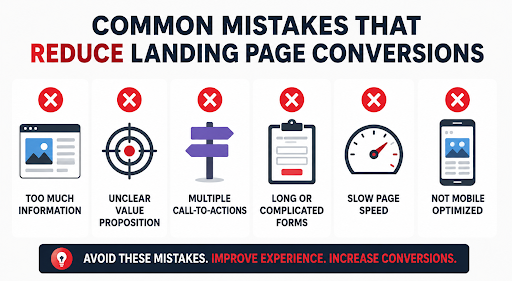
Common Mistakes That Reduce Landing Page Conversions
Landing page conversion drops often result from structural UX flaws, messaging misalignment, cognitive overload, and friction-heavy interaction design patterns that disrupt user flow and reduce intent-to-action conversion efficiency across the page.
Conclusion
High-converting landing pages rely on intent alignment, clear messaging flow, and friction-free structure. When copy is strategically sequenced with behavioral logic and hierarchy, it turns passive visitors into measurable conversions and scalable business outcomes instead of simple page traffic.
At Think Shaw, we apply these principles in our work to build digital agency landing page that are strategically designed to capture attention, build trust, and drive action. We combine conversion psychology, data-driven testing, and CRO systems to ensure every element of the page contributes to measurable growth.
Want landing pages that consistently convert visitors into leads and customers? Contact us at Think Shaw today and scale faster!
FAQ’s
What makes landing page copy different from general website content?
Landing page copy is conversion-specific, designed around a single behavioral objective. It removes navigational noise, aligns tightly with traffic intent, and uses structured persuasion architecture to guide users toward one defined action instead of multiple exploratory paths.
Why is information hierarchy important in landing page design?
Information hierarchy ensures content is processed in an optimized sequence based on attention priority. It organizes elements from high-impact value statements to supporting details, improving readability flow, reducing cognitive overload, and increasing the probability of conversion-focused interaction.
What role does behavioral triggering play in CTA effectiveness?
Behavioral triggers activate decision momentum using urgency cues, loss aversion framing, and action-oriented language. When combined with reduced friction design and microcopy clarity, they significantly improve click-through and completion rates at the conversion point.
How do trust signals influence conversion rates?
Trust signals such as quantified outcomes, third-party validation, and risk-reversal elements reduce perceived uncertainty. They function as credibility accelerators, lowering psychological resistance and increasing decision confidence during high-intent user evaluation stages.
How does microcopy influence user interaction behavior on landing pages?
Microcopy provides contextual guidance near interactive elements such as forms and CTAs. It reduces uncertainty by clarifying outcomes, setting expectations, and pre-emptively addressing hesitation points, thereby improving interaction completion rates and reducing abandonment.