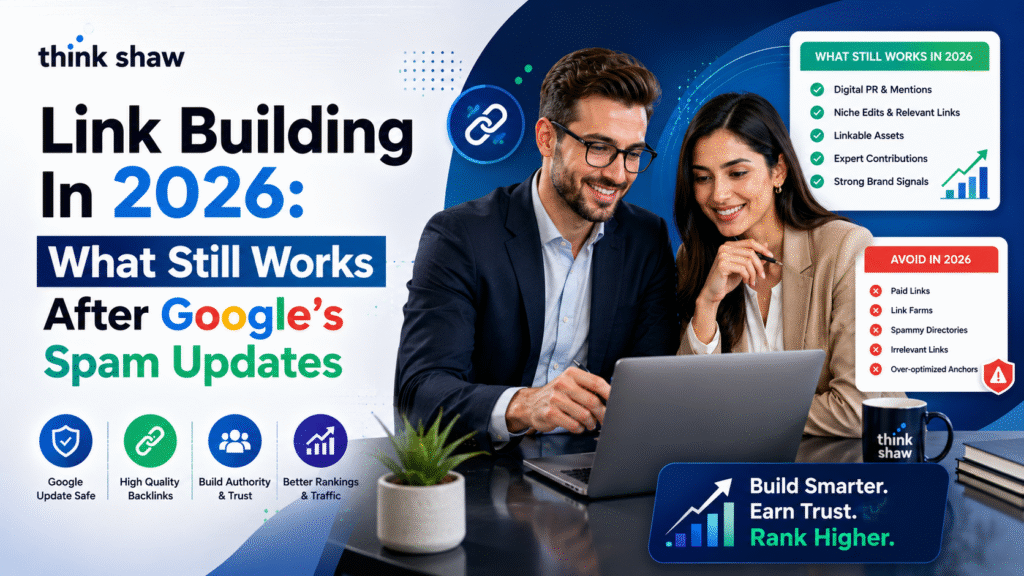
Google’s spam updates have changed link building from a volume game into a credibility test, making relevance, editorial judgment, and trust far more important than sheer backlink count. In 2026, brands that still earn strong organic visibility are focusing on white-hat tactics such as digital PR, original research, expert contributions, resource outreach, and relationship-led placements instead of cheap, manipulative links. That shift also aligns with Google’s E-E-A-T principles for both content and the signals surrounding it.
This blog explores what still works, what now carries risk, and how to build backlinks that strengthen rankings, brand authority, and long-term search resilience after repeated spam-focused updates for link building in 2026.
Link Building In 2026: SummaryLink building in 2026 is driven by credibility, relevance, and editorial trust rather than backlink volume. Google’s spam policies continue to penalize manipulative link schemes, while newer enforcement measures, including action against back button hijacking, show a broader push toward search quality and user safety. Results now come from digital PR, original research, expert contributions, resource outreach, broken link building, and relationship-led strategies that earn authoritative, contextually relevant backlinks and support long-term organic growth. |
Google’s Link Spam Updates 2026
Google defines link spam as links created to manipulate search rankings, whether they point to a site or come from it. In practical terms, this includes
- Buying or selling ranking-passing links
- Excessive link exchanges
- Large-scale article marketing or guest posting with keyword-rich anchor text
- Automated link creation
- Low-quality directory or bookmark links
- Widely distributed footer or template links designed mainly for SEO gain.
What does it mean?
For 2026, the most accurate way to discuss Google’s “link spam updates” is through its spam policies. Google’s public guidance makes clear that manipulative backlink schemes remain a violation, and its spam systems can neutralize those links even without announcing a dedicated link spam update. Sites with original content, stronger editorial standards, clear authorship, and trustworthy link-building practices will continue to be better positioned to remain stable.
This year, Google widened its spam enforcement by introducing a specific policy against back button hijacking, a deceptive tactic that interferes with a user’s browser behavior after they try to leave a page. Google says this breaks a basic user expectation and creates a deceptive, frustrating experience, which is why it has now made the practice an explicit violation under its malicious practices spam policy.
Google spam update links strategies are targeting it because the behavior manipulates users, damages trust in search results, and can even come from third-party scripts or ad tech that publishers allow on their pages. In April 2026, Google announced the policy and gave site owners until June 15, 2026, to fix the issue before enforcement, with penalties that can include manual spam actions or automated ranking demotions.
Why Google’s spam updates changed link building, not its importance?
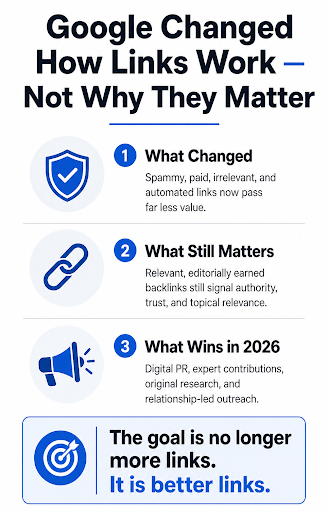
Google’s spam updates did not reduce the value of links; they reduced the value of manipulative ones. In 2026, white hat link building still matters, but success now depends on earning relevant, trustworthy, editorial backlinks through digital PR, expert content, relationships, and genuinely useful assets rather than bulk, low-quality acquisition. This infographic explains it better!
Link-building tactics that still work in 2026
Here are some effective tactics that still work for link building in 2026:
Turn Newsworthy Ideas Into Links
Digital PR for SEO is the process of earning backlinks by pitching stories, data, commentary, or insights to journalists and publishers. To do it well, create something timely or original, such as survey findings, expert reactions, or trend-based insights, then pitch it to relevant media outlets with a clear angle and supporting evidence. This works because editorial links are harder to fake and usually come from trusted websites, which makes them more valuable for authority and visibility.
Publish Data Others Want to Cite
Original research still earns links by giving other writers unique information they can reference in articles, reports, and roundups. This can include surveys, benchmark reports, industry studies, or statistics pages built from first-party or well-organized proprietary data. The best approach is to publish findings in a clear, skimmable format with charts, takeaways, and quotable stats so other sites can cite them easily.
Become a Source for Industry Coverage
Expert contribution link building in 2026 means providing quotes, opinions, or analysis to journalists, bloggers, and industry publishers who need credible input. You can do this by monitoring journalist request platforms, responding quickly with concise expert commentary, or proactively building relationships with writers in your niche. It works best when the insight is specific, practical, and backed by real experience rather than generic opinion.
Earn Placement on Curated Pages
Resource page outreach involves getting your content included on pages that list useful tools, guides, services, or references on a specific topic. To do this, find resource pages that closely match your niche, review what they already link to, and suggest your content only if it clearly adds value. This strategy works when your asset is genuinely helpful and fits the page’s purpose better than a self-promotional blog post would.
Replace Dead Links With Better Content
Broken link building is the practice of finding outdated or non-working links on relevant websites and offering your content as a replacement. The process usually starts by identifying broken pages in your niche, checking what the original content covered, and then creating or matching a live resource that serves the same intent. Outreach is more effective when you lead by helping the site owner fix a problem rather than by pushing for a link.
Contribute to Relevant Publications
Guest posting still works when the goal is thought leadership, not link insertion at scale. The right way to do it is to target reputable websites in your industry, pitch topics that suit their audience, and contribute useful, non-promotional content that demonstrates expertise. A guest post is worth pursuing only when the publication has real editorial standards and a real audience.
Reclaim Mentions You Already Earned
Unlinked mention reclamation is a simple strategy where you find pages that mention your brand, product, founder, or research but do not include a backlink. From there, reach out politely, thank the publisher for the mention, and request a link to the most relevant page so readers can find the original source. This tends to convert well because the site has already acknowledged your brand.
Build Assets Worth Referencing
Linkable assets are pages people naturally want to reference, such as calculators, templates, checklists, glossaries, tools, visual explainers, and in-depth guides. To make this strategy work, focus on utility first: create something that saves time, explains a complex topic clearly, or gives users a resource they can apply immediately. The more useful and easy to cite the asset is, the more likely it is to attract links over time.
Use Relationships, Not Mass Outreach
Relationship-led link building focuses on earning links through genuine professional connections rather than sending large volumes of cold emails. This can come from partnerships, podcast appearances, industry communities, webinars, associations, supplier networks, or co-created content with complementary brands. The advantage is that these links are usually more natural, contextually relevant, and harder for competitors to replicate.
Study Competitors for Real Opportunities
Backlink strategy in 2026 includes gap analysis. It is the process of reviewing where competitors are getting links and identifying which of those sources are realistic targets for your own site. Start by looking for patterns, such as niche directories, trade publications, expert roundups, local citations, association pages, or resource hubs that repeatedly link to similar businesses. Then prioritize the opportunities where your brand has a genuine reason to be included, rather than trying to copy every link blindly.
Conclusion
In 2026, effective link building comes down to consistency, judgment, and a clear focus on long-term brand visibility. Businesses that invest in credible outreach, useful content, and sustainable authority signals will be better prepared for future algorithm shifts and stronger organic growth.
If you need expert support, Think Shaw offers strategic SEO services, content-led link acquisition, technical audits, and authority-building campaigns tailored to modern search. Our team helps brands build cleaner, safer, and more competitive SEO foundations through customized strategies designed for lasting performance, visibility, and measurable business impact. Reach out to us today!
FAQs on Link Building
What should I outsource in a link-building campaign?
Research, prospecting, outreach support, digital PR pitching, and reporting are often suitable for outsourcing, while brand messaging, approvals, and final quality checks should stay internal.
Are nofollow links useless for SEO?
No. Nofollow links may still support visibility, referral traffic, brand discovery, and natural link profile diversity, even if they usually pass less direct ranking value.
Do homepage backlinks matter more than deep-page links?
Not always. Deep-page links often help more when they point to relevant commercial or informational pages that better match search intent and topic relevance.
Should every backlink use a keyword-rich anchor text?
No. Over-optimized anchor text can look unnatural. A healthier profile usually includes branded, generic, topical, and natural phrase variations.
How often should a backlink profile be audited?
A backlink profile should usually be reviewed quarterly, or more often during active campaigns, traffic drops, manual actions, or major algorithm volatility.
Can AI-generated content earn backlinks?
Yes, but only when it is genuinely useful, accurate, original, and well-edited. People link to value, not simply to content produced quickly.
How can I measure link-building success beyond rankings?
Track referring domains, referral traffic, brand mentions, assisted conversions, keyword growth, and the quality of links earned, not just ranking movement alone.