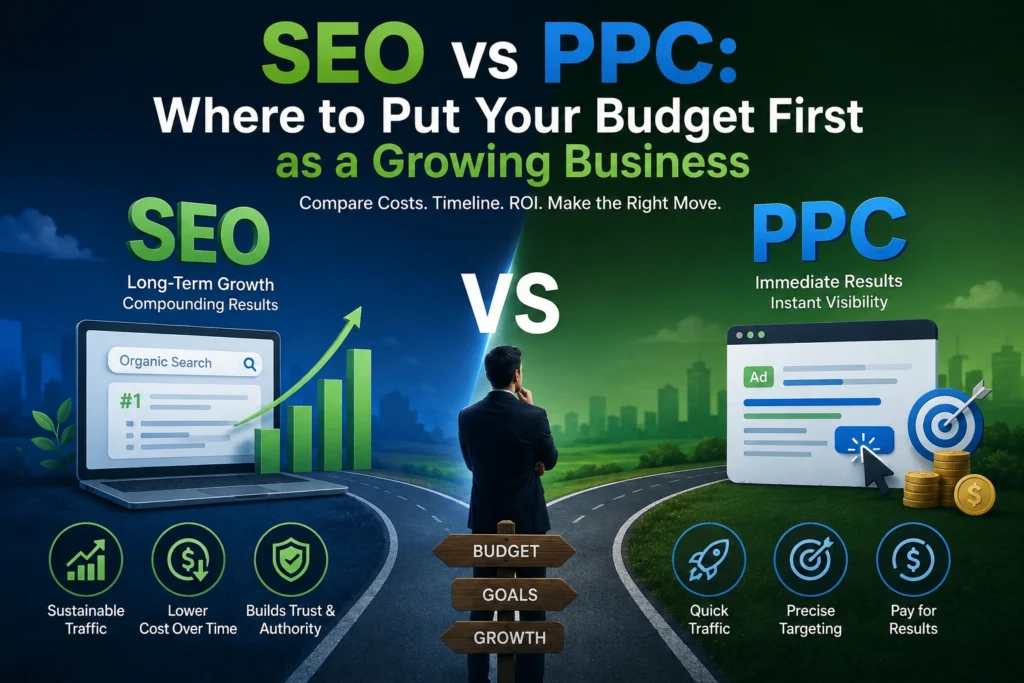
Every growing business eventually faces the same budget standoff: chase immediate leads through paid ads, or invest in organic visibility that compounds for years. The stakes are real. As per Resourcera, small and mid-sized businesses collectively pour nearly seven times more into PPC than into SEO, even though organic search converts at nearly double the rate of paid clicks and produces leads at a fraction of the cost per acquisition.
Yet neither channel is universally better; the right first move depends on your runway, industry, and how fast revenue needs to arrive. Before splitting a limited budget between the two, it helps to understand how PPC vs SEO for small business and larger ones generate returns differently, and why sequencing them correctly can shape growth for years. Let’s discuss this through our blog here!
Quick Recap: Budget Allocation EssentialsSEO builds compounding organic visibility with falling cost-per-acquisition over time, while PPC delivers instant traffic and granular targeting control but stops the moment spend pauses. SEO typically costs $500–$5,000 monthly with 3–6 months to results and ROI up to 1,300%, versus PPC’s 24–72 hour turnaround and roughly 200% ROI. A hybrid approach works best: 70–80% PPC early on, shifting to 50/50 during growth, then 60–70% SEO once organic momentum and lead volume stabilize. |
SEO vs PPC — How Each One Actually Grows Your Business
PPC vs SEO for small business and larger ones don’t just differ in cost; they generate growth through fundamentally different mechanics: one builds a compounding asset, the other buys immediate access to demand. Understanding that mechanical difference, not just the price tag, is what determines which channel should get your first dollar.
What SEO Does?
SEO grows a business by earning unpaid placement in organic search results through content relevance, technical site health, and authority signals, rather than paying for each visit. This matters because organic listings still capture the overwhelming majority of clicks: as per Rankpedia, the #1 organic result averages a 37–40% click-through rate, compared to roughly 2–3% for the top paid ad position. Organic search also remains the largest single traffic source for most websites, driving around 53% of all trackable website traffic, versus roughly 15% from paid search. The growth mechanism here is compounding. A page that ranks well continues generating visits without additional spend per click, so cost-per-acquisition actually falls over time as rankings mature.
What PPC Does?
PPC grows a business by purchasing guaranteed placement at the top of search results the moment a campaign goes live, making it the only channel that delivers traffic and leads on day one rather than after months of ranking work. This immediacy is the entire value proposition: a business can test a new offer, launch a product, or fill a seasonal gap in demand without waiting for algorithmic trust to build. PPC also gives granular control that SEO can’t match; advertisers can target by keyword, geography, device, and time of day, and adjust or pause spend instantly based on performance data.
Cost, Timeline, and ROI: SEO vs PPC
Once you understand how SEO and PPC each drive growth mechanically, the next question is purely practical: what will each one cost you, how long before you see something back, and what return can you realistically expect. These three variables, cost, timeline, and ROI, are where the two channels diverge most sharply, and where most budget decisions actually get made. The table below lays out current benchmark ranges for SEO vs PPC channels side by side:
| Factor | SEO | PPC |
| Typical monthly cost (small business) | $500–$5,000 retainer, plus $3,000–$10,000 initial setup for audits, technical fixes, and content. | $1,000–$5,000 management fee plus ad spend, which scales directly with clicks and competition. |
| Cost-per-click / cost-per-lead range | Cost per lead typically falls over time; local SEO leads average $20–$40 | CPC ranges from $2–$5 for low-competition terms to $50–$100+ for competitive industries like legal, insurance, or finance; average cost-per-lead $55–$110 |
| Time to first measurable result | 3–6 months for initial ranking movement; competitive industries can take 6–12 months. | 24–72 hours for first clicks and leads; optimized performance within 30–60 days |
| Reported average ROI | Cited in the 500%–1,300% range across studies on UpGrowth | Cited around 200% depending on the study and industry data in Rankpedia |
A Practical Hybrid Budget Allocation Framework
Most growing businesses don’t actually need to choose between SEO or PPC for small business or bigger ones; they need a sequencing plan that shifts the ratio as organic visibility builds. The framework below reflects how multiple marketing agencies and B2B research groups approach this allocation problem in practice.
Start With Your Minimum Viable Lead Volume, Not a Fixed Percentage
Before picking a split, calculate how many leads or enquiries your business needs each month to hit revenue targets and support current team capacity. Estimate what it would cost to generate that volume through PPC alone using your industry’s average cost-per-lead; whatever remains in your total budget after covering that minimum becomes your SEO allocation. This “PPC covers the floor, SEO builds the ceiling” approach ensures lead flow never stalls while organic growth compounds in the background, and it avoids the common mistake of picking an arbitrary 50/50 split before understanding actual demand costs.
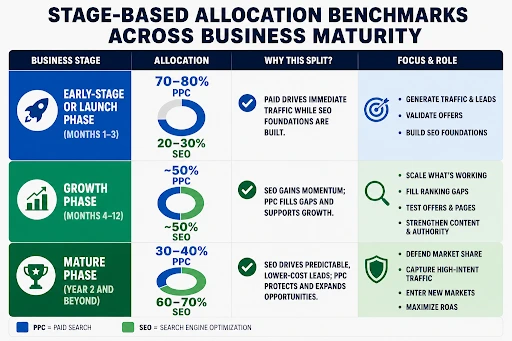
Stage-Based Allocation Benchmarks
Across the agency frameworks reviewed, a consistent pattern emerges by business maturity:
- Early-stage or launch phase (months 1–3): 70–80% PPC, 20–30% SEO. New businesses have no ranking history, so paid search is the only channel that can generate traffic immediately while SEO foundations (technical setup, core content, initial authority-building) are laid down.minnetonkadigital+1
- Growth phase (months 4–12): roughly 50/50. As early SEO investment starts producing organic rankings, PPC spend can shift from pure demand-generation toward filling specific gaps — competitive keyword protection, testing new offers, or covering terms where organic hasn’t ranked yet.minnetonkadigital+1
- Mature phase (year 2 and beyond): 60–70% SEO, 30–40% PPC. Once organic channels are established and producing predictable, lower-cost leads, PPC’s role narrows to defending market share, entering new markets quickly, and capturing bottom-funnel transactional intent that still converts well on paid.
Revenue and Overall Marketing Budget Anchors
For businesses trying to size the total search budget before splitting it, a reasonable starting anchor is allocating 7–15% of annual revenue to marketing overall, with 45–70% of that going to digital channels, and 20–30% of the digital budget specifically to search marketing (SEO plus PPC combined). From that combined search budget, the stage-based ratios above determine the SEO/PPC split.
When to Rebalance
Budget allocation shouldn’t be static. Three triggers signal it’s time to shift the ratio of SEO vs Google Ads:
- Organic leads begin arriving in meaningful volume, typically starting around month 4–6 of sustained SEO investment; savings from reduced PPC dependency should be reinvested into SEO to accelerate the compounding effect rather than pocketed or redirected elsewhere.
- A 12-month review of analytics shows one channel consistently outperforming the other on cost-per-conversion, in which case budget should shift proportionally toward the higher-ROI channel while preserving a smaller test allocation in the other
- Competitive or market conditions change, such as a new competitor bidding aggressively on your core keywords or a shift into a new, unranked market, both of which justify temporarily increasing PPC even for otherwise SEO-mature businesses.
Conclusion
There’s no universal winner between PPC vs SEO for small business and larger ones, only the right sequence for your growth stage, runway, and industry. The smartest businesses don’t pick one; they build a hybrid framework that shifts deliberately from paid demand capture toward compounding organic growth. Getting that allocation wrong wastes budget you can’t easily recover as a growing business. This is precisely the gap Think Shaw closes for growth-stage companies. As a certified white hat SEO agency, we combine organic strategy, paid media, and Shopify/web development under one roof , so your SEO and PPC budgets work as a single system instead of competing line items.
| Stop splitting your budget by guesswork, let Think Shaw build your growth roadmap. |
SEO vs PPC FAQs
Can a small business run SEO and PPC at the same time?
Yes. Running both simultaneously can lift overall conversions since paid ads reinforce brand recall while organic listings build long-term trust and credibility.
Is PPC worth it for a business with no ad-blocker-heavy audience?
Yes, PPC remains effective for most audiences, though ad-blocker usage and banner blindness in advisory or B2B categories can reduce paid ad trust and click-through rates.
Which industries should prioritize SEO over PPC almost immediately?
High-CPC verticals like legal, insurance, and finance, where PPC costs often exceed $40–$100 per click, making SEO’s long-term economics more favorable despite the slower ramp-up.
Can PPC campaigns target specific locations or devices?
Yes, PPC allows granular targeting by geography, device type, time of day, and demographics, offering control that organic SEO rankings cannot replicate.
Does PPC ranking help SEO rankings, or vice versa?
No direct ranking effect exists between them, but strong SEO content improves PPC Quality Score, lowering cost-per-click, since landing page relevance factors into both algorithms.