In June 2026, Meta launched its Small Business Growth Academy across 12 Asia-Pacific markets, highlighting advertising, Reels, AI tools, and lead generation as key areas for business growth. But what actually happens when a business runs an ad? We know that Meta’s advertising system connects campaign settings, audience signals, ad placements, and its delivery technology to decide when and where an advertisement appears. But there’s more to it that you need to confer before running any ad on Facebook and Instagram platforms.
Well, to help in this endeavour, this guide elaborates on the process from campaign setup and audience targeting through ad delivery, customer interaction, and lead capture so you can understand exactly how Facebook and Instagram ads work for small businesses.
Small Business Meta Ads: Key InsightsFacebook and Instagram ads help small businesses reach potential customers through Meta’s advertising system, using campaign objectives, ad auctions, audience signals, placements, and creative. Leads can come through instant forms, websites, messages, or calls. Relevant advertising, suitable conversion paths, strong creative, and varied formats can help small businesses attract genuine enquiries and make better use of paid social campaigns. |
How Does the Meta Advertising Platform Work?
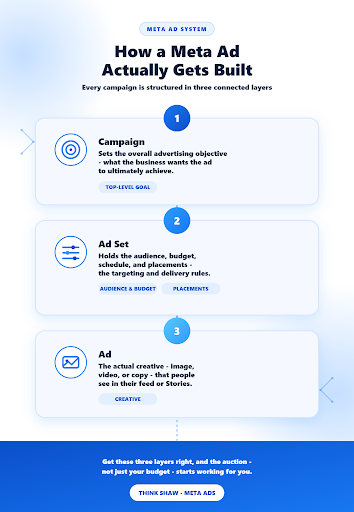
An advertisement does not necessarily begin appearing as soon as it is submitted. Meta organizes advertising into three levels: campaign, ad set, and ad. The campaign establishes the overall advertising objective; the ad set contains settings such as audience, budget, schedule, and placements; and the ad is the actual content people see.
How Meta Decides Which Ads to Show
When an advertising opportunity becomes available, Meta does not simply display every eligible advertisement. Ads compete through an auction, where Meta considers factors including the advertiser’s bid, the estimated likelihood that the person will take the desired action, and the quality of the ad. This means the ad with the highest monetary bid does not automatically win every impression.
How Meta Reviews Ads Before They Run
An advertisement does not necessarily begin appearing as soon as it is submitted. Meta reviews ads against its Advertising Standards before delivery. Ads can be placed into an In Review status while this process takes place, and an ad that does not meet Meta’s requirements may be rejected.
| A rejected ad can delay your campaign and waste valuable time. Think Shaw can help you create Meta ads that align with platform requirements while keeping your message clear and customer-focused. |
How Meta Decides Where an Ad Can Appear
Meta calls the locations where advertisements appear placements. Depending on the objective, ad type, and settings, placements can include Facebook, Instagram, Messenger, WhatsApp, Threads, and the Meta Audience Network. Not every placement is available for every advertisement.
Advertisers can sometimes choose placements manually, while Meta also offers automated placement options that allow its delivery system to distribute ads across eligible placements based on available opportunities.
How Meta Measures What Happens After an Ad
The platform also needs information about what happens after someone interacts with an advertisement. For website-based campaigns, tools such as the Meta Pixel and Conversions API can send relevant event information back to Meta, helping businesses measure actions. Meta describes Conversions API as a way to create a more direct connection between marketing data and Meta’s technologies.
How Does a Facebook or Instagram Ad Turn Into a Lead for a Small Business?
In its January 2026 update, Meta reported that improvements to its ad models produced a 3.5% increase in Facebook ad clicks and more than a 1% increase in Instagram conversions in Q4 2025. It also reported a 3% increase in conversion rates after introducing a new model across Instagram Feed, Stories, and Reels.
For small businesses, this means ad performance is increasingly influenced by automated systems that can learn from campaign and user-response data.
The Customer Can Choose Different Paths to Become a Lead
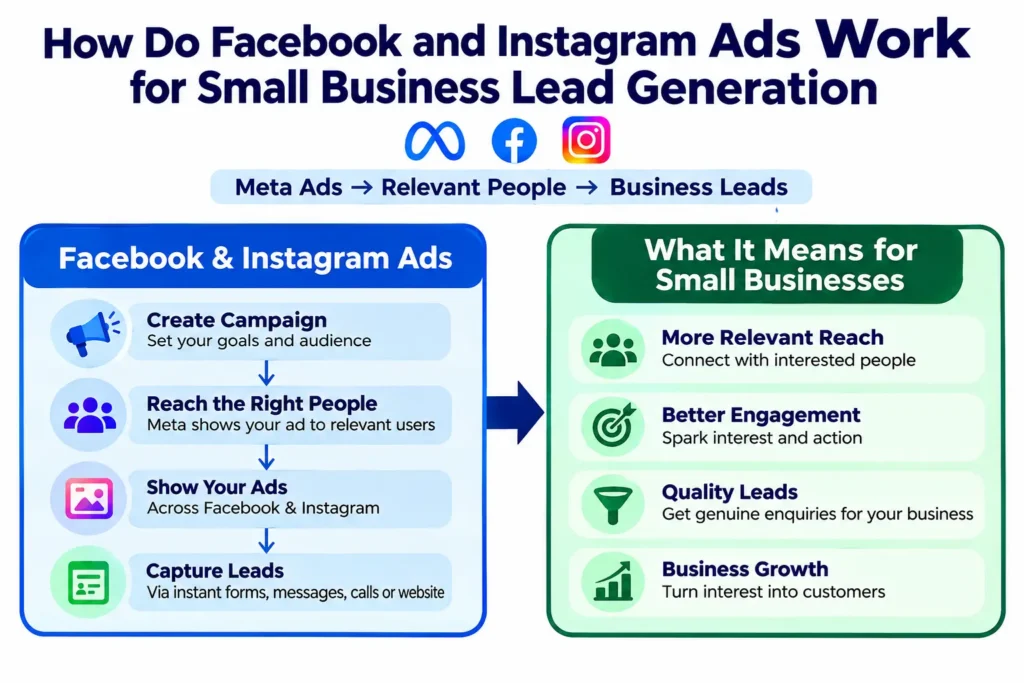
Facebook or Instagram ads do not have one fixed route to conversion. Meta currently supports several lead-generation paths, including instant forms, website forms, messaging, and phone calls. The appropriate path depends on what action the business wants the customer to take.
Where the Lead Is Actually Captured
Quality leads are influenced by what happens after someone responds to the ad. Meta offers several lead-conversion routes, including:
-
Instant forms:
The customer submits their details without leaving the platform.
-
Website forms:
The ad sends the customer to a business website or landing page where they complete a form.
-
Messaging:
The customer starts a conversation through Messenger, Instagram Direct, or another supported messaging route.
-
Calls:
The advertisement can encourage a customer to contact the business directly where call-based options are available.
This means a click is not automatically a lead. The person needs to complete the action that the business has defined as a lead.
Where Facebook and Instagram Fit In
Facebook and Instagram are connected through Meta’s broader advertising system. Rather than creating an entirely separate advertising infrastructure for each platform, businesses can manage eligible placements through Meta’s advertising tools.
Depending on the campaign and settings, an advertisement may appear in places such as Facebook Feed, Instagram Feed, Stories, or Reels. The available placement options can vary according to the campaign objective and ad format.
How to Create Facebook and Instagram Ads That Attract Quality Leads
Make the Creative Relevant to the Person You Want to Reach
The advertisement itself has a role in Meta’s delivery system. Meta says ad quality and relevance are considered alongside factors such as the campaign objective, audience, budget, and duration when its auction evaluates ads.
For a small business, this means the creative should do more than look professional. The visual, message, and offer should immediately make sense to the intended customer.
Choose a Lead Experience That Fits the Buying Decision
A website can be more appropriate when customers need to review detailed information before submitting an enquiry. For businesses where questions are part of the buying process, click-to-message ads allow the conversation to begin immediately. Meta recommends keeping automated qualifying questions concise, with six or fewer questions generally considered optimal for its messaging lead flows.
This helps avoid treating every click as a potential lead when the real objective is to attract people with a genuine reason to enquire.
Keep Creative From Becoming Repetitive
Even a well-performing advertisement can lose effectiveness when people repeatedly see the same creative. Meta’s advertising system uses signals from people’s interactions with ads, including how they respond to different content, to help determine which ads are more relevant to them. For small businesses, this makes creative variety important. Rather than repeatedly showing the same image and message, businesses can present the same offer through different formats. The aim is not to create more ads for the sake of it, but to give the platform and audience different, relevant ways to engage with the same business offer.
Conclusion
Facebook and Instagram ads give small businesses a practical way to connect with potential customers and generate enquiries. Understanding how Meta’s platform handles ad delivery, placements, creative, and customer actions can help businesses make smarter advertising decisions. Think Shaw helps businesses create and manage Meta ad campaigns focused on meaningful results.
| Ready to Get More From Your Meta Ads?
Facebook and Instagram ads can do more than put your business in front of people. Think Shaw helps you build and manage Meta advertising campaigns designed to reach the right audience and generate meaningful enquiries. |
Frequently Asked Questions About Facebook & Instagram Ads
How much should a small business spend on Facebook and Instagram ads?
There is no fixed amount. Budget depends on industry, location, audience size, competition, objectives, and how much the business can comfortably invest.
How long does it take for Facebook ads to work?
Results vary by business and campaign. Some ads generate enquiries quickly, while others need more time to collect sufficient performance data and reach potential customers.
What is a good click-through rate for Facebook ads?
There is no universal benchmark. A useful click-through rate varies considerably by industry, campaign objective, audience, placement, creative, and whether the campaign targets cold or existing audiences.
What is the difference between boosted posts and Facebook ads?
Boosting promotes an existing Facebook post with simplified controls, while Ads Manager provides broader campaign objectives, audience options, placements, budgeting controls, and measurement capabilities.
How often should a small business change its Facebook ad creative?
There is no universal schedule. Businesses should monitor performance and audience response, then refresh creative when engagement declines or the same audience has repeatedly seen the advertisement.
Can Facebook ads help a local business reach nearby customers?
Yes. Meta advertising provides location-based audience controls that can help businesses promote products or services within the geographic areas where they operate or serve customers.