The platform behind a website can influence how easily a business builds, manages, and expands its search presence, and both WordPress and Shopify offer their own strengths. WordPress is an open-source content management system with extensive customization opportunities, while Shopify is a hosted ecommerce platform with SEO features built into its store infrastructure. For businesses comparing the two, the real question is how each platform fits their content strategy, technical requirements, ecommerce model, and long-term growth plans. So, understanding these differences is essential, and this guide helps you decide which platform can best support an SEO strategy without creating unnecessary technical or operational constraints as the website develops.
WordPress vs Shopify: SEO Growth OverviewWordPress offers extensive customisation, content flexibility, and technical SEO control, making it suitable for content-led businesses and complex websites. Shopify provides a structured, hosted ecommerce environment with integrated product management, checkout, and reduced maintenance responsibilities. Both platforms can support scalable websites and effective SEO when properly managed. Choosing between them depends on business goals, content strategy, technical resources, ecommerce requirements, site architecture, and long-term growth plans, alongside ongoing optimisation and performance management. |
Why WordPress and Shopify Matter for SEO and Business Growth
What Is WordPress?
WordPress is a flexible content management system (CMS) that allows businesses to create, organise, publish, and manage website content. Unlike a platform built around one specific business model, it can support service websites, publishers, membership sites, portfolios, online stores, and large content-driven websites. Its open ecosystem also allows businesses to extend functionality through themes, plugins, custom development, and different hosting environments.
WordPress matters when a business relies heavily on:
- Organic content,
- Detailed service pages,
- Landing pages, or
- Topic-based resources to attract qualified search traffic
Its flexibility allows businesses to expand their website architecture and customise SEO implementation as new services, audiences, and content opportunities develop.
What Is Shopify?
As a hosted e-commerce platform designed primarily for businesses, Shopify sells products online. It combines the main components needed to operate an online store, including product management, storefront creation, checkout, payments, inventory, and order management. As Shopify manages the hosting environment and much of the underlying infrastructure, businesses can operate an ecommerce website without handling many of the technical responsibilities associated with building and maintaining a site from scratch. Shopify is essential for ecommerce businesses because its structured store environment supports the management of:
- Products
- Collections
- Commercial landing pages at scale.
This allows SEO activity to work alongside catalogue expansion and product-led acquisition without requiring the business to manage its own hosting infrastructure.
WordPress vs. Shopify: Key Differences for SEO
When comparing WordPress and Shopify for SEO, the differences become clearer in how each platform handles technical control, content structure, ecommerce functionality, performance, and ongoing maintenance. These practical differences shape how businesses build and manage their search presence as they grow.
| SEO Factor | WordPress | Shopify |
| Technical SEO Control | Provides extensive control over code, themes, redirects, structured data, hosting, and technical configurations. | Manages much of the technical infrastructure, making maintenance easier but limiting certain advanced customisations. |
| Content & Information Architecture | Supports custom post types, taxonomies, resource hubs, topic clusters, and complex internal-linking structures. | Uses a more structured system of products, collections, pages, and blogs, making it well suited to ecommerce-focused content. |
| Ecommerce SEO | WooCommerce can support advanced ecommerce SEO, but requires more decisions around plugins, hosting, security, and configuration. | Integrates products, collections, checkout, inventory, payments, and storefront functions within one ecommerce ecosystem. |
| Performance Management | Performance depends on hosting, themes, plugins, caching, image optimisation, and technical configuration, providing greater room for custom optimisation. | Platform-managed infrastructure reduces technical performance responsibilities for the business. |
| Maintenance Requirements | Requires ongoing management of updates, plugins, security, hosting, and performance. | Requires less infrastructure maintenance because Shopify manages much of the underlying platform. |
| See what the right SEO strategy can do for your website. Get expert guidance from Think Shaw to identify the right WordPress or Shopify SEO approach for your business growth goals. |
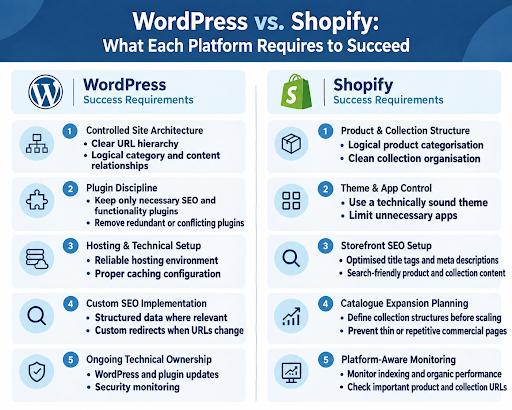
WordPress vs. Shopify: What Each Platform Requires to Succeed
Before comparing WordPress and Shopify, it is important to understand that neither platform succeeds through its built-in features alone. Each requires a different approach to site structure, technical management, content organization, and ongoing SEO maintenance. The difference lies in how the flexibility or structure is managed as the website grows. The infographic below highlights the key requirements businesses should address on each platform to build a technically sound, scalable, and search-friendly website.
Which Platform Fits Your Business Goals Best?
WordPress is better aligned with business models where organic content, custom website functionality, and long-term SEO development are important parts of growth.
Choose WordPress for Content-Led Growth
- Content-intensive websites: Suitable for businesses publishing detailed blogs, guides, service pages, resources, and topic clusters to capture informational and commercial searches.
- Greater customisation: Supports deeper control over website architecture, themes, plugins, code, structured data, redirects, and other SEO implementations.
- Complex business requirements: Useful when a website needs custom functionality, specialised page types, integrations, or an information architecture beyond a standard ecommerce structure.
- SEO-focused teams: A practical option for businesses with developers, technical SEO specialists, or agencies capable of managing hosting, plugins, performance, and ongoing customisation.
Choose Shopify for Ecommerce-Led Growth
Shopify is designed around online selling, making it particularly relevant when product sales, catalogue expansion, and streamlined store operations are the primary business objectives.
- Product-focused businesses: It is suitable for retailers that need to manage products, collections, inventory, checkout, payments, and orders within one platform.
- Scalable catalogue management: Provides a structured ecommerce environment for businesses expanding their product range without building core store infrastructure themselves.
- Lower technical overhead: Shopify manages hosting and much of the underlying infrastructure, reducing the technical maintenance required from an internal team.
- Commerce-focused SEO: Supports SEO for product and collection pages, allowing organic search activity to work alongside a product-led acquisition strategy.
Conclusion
Now that you have gone through the guide, you must have know that choosing a platform is only the starting point; turning it into a search-ready, growth-focused website requires the right execution. At Think Shaw, our team provides WordPress SEO, Shopify SEO, ecommerce SEO, and website development services, helping businesses align technical optimisation, search strategy, and website performance with their commercial objectives. Our platform-specific SEO approach can also help businesses identify and address optimisation opportunities as their websites grow.
| Ready to turn your online store into a stronger search channel? Let Think Shaw develop a tailored ecommerce SEO strategy covering your product pages, site architecture, and technical SEO. |
FAQ’s About WordPress and Shopify For SEO And Business Growth
Does Shopify automatically create an XML sitemap for SEO?
Yes, Shopify automatically generates XML sitemaps for stores, helping search engines discover important pages as your website and catalogue expand.
How do WordPress and Shopify work with Google Search Console?
Search Console can be used with websites on both platforms to monitor indexing, search performance, and eligible structured-data reporting.
What happens to Google rankings when changing platforms?
A platform migration can affect organic visibility if URLs, redirects, content, canonicals, or indexing signals change without proper migration planning and monitoring.
Can WordPress and Shopify handle large websites with thousands of pages?
Yes, both can support large websites, although scalability depends on architecture, implementation quality, content organisation, and ongoing technical management.
Which platform is better for multilingual SEO?
Both support multilingual SEO, although implementation differs. WordPress offers extensive multilingual plugins, while Shopify provides built-in and app-based options for multiple languages.