Nowadays, many people check Google Maps to compare businesses when searching for nearby services before visiting a website. Others search for detailed information, compare providers, or explore solutions through standard search results. Understanding Google Maps SEO vs traditional SEO helps businesses decide how to reach these different audiences. Each approach serves a distinct purpose, from helping nearby customers to find a business to attracting customers searching for a particular product or service across wider markets. The right choice depends on your location, customer journey, and growth objectives. This guide compares both strategies and matches which is beneficial for your business.
Overview of Both SEO StrategiesGoogle Maps SEO optimizes your Business Profile to win nearby, ready-to-visit customers in the local pack, ranking on relevance, distance, and prominence, with reviews playing a direct role. Traditional SEO optimizes website pages to attract searchers from any location through content, backlinks, and technical health. Restaurants, clinics, and home-service providers should lead with Maps; law firms and agents need both, and online stores and B2B companies should prioritize traditional SEO. |
Google Maps SEO vs Traditional SEO: Side-by-Side Comparison
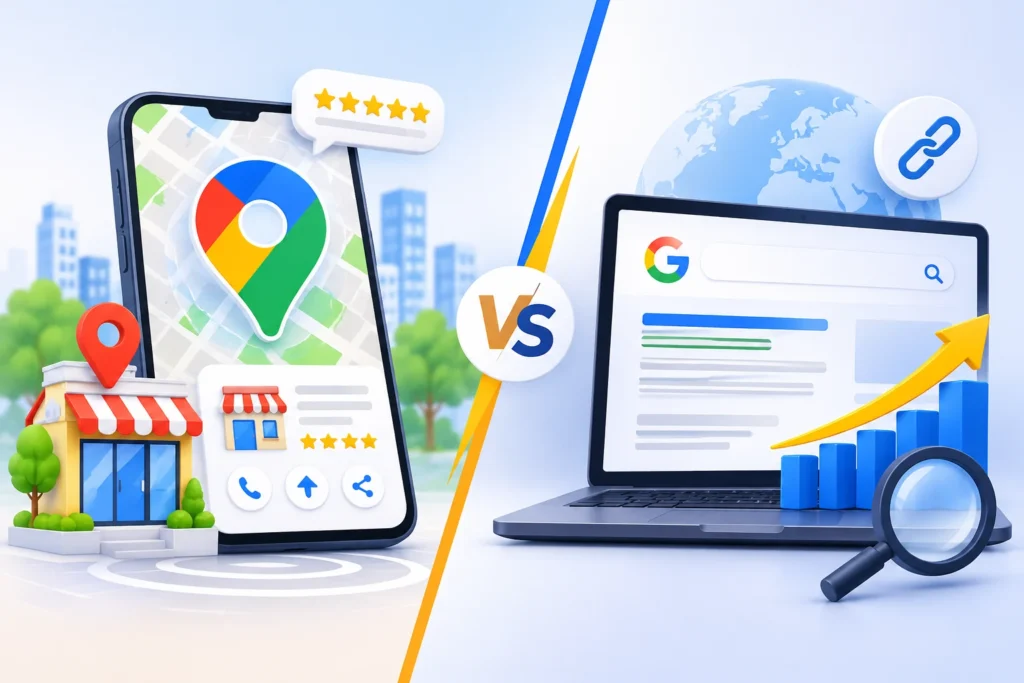
Google Maps SEO helps increase your business visibility in Google Maps and location-based search results, showcasing three local business listings above regular results. Traditional SEO means optimizing your website’s pages to rank in organic search.
Moreover, the biggest difference is location. Google’s guidelines explain that local results depend on relevance, distance, and prominence. But Traditional SEO has no distance means, so a page written in Delhi can rank for a searcher in Chennai. However, this is not for a Google Business Profile. The table below displays the main comparison between Google Maps SEO and Traditional SEO
| Factor | Google Maps SEO | Traditional SEO |
| Main Goal | Appear in the map and local pack | Rank the web page in organic results |
| Core Asset | Google Business Profile | Website and content |
| Search Intent | Nearby clients (ready to visit or call) | Learn, compare, and buy online |
| Ranking Drivers | Relevance, distance, prominence | Content quality, backlinks, and technical health |
| Roles of Reviews | Direct ranking signal | Indirect trust signal |
| Roles of Backlinks | Supporting signal | Core signal |
| Time to results | Often quicker but no guarantee | Gradual and builds over months |
| Suitable to | Businesses serving a local area | Businesses serving any location |
Reviews show the gap clearly. As part of prominence, Google counts review volume and rating, because more positive reviews can lift a local ranking. On a regular web page, reviews build trust indirectly. In simple terms, Maps SEO wins the nearby search, and traditional SEO wins the research search.
| Want to know where your business stands today? A local seo audit can review your Google Business Profile, your business name, address, phone details, and your service areas. |
Which Strategy Fits Your Business?
The right option depends on how your customers search and how far they will travel to reach your business. Here is how it affects different business types:
Restaurants and Cafes: Start With Maps
Diners decide fast, usually confirm bookings on calls, and search through nearby areas. Accurate hours, fresh photos, a current menu, and recent reviews help a lot. Your website just needs to load quickly and show the current menu while local SEO builds the site foundation through Google Business Profile optimization.
Dentists and Clinics: Maps Plus Helpful Content
Patients check ratings first before booking, so your profile and review replies carry weight. Some users search with a specific question, like what a root canal involves. Clear pages on your website answering that question help in earning organic traffic. Then, those visitors search on the map when they are ready to book.
Plumbers and Electricians: Maps With Service-Area Pages
Urgent services win in the map pack SEO when a customer needs immediate help. Set areas where you offer service if you travel to customers. You should also create a separate page on your website for each major service area to show Google your business’s local relevance.
Law Firms and Real Estate Agents: Use Both
Clients research for weeks before making a call. Useful content about local property prices or relevant legal processes can help answer customer questions and strengthen your website’s relevance to local searches. Your map listing captures the moment customers decide to contact someone nearby. This is how each channel handles a different stage of the decision.
Online Stores: Choose Traditional SEO
A shopper in another state will never see your local pack, so your local pack ranking depends on product pages, category pages, and links from other websites. Adapting E-Commerce SEO service focuses on working exactly for these areas. Keep a profile of the location where your physical store exists.
SaaS and B2B Companies: Choose Traditional SEO
Software buyers search for problems, comparisons, and alternatives, not use terms like “software near me.” They are often attracted to educational articles and comparison pages. A map listing adds little unless clients visit your office.
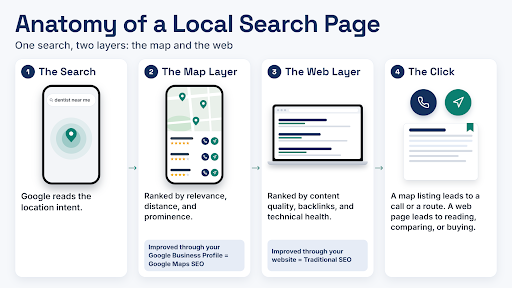
Anatomy of a Local Search Page
A local search for “dentist near me” moves through four stages: search intent, map listings, website results, and user action. Map rankings depend on relevance, distance, and prominence, while traditional SEO focuses on content quality, backlinks, and technical health. Users can call a local business, get directions, read information, compare options, or make a purchase.
Conclusion
Now you understand that Google Maps SEO attracts a local audience, and traditional SEO enhances visibility across your local area. They do not replace each other. At Think Shaw, we help different audiences, whether they serve in the local area or beyond local area. Our team offers a solution that matches how your customers search today and helps you reach your target audience more efficiently.
| Ready to discover the right customers? Whether you want more calls from nearby searchers or more visitors from across the country, you just need a plan around your business |
Google Maps SEO vs Traditional SEO: Common Questions Answered
Can I rank on Google Maps without a website?
Yes, it’s possible if your Business Profile is verified; then it can appear in Maps without a website. A website works when it gives more details to customers and Google about your services.
How can I tell if my customers search with a map in mind?
Type your main service on Google, such as “tailor shop.” Check whether a map with local businesses appears above the web results. If it does, searchers have local intent.
Why does a competitor with fewer reviews outrank me on the map?
Reviews are only part of prominence. Google also checks for relevance and distance, so a competitor may match the search more closely. You should compare their category, listed services, and location with your business.
How to verify my Google Business Profile?
Create your business profile and follow Google’s verification process, such as phone, email, video, or postcard. The methods available depend on your business type and location.
Can I add keywords to my business name to rank higher?
No, your profile name should match your real-world business profile. Adding extra keywords breaks Google’s guidelines, which can lead to your profile being suspended.