
Expanding your website into new countries and languages can unlock significant organic growth, but international visibility depends on more than simply translating content. Without a well-planned International SEO strategy, search engines may struggle to identify the correct version of your pages, resulting in ranking conflicts, diluted authority, and unintended keyword cannibalization across regional markets.
Proper hreflang implementation helps search engines understand the intended language and geographic audience for each page, ensuring users are served the most relevant version while preserving search performance. In this guide, you’ll learn how Hreflang tags for international SEO work, why they matter for sustainable global growth, and the best practices for expanding into international markets without competing against your own rankings.
International SEO Strategy OverviewInternational SEO and hreflang work together to ensure search engines deliver the correct language or regional version of a website, improving user experience and global search visibility. Proper hreflang implementation minimizes keyword cannibalization, supports accurate indexing, and strengthens localized rankings. Following best practices—such as using valid language codes, reciprocal tags, canonical alignment, and localized content—helps businesses build a scalable international presence while maximizing organic performance across multiple countries and languages. |
What Is International SEO & Why Hreflang Matters for Global Growth?
International SEO Hreflang is the process of optimizing a website so search engines can deliver the correct language or country-specific version of a page to users in different markets. A key element of this strategy is the hreflang attribute, which tells search engines which page version is intended for a particular language or region, such as English (US) or English (UK). This reduces the likelihood of users seeing the wrong version of your content and helps search engines index localized pages accurately. For businesses expanding globally, proper hreflang implementation improves user experience, supports regional search visibility, and minimizes keyword cannibalization between similar pages, allowing each localized version to compete effectively in its target market.
How Hreflang Prevents Keyword Cannibalization Across International Markets
When businesses expand into multiple countries or languages, they often publish pages that target the same products, services, or topics with only slight regional variations. While this approach is essential for serving local audiences, it can create keyword cannibalization if search engines cannot determine which page should rank for users in a specific location. The Hreflang tags for international Hreflang SEO attribute solve this challenge by explicitly signaling the intended language and regional audience for each version of a page.
Instead of treating similar pages as competing alternatives, search engines use hreflang to understand that each page serves a different audience. As a result, users in the United States are more likely to see the US version, while users in the United Kingdom, Canada, or Australia receive the version optimized for their region. This improves search relevance without sacrificing the visibility of localized content.
How Hreflang Prevents Keyword Cannibalization?
Here’s how Hreflang tags for international SEO prevent keyword cannibalization:
- Identifies the correct audience: Hreflang specifies the intended language and country for each page (for example, en-US, en-GB, or fr-CA), helping search engines serve the right version to the right users.
- Reduces ranking conflicts: Without hreflang, Google may alternate between similar regional pages in search results, causing unstable rankings and reduced visibility.
- Supports localized optimization: Multiple pages can target the same core keyword while incorporating local spelling, terminology, currency, pricing, and cultural references.
- Improves user experience: Visitors land on the version that matches their language and location, increasing engagement and reducing bounce rates.
- Strengthens international search performance: Each localized page can earn visibility within its intended market rather than competing with other regional versions of the same content.
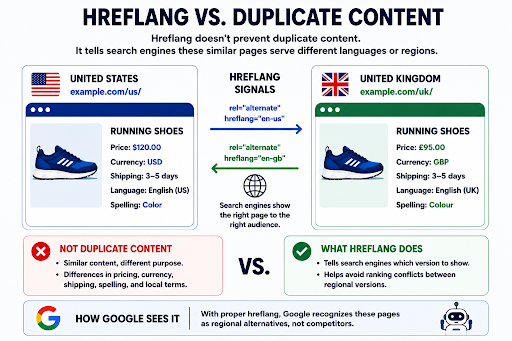
Hreflang vs. Duplicate Content
A common misconception is that hreflang eliminates duplicate content. In reality, hreflang does not prevent duplicate content or replace canonical tags. Instead, it helps search engines understand that similar pages exist intentionally to serve different languages or geographic regions.
For example, a product page targeting the United States (example.com/us/) and another targeting the United Kingdom (example.com/uk/) may contain largely similar content but differ in spelling, pricing, currency, shipping information, and local terminology. When hreflang is implemented correctly, Google recognizes these pages as regional alternatives rather than direct competitors.
Hreflang Implementation Best Practices for International Websites
Use Valid Language and Country Codes
A successful hreflang implementation starts with using standardized language and country codes. Google recognizes ISO 639-1 language codes (such as en, fr, and es) and ISO 3166-1 Alpha-2 country codes (such as US, GB, and CA). Combining these codes correctly (for example, en-US or fr-CA) helps search engines identify the intended audience for each page. Using invalid or unsupported codes can cause Google to ignore your hreflang annotations altogether, reducing the effectiveness of your international Hreflang SEO strategy.
Add Self-Referencing and Reciprocal Hreflang Tags
Every localized page should include a self-referencing hreflang tag and reference every alternate version of the page. Likewise, all alternate pages must return the reference, creating a reciprocal relationship. This complete hreflang cluster helps Google verify that all pages are equivalent versions intended for different audiences. Missing reciprocal tags are among the most common implementation errors and can prevent search engines from interpreting your annotations correctly.
Use the Right Hreflang Implementation Method
Google supports three methods for implementing hreflang annotations: HTML tags, XML sitemaps, and HTTP headers for non-HTML content such as PDFs. While each method is equally effective, XML sitemaps are often preferred for large multilingual websites because they are easier to manage and update at scale. Regardless of the chosen method, maintain consistency across all localized URLs and avoid mixing incomplete implementations.
Combine Hreflang with Canonical Tags Correctly
Hreflang and canonical tags serve different purposes and should work together rather than replace one another. Canonical tags tell search engines which URL is the preferred version when duplicate or near-duplicate content exists, whereas hreflang identifies equivalent pages created for different languages or regions. Each localized page should typically have a self-referencing canonical tag while using hreflang to connect all international versions. Incorrect canonicalization can override hreflang signals and reduce international visibility.
Create Localized Content Instead of Simple Translations
Effective international SEO goes beyond translating text. Each regional page should be adapted to local spelling, currency, measurements, pricing, legal requirements, cultural preferences, and user behavior. Search engines reward content that genuinely meets local search intent, while users are more likely to engage with content that feels native to their market. Proper localization also reduces the risk of thin or repetitive content across international websites.
Include an x-default Page for Unspecified Users
The x-default hreflang attribute identifies the page that should be shown when no specific language or regional version matches a user’s settings. This is particularly useful for global homepages, language selection pages, or websites serving visitors from countries without dedicated localized content. Using x-default improves user experience by ensuring visitors always reach an appropriate landing page instead of an unrelated regional version.
Keep All Localized Pages Crawlable and Indexable
Hreflang annotations only work if the referenced pages can be crawled and indexed by search engines. Avoid blocking localized pages through robots.txt, applying noindex directives, or linking to redirected URLs. Each alternate page should return a 200 OK status and be accessible to search engine crawlers. Regular technical audits help identify crawlability issues before they affect international search performance.
Validate and Monitor Your Hreflang Implementation
Even small hreflang errors can impact international search visibility. Regularly audit your implementation using Google Search Console, XML sitemap validation tools, and professional SEO crawlers to identify missing return tags, incorrect language codes, broken URLs, or conflicting annotations. As your website expands into new markets, update every hreflang cluster to include newly added language and regional pages. Continuous monitoring ensures your International SEO Hreflang strategy remains accurate, scalable, and aligned with Google’s best practices.
Conclusion
Expanding globally requires more than translating content; it demands a strategic International SEO approach backed by accurate hreflang implementation. By following proven best practices, businesses can improve regional search visibility, deliver the right content to the right audience, and avoid keyword cannibalization.
If you’re planning to scale your website internationally, Think Shaw can help with expert International SEO strategies, technical implementation, and multilingual optimization. Ready to grow your global search presence? Contact us today and let our SEO experts build a strategy that drives sustainable international success.
FAQs About International SEO & Hreflang
Does Google automatically detect a user’s location for international search results?
Google uses multiple signals, including the user’s location, language settings, search intent, and hreflang annotations, to determine the most relevant regional page instead of relying on location alone.
Is machine-translated content acceptable for international SEO?
Machine translation is acceptable only if it is reviewed for accuracy, readability, and user value. Publishing unedited or low-quality translations may negatively affect user experience and search performance.
How often should international SEO performance be audited?
Review technical implementation and performance at least quarterly or after major website updates, migrations, or launching new language and country versions to identify issues before they impact rankings.
Can different countries have different metadata for the same page?
Yes. Optimizing title tags and meta descriptions for local keywords, language variations, and regional search intent can improve click-through rates and search relevance in each market.
What role does server location play in international SEO?
Server location has minimal impact today because Google primarily relies on stronger signals such as hreflang, localized content, and URL structure rather than hosting location alone.