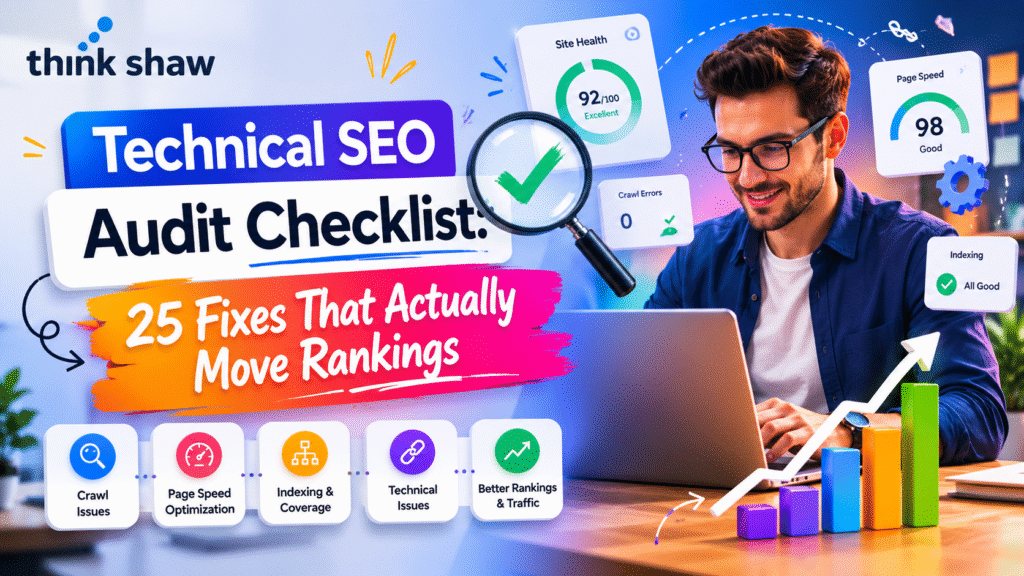
Hyperpigmentation is a common SEO challenge for websites where technical issues create invisible dark spots in rankings, reducing visibility despite having quality content. Many site owners rely on content updates alone but fail to fix underlying structural problems that limit crawlability and indexing. This is where a technical seo audit checklist becomes essential. It helps identify issues such as broken links, slow page load times, duplicate URLs, and poor mobile performance that prevent search engines from fully understanding your site. By fixing these core technical barriers, websites can achieve better indexing, stronger rankings, and improved organic performance across search engines.
| Technical SEO Fixes Overview
Technical SEO determines how efficiently search engines crawl, interpret, and rank a website. Issues like crawl errors, poor site architecture, indexing gaps, and slow performance can silently reduce visibility even with strong content. Optimizing internal linking, mobile usability, Core Web Vitals, structured data, and server response helps improve rankings and user experience. A structured audit ensures better indexation, stronger authority signals, and sustainable organic growth across search engines. |
25 Technical SEO Fixes That Actually Move Rankings
Fix Crawl Errors
Crawl errors occur when search engine bots cannot access a page due to server issues, broken URLs, or blocked resources. Resolving 4xx and 5xx status code errors ensures search engines can properly discover and evaluate important pages.
Optimize XML Sitemap
An XML sitemap acts as a roadmap for search engines, helping them prioritize URL discovery and indexation. Ensure that only canonical, indexable, and high-value pages are included, and remove redirects and duplicate URLs.
Improve Robots.txt Configuration
A poorly configured robots.txt file can accidentally block essential pages from being crawled. Review disallow directives to ensure search engines can access JavaScript, CSS, and critical site resources needed for rendering.
Resolve Indexing Issues
Pages marked Discovered Currently Not Indexed or Crawled – Not Indexed indicate content quality or technical concerns. Reviewing index coverage helps identify pages that require stronger signals or optimization.
Fix Broken Internal Links
Broken internal links negatively affect crawl flow and user experience while wasting crawl budget optimization. Replacing dead links with working URLs improves navigational efficiency and distributes authority more effectively.
Eliminate Redirect Chains and Loops
Multiple redirects slow down crawling and dilute link equity transmission. Replacing redirect chains with direct 301 redirects ensures faster page access and preserves site speed SEO value.
Implement Canonical Tags Correctly
Canonical tags help search engines identify the preferred version of duplicate or similar pages. Proper canonicalization prevents keyword cannibalization and consolidates ranking signals into one authoritative URL.
Resolve Duplicate Content Problems
Duplicate pages confuse search engines and split ranking potential across multiple URLs. Addressing duplication through canonicalization, noindex tags, or content consolidation strengthens topical authority.
Improve Website Architecture
A logical site hierarchy enables search engines to understand content relationships and page importance. A shallow architecture ensures essential pages are accessible within a few clicks from the homepage.
Fix Orphan Pages
Orphan pages lack internal links, making them difficult for crawlers to discover naturally. Connecting them strategically through internal linking improves crawlability and indexation probability.
Optimize URL Structure
SEO-friendly URLs should remain concise, descriptive, and keyword-relevant while avoiding unnecessary parameters. Clean URL structures improve crawl comprehension and enhance user trust.
Strengthen Internal Linking
Internal linking distributes PageRank across pages while signaling topical relationships to search engines. Contextual anchor text improves discoverability and strengthens semantic relevance.
Reduce Crawl Depth
Pages buried deep within site architecture receive less crawl frequency and weaker authority signals. Keeping priority pages within three clicks improves crawl efficiency and visibility.
Ensure HTTPS Across All Pages
HTTPS encryption protects user data and serves as a lightweight ranking signal. Mixed-content warnings or unsecured resources can negatively impact trust and user engagement.
Improve Core Web Vitals
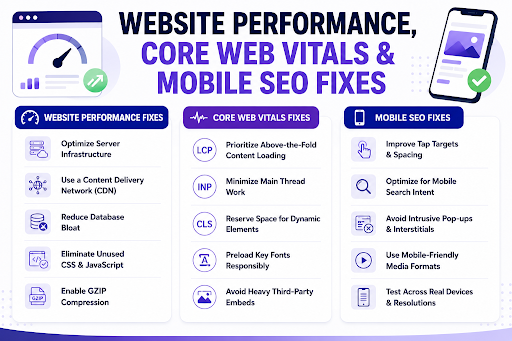
Core Web Vitals fixes measure loading speed, interactivity, and visual stability through metrics like Largest Contentful Paint (LCP), Interaction to Next Paint (INP), and Cumulative Layout Shift (CLS). Optimizing these signals improves both rankings and UX.
Increase Page Loading Speed
Slow-loading websites increase bounce rates and reduce crawl efficiency. Compressing resources, minimizing render-blocking assets, and optimizing server performance significantly improve loading times.
Compress and Optimize Images
Oversized images create unnecessary page weight and slow rendering performance. Using next-generation formats like WebP, compression, and responsive image sizing improves speed without sacrificing quality.
Enable Browser Caching
Browser caching stores static assets locally, reducing repeat load times for returning visitors. Proper cache-control headers decrease server requests and improve performance metrics.
Minify CSS, JavaScript, and HTML
Excessive code bloat delays rendering and increases page load time. Minification removes unnecessary characters, whitespace, and unused scripts to improve performance efficiency.
Fix Mobile Usability Issues
Mobile-first indexing means Google primarily evaluates mobile versions of websites. Responsive layouts, touch-friendly elements, and readable font scaling improve mobile accessibility and rankings.
Resolve JavaScript Rendering Problems
Heavy JavaScript frameworks may prevent search engines from properly rendering page content. Implementing server-side rendering or dynamic rendering ensures crawlers access essential information.
Implement Structured Data Markup
Schema markup provides contextual information about content using standardized vocabulary. Rich snippets, FAQs, reviews, and product schema enhance search visibility and improve click-through rates.
Improve Server Response Time
Slow Time to First Byte (TTFB) indicates inefficient hosting or backend delays. Optimizing server resources, database queries, and content delivery networks improves crawl responsiveness.
Implement Lazy Loading
Lazy loading delays non-critical resource loading until users scroll to them, reducing initial page weight. This improves rendering speed and enhances perceived performance.
Monitor Technical SEO Regularly
Technical SEO issues evolve with site updates, migrations, and algorithm changes. Regular audits through crawl analysis, log files, and performance monitoring prevent long-term ranking losses.
Website Performance, Core Web Vitals & Mobile SEO Fixes
A strong technical SEO audit checklist strategy combines fast loading speeds, optimized Core Web Vitals, mobile responsiveness, crawl efficiency, and structured data errors implementation to improve rankings and user experience.
Conclusion
Now you know how technical SEO fixes can resolve hidden website issues and improve your rankings by making your site faster, cleaner, and easier for search engines to crawl and understand, it is high time to take action. For this, start prioritizing structured audits and systematic optimization to eliminate barriers that restrict visibility and performance with expert guidance from Think Shaw, ensuring your website stays fully optimized for search engines. With consistent improvements and a well-planned SEO approach, your website can achieve stronger rankings, better user experience, and long-term organic growth.
Take control of your rankings today with expert technical SEO optimization from Think Shaw and unlock your website’s full organic growth potential.
Technical SEO FAQs: Key Insights & Answers
How can a business identify whether ranking issues are technical or strategic in nature?
Ranking drops despite stable content performance often indicate structural or crawl-related limitations, whereas competition-driven gaps usually reflect weaker authority signals or content depth compared to top-ranking pages.
Can technical SEO fixes improve rankings without changing content?
Yes. In many cases, rankings improve significantly after fixing crawl errors, improving Core Web Vitals, or resolving indexing issues because search engines can finally access and understand your existing content properly.
Why do some pages perform well while others on the same website fail to rank?
This usually occurs due to differences in internal visibility signals, topical relevance strength, or how effectively search engines evaluate page importance within the overall site structure.
Does improving technical SEO reduce dependency on paid ads?
Improved organic discoverability can reduce long-term reliance on paid acquisition, but performance still depends on overall SEO strategy, market competition, and content authority.
What is the risk of ignoring technical SEO for a long period?
Over time, unresolved technical inefficiencies can lead to reduced crawl efficiency, weaker indexing behavior, and gradual loss of organic visibility even if content quality remains strong.