Product page SEO in 2026 is no longer just about ranking individual SKUs; it’s about turning every product into a high-intent landing page that can attract, educate, and convert on its own. As search experiences become more conversational and AI-assisted, buyers expect product pages to answer their questions, showcase proof, and provide a frictionless path to purchase in a single view. This means your optimization strategy must go beyond keywords to include content quality, user experience, and trust signals aligned with Google’s E-E-A-T principles.
But how do you design product pages as self-contained experiences that address search intent to influence decision-making moments?
Well, in this blog, we’ll break down how to future-proof your e-commerce product page SEO, so each one performs like a dedicated landing page in your wider SEO strategy.
Product Page SEO in 2026: Strategic SnapshotProduct pages in 2026 must act as self-contained landing experiences that align with search intent, showcase unique benefit-led copy, and leverage high-quality visuals, UX, and trust signals to drive conversions. Scalable SEO for large catalogs relies on structured product data, template-driven metadata, AI-assisted content, and disciplined SOPs to keep every SKU optimized. Strong site architecture, automated internal linking, dynamic sitemaps, and continuous performance monitoring ensure product pages remain discoverable, competitive, and revenue-focused over time. |
Why Product Pages Are the New SEO Landing Pages in 2026?
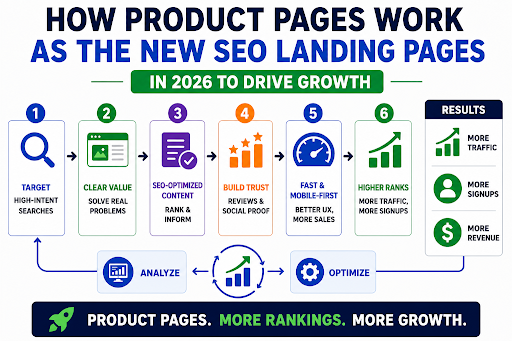
Product pages are becoming the new SEO landing pages in 2026 because search engines increasingly surface product-level results for high-intent and commercial queries, not just category or generic landing pages. As AI-driven search and richer SERP features evolve, users expect to find detailed information, social proof, and clear CTAs directly on the product page, reducing the need for separate campaign landing pages. This shift forces brands to treat each product page as a complete experience that captures discovery, evaluation, and conversion in one place.
Core Elements of a High-Converting, SEO-Optimized Product Page
Let’s now discuss the core elements of high-converting e-commerce product page SEO:
Intent-Led Keyword and Topic Targeting
A high-converting product page starts with aligning keywords to the user’s intent, not just stuffing transactional phrases into titles and descriptions. You should map primary queries (e.g., “buy [product]”) alongside modifiers like use cases, features, and pain points to ensure the page answers the exact problem the searcher is trying to solve. Placing these terms naturally in titles, headings, image alt text, and product descriptions in SEO helps search engines understand topical relevance while keeping the copy readable and persuasive.
Unique, Benefit-Driven Product Copy
Thin or duplicated manufacturer descriptions are a common reason product pages fail to rank or convert. Search and users both reward unique, benefit-led copy that clearly explains what the product is, who it’s for, and how it solves specific pain points. Descriptions that combine features (specs, materials, technical details) with outcomes (time saved, risk reduced, revenue impact) build relevance for long-tail queries and reduce friction in the decision-making process.
High-Quality Visuals and Rich Media
Visuals are often the deciding factor on whether a visitor stays or bounces from a product page. High-resolution images from multiple angles, zoom functionality, and contextual photos or videos give users confidence that they understand what they’re buying. Well-optimized images and videos (compressed files, descriptive filenames, and alt text) also support SEO by improving load times and giving search engines more context about the product.
Clear, Prominent Calls-to-Action
Even a perfectly optimized page fails if users can’t see what to do next. High-converting product pages use clear, visually prominent CTAs such as “Add to Cart,” “Request Demo,” or “Get a Quote,” placed above the fold and repeated where it’s contextually relevant. Surrounding CTAs with clean whitespace, logical supporting content, and reassurance elements (returns, guarantees, pricing clarity) helps reduce cognitive load and nudges visitors toward action.
Trust Signals and Social Proof
Users are more cautious than ever, and they look for evidence that a product and brand are credible before committing. Ratings, testimonials, case studies, security badges, transparent policies (shipping, returns, warranties), and product reviews in SEO act as trust signals that reduce perceived risk. From an SEO perspective, review content and FAQs add fresh, user-generated text that can capture additional long-tail queries and improve perceived E-E-A-T.
UX, Page Speed, and Mobile Experience
A page that loads slowly or is hard to navigate will bleed both rankings and revenue. Best ecommerce UX practices include responsive design, intuitive layout, readable typography, and simplified flows that minimize clicks between product view and checkout. Technical optimizations such as image compression, code minification, caching, and efficient loading of scripts directly impact Core Web Vitals, which in turn influence both user satisfaction and SEO performance.
Structured Data and Search Enhancements
Structured data (Product, Review, FAQ schema) helps search engines understand and showcase your product information in rich results. Marking up elements like price, availability, ratings, and FAQs can unlock enhancements such as review stars, stock status, and Q&A snippets directly in the SERP, which typically improves click-through rates. These signals also reinforce the page’s topical authority by making content more machine-readable in an AI-first search environment.
Internal Linking and Supporting Content
High-performing product pages rarely stand alone; they sit within a supportive network of categories, collections, and educational content. Strategic internal links from blogs, guides, and comparison pages pass authority to key products and guide users from problem awareness to solution selection. On-page links to related products, accessories, or higher-tier plans also increase average order value and keep users engaged within your ecosystem instead of bouncing back to search.
How To Scale E-Commerce Product Page SEO Across Large Catalogs?
Centralize Product Data with a PIM or Structured Catalog
Scaling SEO starts with clean, centralized product data rather than ad‑hoc spreadsheets and siloed systems. A Product Information Management (PIM) system or equivalent structured catalog becomes the single source of truth for titles, descriptions, attributes, images, and categories, which you can then programmatically push into templates and product schema. This centralization reduces inconsistency, avoids conflicting information across channels, and makes it feasible to update thousands of pages when you refine your SEO strategy or brand messaging.
Use Template-Driven Metadata with a Tiered Approach
For large catalogs, writing unique meta titles, descriptions, and H1s manually for every SKU is impractical, so you need scalable templates with dynamic fields. Well-designed templates pull in key attributes such as brand, product type, features, color, or use case (for example, “Men’s Waterproof Running Shoes – Size 11 – Black Mesh”) to capture long‑tail search intent at scale. A tiered strategy reserves hand-crafted metadata for top-performing or strategically important products, while the long tail relies on automated templates, giving you both efficiency and quality where it matters most.
Implement Programmatic and AI-Assisted Content
Programmatic SEO and AI-assisted workflows allow you to generate or enhance product descriptions, category blurbs, and FAQs across thousands of URLs. You can use AI for keyword clustering, content briefs, and baseline copy, then layer human editing for compliance, brand voice, and E‑E‑A‑T alignment on high-value pages. This blend of automation and editorial review helps maintain a consistent level of detail and quality across the catalog without overwhelming your content team.
Standardize Page Creation with Checklists and SOPs
Even with automation, new SKUs and collections need a consistent SEO process before they go live. This includes:
- Creating standard operating procedures (SOPs) and launch checklists
- Covering URL patterns
- On-page copy minimums
- Image requirements
- Internal links
This ensures every product page meets baseline SEO criteria. Assigning clear ownership for SEO sign-off at the point of creation helps you catch issues early, avoiding large-scale technical debt that later requires expensive rework.
Optimize Site Architecture and Crawl Efficiency
Large catalogs demand an information architecture that both users and search engines can navigate efficiently. Keeping a logical Category > Subcategory > Product hierarchy and ensuring products are within a few clicks of the homepage improves discoverability, internal link equity, and crawl coverage. Controlling faceted navigation, using canonical tags, and segmenting XML sitemaps by category help search engines crawl your catalog without wasting budget on low-value duplicate or filtered URLs.
Automate Internal Linking Across the Catalog
Manual internal linking won’t scale when you have tens of thousands of products. Automated or rules-based systems can create links between related products, cross-sell bundles, and category or content hubs based on shared attributes or behavior signals. This not only improves user discovery and average order value but also distributes authority more evenly, helping important product pages rank better without one-off link-building campaigns.
Use Dynamic Sitemaps and Inventory-Aware SEO
In large catalogs, products are constantly being added, updated, or discontinued, so static sitemaps quickly become outdated. Dynamic sitemap generation that updates whenever inventory changes helps search engines discover new products faster and drop obsolete URLs more gracefully. Rather than deleting out-of-stock pages, many experts recommend keeping them live with clear messaging, related alternatives, or waitlist options, preserving accumulated SEO value and user trust.
Monitor Performance and Iterate Systematically
Scaling e-commerce product page SEO is an ongoing process that relies on data, not one-off optimizations. Using tools like Google Search Console, analytics platforms, and heatmaps, you can identify which product segments, templates, or attributes drive the most impressions, clicks, and conversions. Based on this insight, you can refine templates, re-prioritize tiered optimization, and A/B test elements like CTAs or messaging, gradually lifting performance across entire product groups instead of just single pages.
Conclusion
In 2026, the gap between average and high-performing product pages is defined by how intentionally teams treat them as revenue assets, not just catalog entries. Instead of chasing isolated quick wins, we at Think Shaw focus on building repeatable systems: scalable information architecture, intent-led content workflows, and AI-assisted optimization that still respects human oversight and brand context. When you’re ready to turn every SKU into a measurable growth lever, we can help you audit, prioritize, and upgrade your product pages end to end.
Contact us today to transform your product pages into high-converting landing experiences.
Frequently Asked Questions: Product Page SEO 2026
What is the biggest product page SEO mistake in 2026?
Focusing only on keywords while ignoring user behavior data, session recordings, and on-site search queries, which reveal what real buyers struggle to find or understand.
How can product pages be optimized for voice search?
Use conversational questions, concise answers, and structured FAQ sections that mirror how users speak, then support them with schema and mobile-friendly layouts.
Which tools help automate product page SEO tasks?
Use SEO suites for audits and tracking, content tools for on-page optimization, and automation workflows to scale metadata and reporting across large catalogs.
What KPIs best measure product page SEO success?
Monitor organic impressions, click-through rate, add-to-cart rate, assisted conversions, and revenue per session rather than rankings alone for a complete picture.
Should product filters and faceted navigation be indexed?
Most sites benefit from restricting indexation of overly granular filter combinations to avoid duplicate content, crawl waste, and diluted ranking signals.
How do regional differences impact product page SEO?
Localized pricing, measurements, languages, and shipping details enhance relevance and trust for regional audiences, while also improving eligibility for local search results.