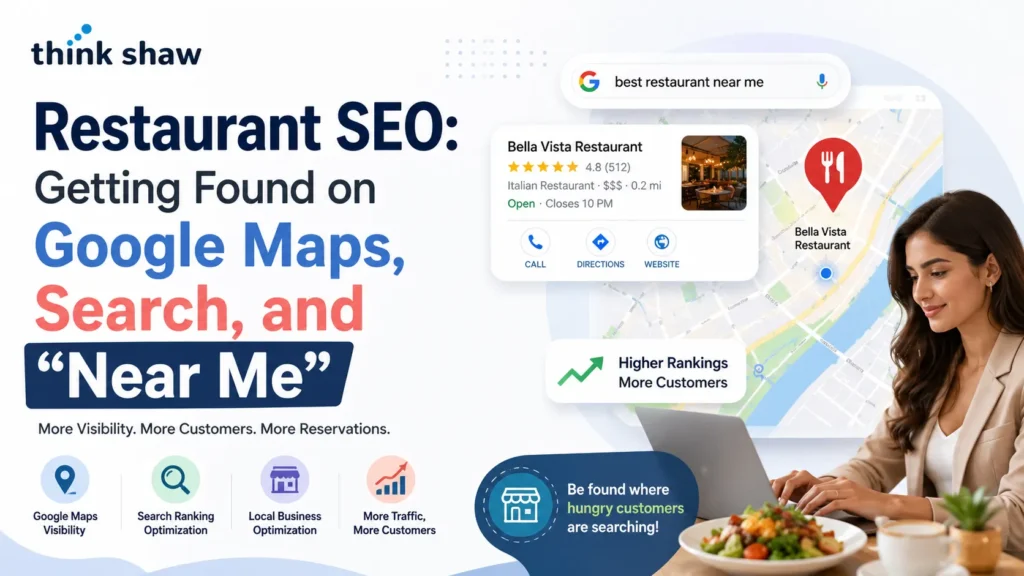
When hungry customers search for “restaurants near me,” “best Italian food nearby,” or a place open now, visibility can influence where they choose to dine. Restaurant SEO helps a business appear across Google Search and Google Maps by making its location, menu, opening hours, services, and reputation easier for users and search engines to understand. Google states that local results are primarily shaped by relevance, distance, and prominence, which means rankings depend on more than simply having a website. An accurate Google Business Profile, focused content, customer reviews, and more contribute to stronger discoverability.
In this blog, we detail what restaurant local SEO actually is and how you can leverage it to improve your visibility and growth.
A Practical Overview of Restaurant SEORestaurant SEO strengthens local visibility by optimizing Google business profile for restaurant information, menus, categories, photos, reviews, and booking links. High-intent local keywords, location pages, conversational content, and internal linking improve relevance for Google Search and “near me” queries. Authentic reviews, local authority signals, mobile performance, structured data, and clear conversion paths help restaurants earn trust, attract qualified diners, and turn online discovery into reservations, calls, directions, and orders more consistently online. |
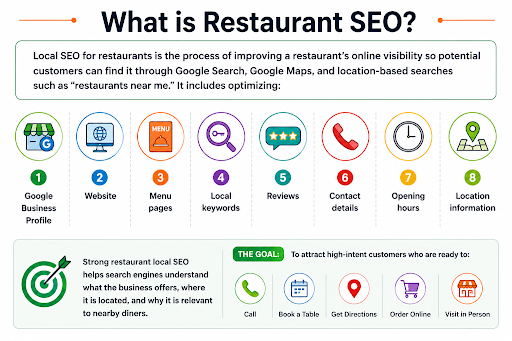
What is Restaurant SEO?
Local SEO for restaurants is the process of improving a restaurant’s online visibility so potential customers can find it through Google Search, Google Maps, and location-based searches such as “restaurants near me.” It includes optimizing the
- Restaurant’s Google Business Profile
- Website
- Menu pages
- Local keywords
- Reviews
- Contact details
- Opening hours
- Location information.
Strong restaurant local SEO helps search engines understand what the business offers, where it is located, and why it is relevant to nearby diners. The goal is to attract high-intent customers who are ready to call, book a table, get directions, order online, or visit the restaurant in person today.
Optimize Your Google Business Profile for Local Restaurant Searches
Complete and Verify Business Information
Verify the profile and complete every essential field, including the restaurant’s official name, address, phone number, website, opening hours, cuisine, price range, and service options. Keep these details consistent across the website, directories, and delivery platforms. Clear, accurate information helps Google understand the business and answer local queries such as “Is this restaurant open now?” or “Does it offer delivery?” Follow Google’s business representation guidelines to maintain accuracy across searches.
Choose Accurate Business Categories
Choose the most specific primary category that reflects the restaurant’s main offering, such as “Italian restaurant,” “Vegan restaurant,” or “Seafood restaurant.” Add only relevant secondary categories for additional services or cuisine types. Accurate categories improve relevance for local searches and help Google connect the profile with queries like “Japanese restaurant near me.” Avoid selecting unrelated categories to increase visibility, as Google recommends using only categories that genuinely describe the business.
Add a Detailed, Searchable Menu
Add a complete, text-based menu to the profile with clearly organized sections, dish names, descriptions, prices, and dietary details. Avoid relying only on menu images or PDFs because structured text is easier for Google and AI systems to understand. Use factual descriptions that mention ingredients, preparation methods, and portion details where relevant. This can improve visibility for searches involving specific dishes, prices, vegetarian options, allergens, and cuisine-related questions from diners.
Complete Relevant Restaurant Attributes
Complete all applicable attributes, including dine-in, takeaway, delivery, outdoor seating, wheelchair accessibility, parking, Wi-Fi, family-friendly facilities, and accepted payment methods. These restaurant SEO details help Google answer specific customer questions and improve the profile’s usefulness in Search, Maps, voice search, and AI-generated results. Only select attributes that are currently accurate, and review them regularly whenever services, facilities, seasonal options, or operating policies change to maintain accuracy and build customer trust over time.
Upload Authentic Restaurant Photos
Upload recent, original photos of the restaurant’s exterior, entrance, dining area, food, staff, parking, and accessibility features. Authentic visuals help customers recognize the location and understand the atmosphere before visiting. They also strengthen trust by providing real-world evidence of the restaurant’s experience and environment. Include images that answer practical questions about seating, portion sizes, group suitability, outdoor dining, and accessibility, rather than relying heavily on stock photos or promotional graphics.
Add Booking Links and Profile Updates
Add direct links for reservations, online ordering, delivery, pickup, menus, and the restaurant website. Test each link regularly to ensure it works correctly on mobile devices and leads to the appropriate page. Publish timely profile updates for seasonal menus, holiday hours, events, closures, and special offers. Use clear dates, locations, and actions in every post so customers, search engines, and AI systems can quickly understand the information and respond accurately.
Target Google Search and “Near Me” Restaurant Keywords
Research High-Intent Local Keywords
Identify keywords that reflect how customers actually search for restaurants, such as “restaurants near me,” “best Mexican restaurant in Austin,” or “family-friendly restaurant nearby.” Combine cuisine, location, dining style, and customer intent to target searches with higher conversion potential. Use tools like Google Keyword Planner and Google Search Console to discover valuable local search terms.
Optimize Key Website Pages
Include primary local keywords naturally in page titles, meta descriptions, headings, URLs, image alt text, and body content. Focus each page on a specific topic or location while maintaining clear, helpful content. Avoid keyword stuffing, as Google rewards pages that provide genuine value and satisfy user search intent.
Create Location-Specific Landing Pages
If the restaurant serves multiple cities or neighborhoods, create unique landing pages for each location. Include localized information such as nearby landmarks, parking details, service areas, popular menu items, and community relevance. Original location content helps Google understand geographic relevance and improves visibility for “near me” and city-based searches.
Optimize for Voice and Conversational Searches
Many local searches are performed through voice assistants using natural language. Include conversational phrases and FAQ-style content that answers questions like “Where can I get sushi near me?” or “What restaurants are open late in Chicago?” Direct, concise answers improve visibility in AI-powered and voice search results.
Strengthen Local Relevance with Internal Linking
Connect menu pages, location pages, blogs, reservation pages, and contact pages through relevant internal links. This helps search engines understand your website structure while guiding visitors to important information. Use descriptive anchor text containing relevant local terms where appropriate, making it easier for Google to identify relationships between pages and improve overall local search visibility.
Build Trust Through Reviews, Local Content, and Authority Signals
Encourage Authentic Google Reviews and Respond to Every Customer
Google states that high-quality, recent reviews can improve a business’s prominence in local search results while also influencing customer decisions. Encourage genuine diners to leave honest reviews after their visit, but never offer incentives or purchase reviews, as this violates Google’s policies. Respond thoughtfully to both positive and negative feedback by addressing specific experiences rather than using generic replies. Consistent review management demonstrates active customer engagement, builds trust with potential diners, and provides Google with fresh, user-generated content that reinforces the restaurant’s credibility and local relevance.
Publish Helpful Local Content That Demonstrates Experience
Create content that answers questions local diners actually ask, such as where to eat before a nearby event, the best seasonal dishes, private dining options, or family-friendly restaurants in the area. Incorporate local landmarks, neighborhoods, and community events naturally where relevant. This type of original, experience-based content aligns with Google’s E-E-A-T principles by demonstrating first-hand knowledge and expertise. It also provides valuable context for AI-powered search engines, making the restaurant more likely to appear in location-specific recommendations and answer-focused search results.
Strengthen Authority with Local Mentions and Consistent Business Information
Build authority by earning mentions and backlinks from reputable local sources, including tourism websites, chambers of commerce, food bloggers, local newspapers, event organizers, and community organizations. At the same time, ensure the restaurant’s Name, Address, and Phone Number (NAP) remain consistent across Google Business Profile for restaurants, the website, social media platforms, and online directories. Consistent business information helps search engines verify the restaurant’s legitimacy, while authoritative local citations strengthen trust signals that contribute to improved visibility in Google Search, Maps, and AI-generated local recommendations.
Improve Website Performance, Structured Data, and Local Conversions
Improve Website Speed and Mobile Experience
Most local restaurant searches happen on mobile devices, making a fast, responsive website essential. Google considers page experience and Core Web Vitals when evaluating website performance. Compress images, minimize unnecessary scripts, enable browser caching, and ensure pages load quickly across all devices. Your website should also feature easy navigation, readable menus, prominent call-to-action buttons, and click-to-call functionality. A seamless mobile experience reduces bounce rates, encourages reservations and online orders, and helps convert local search traffic into paying customers while supporting stronger search visibility.
Implement Structured Data for Better Search Visibility
Structured data, or Schema.org markup, helps search engines understand key business information beyond standard webpage content. Restaurants should implement Restaurant or LocalBusiness schema along with Menu, OpeningHoursSpecification, PostalAddress, AggregateRating, Review, and FAQ schema where appropriate. This structured information can improve eligibility for rich results and provides AI-powered search systems with machine-readable business details. Accurate schema helps Google better interpret your menu, location, operating hours, customer ratings, and services, improving visibility across Search, Maps, and generative search experiences.
Create Clear Conversion Paths and Measure Performance
Every restaurant website should make it easy for visitors to complete important actions. Display prominent buttons for booking a table, viewing the menu, ordering online, calling the restaurant, or getting directions. Keep these calls to action visible throughout the website to reduce friction during the customer journey. Monitor performance using Google Analytics 4, Google Search Console, and Google Business Profile Insights to track reservations, calls, direction requests, menu views, and organic traffic, allowing you to refine your restaurant local SEO strategy using real customer behavior.
Conclusion
Strong restaurant visibility depends on turning digital discovery into genuine customer interest and measurable growth. With the right strategy, restaurants can strengthen their online presence, attract more qualified diners, and compete more effectively in local markets. Think Shaw helps restaurant brands build practical, data-led restaurant local SEO strategies designed for sustainable results.
Ready to grow your restaurant’s online visibility? Contact us today for a tailored SEO strategy.
Restaurant SEO FAQs
Can restaurant SEO help increase table reservations?
Yes. Better local search visibility attracts people actively looking for places to eat, increasing opportunities for reservations, phone calls, online orders, and walk-in customers.
Do seasonal menu changes affect SEO?
They can. Updating seasonal menus, promotions, and limited-time offerings keeps website content fresh and provides search engines with relevant, up-to-date information for customers.
Can multiple restaurant locations share the same website?
Yes. A single website can support multiple locations by creating unique pages with location-specific information, contact details, operating hours, and locally relevant content.
Can online ordering platforms replace a restaurant’s website?
No. While ordering platforms increase convenience, a dedicated website gives restaurants greater control over branding, customer experience, organic traffic, and long-term SEO performance.
What is the biggest local SEO mistake restaurants make?
One of the biggest mistakes is neglecting ongoing optimization. Outdated business information, inactive websites, and inconsistent local listings can gradually reduce search visibility and customer trust.