Every day, thousands of readers land on a blog post, absorb the content, and leave without converting, and most marketers write that traffic off entirely. That’s a costly mistake. As per Shnoco, Google Ads remarketing consistently outperforms cold prospecting, delivering click-through rates roughly 10 times higher than standard display advertising (0.7% versus 0.07%) and conversion rates of 3.8% compared to 1.5–2.2% for first-touch campaigns. Cost per acquisition also drops by 20–40% when audiences are built from warm, content-engaged visitors rather than anonymous cold traffic. Yet many businesses still treat blog traffic and paid advertising as separate channels instead of a connected funnel.
This blog breaks down exactly how to bridge that gap, turning readers who already trust your content into a structured, high-intent advertising audience.
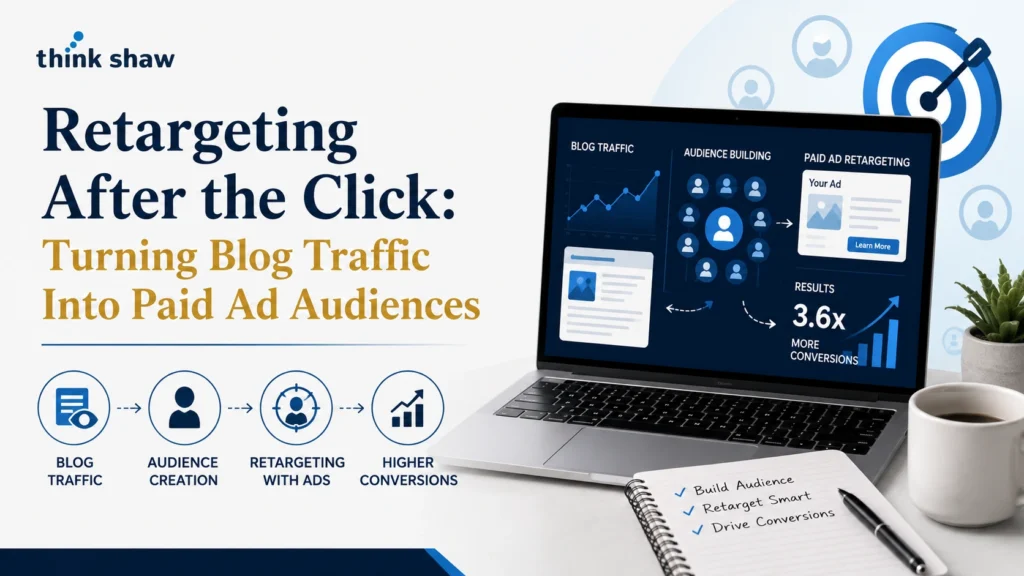
Turning Blog Traffic Into Paid Ad Audiences at a GlanceBlog visitors rarely convert immediately, but retargeting recovers that value by turning content-engaged readers into structured ad audiences. Success starts with pixel tracking (Meta, Google, LinkedIn) and segmentation by topic, funnel stage, and engagement depth. From there, tiered campaigns match creative to intent using frequency caps, recency-based bidding, and refreshed rotation. B2B retargeting outperforms B2C, and blog traffic’s built-in topic signals make audiences sharper than generic retargeting, driving stronger conversions. |
Why Does Blog Traffic Matter for Retargeting Ads?
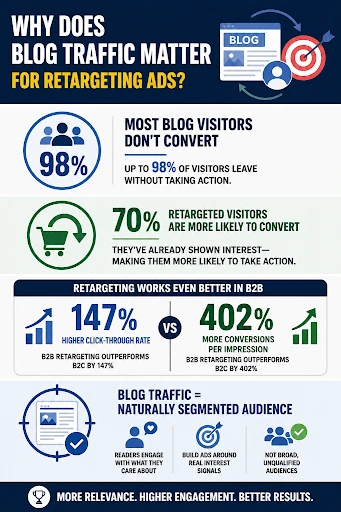
Most blog visitors never convert on their first visit; data from Invesp research shows up to 98% of website visitors leave without taking action. Google Display remarketing exists to recover that lost value. According to the same Invesp research, retargeted visitors are 70% more likely to convert than first-time visitors, since they’ve already shown genuine interest in your content. This effect is even stronger in B2B contexts: original client data published by retargeting platform Retargeter.com found B2B retargeting outperforms B2C retargeting by 147% in click-through rate and 402% in conversions per impression. Blog traffic strengthens this advantage further because it’s naturally segmented; a reader who finishes an article on a specific topic has already told you what they care about, letting you build ads around real interest signals rather than broad, unqualified audiences.
How Do You Track and Segment Blog Visitors for Retargeting?
Tracking and segmenting blog visitors comes down to two connected steps: capturing behavioral data at the pixel level, then organizing that data into meaningful groups an ad platform can act on. Without both steps, Google Ads retargeting collapses into showing the same generic ad to every visitor regardless of what they actually read.
Tracking: Capturing the Right Signals
- Install platform pixels/tags first. The Meta Pixel, Google Ads tag, and LinkedIn Insight Tag are the foundational scripts that let ad platforms recognize a blog visitor later and add them to an audience. These are typically deployed through Google Tag Manager for easier management across a site.
- Track behavior, not just visits. Effective tools capture where people click, how long they stay on a page, and how that varies by referral source and content type, not merely whether someone landed on the page.
- Layer on visitor identification where relevant. For B2B blogs especially, tools like Leadfeeder or DemandSense can de-anonymize traffic at the company level by matching IP data to firms, scoring them by intent and ICP fit, and feeding that into CRM or ad-platform syncing.
- Capture depth-of-engagement metrics. Page views, dwell time, and interaction patterns (scroll depth, video completion) are the core signals used to distinguish a skimmer from a genuinely interested reader.
Segmentation: Turning Raw Data Into Usable Audiences
- Segment by content topic first. The single highest-value segmentation axis for a blog is what the visitor actually read; grouping readers by category (e.g., legal content vs. security services content) lets you match ad creative to their specific interest.
- Segment by funnel stage based on page type. A common framework treats blog readers as top-of-funnel “research mode” visitors (served value-first content like guides or checklists), product/feature-page visitors as mid-funnel (served ROI calculators or comparison tools), and pricing/demo-page visitors as bottom-funnel with real buying signals.
- Segment by engagement intensity. Visitors who spent significant time on a page or scrolled deep into an article are meaningfully more likely to convert than those who bounced after a few seconds, so many marketers create separate tiers based on dwell time and page depth.
- Sync segments directly to ad platforms. Tools like EasyInsights and Customers.ai let marketers build segments (e.g., “high-intent,” “repeat visitor”) and push them automatically into Meta or Google Ads for activation, rather than manually exporting lists.
- Auto-tag visitors for ongoing use. Some Google Ads remarketing platforms apply tags automatically based on browsing behavior, so a visitor’s segment updates as they engage further, keeping the audience current rather than static.
How Do You Build Retargeting Campaigns That Convert Blog Readers?
Building a Google Display retargeting campaign that actually converts blog readers means treating retargeting as a structured system with distinct audiences and matched creative, not a single generic “come back” ad. The strongest campaigns follow a consistent sequence: match ads to intent tier, personalize creative to what was actually read, control exposure, and continuously refresh.
Structure Around a Tiered Funnel
- Build a 3-tier Google Ads remarketing structure. A widely used framework splits audiences into Cold (educational content, industry reports for first-time blog readers), Warm (case studies and comparison guides for repeat visitors), and Hot (free trials, demos, or limited-time offers for high-intent visitors), with each tier getting its own custom audience and content type.
- Segment by page depth and time-on-site. Visitors who read 3+ pages or spent over 2 minutes on-site show meaningfully higher intent than single-page skimmers, so separate campaigns should be built for these groups rather than lumping all blog readers together.
- Run separate campaigns per segment, not one blended campaign. High-intent and low-intent audiences shouldn’t compete for the same ad budget or see identical messaging; each segment needs its own campaign or ad group.
Match the Offer and Creative to the Blog Content
- Lead with a soft, low-threat offer for blog readers specifically. Rather than pushing a hard sale immediately, effective campaigns retarget blog readers with a complementary content piece, a related guide, or a free resource tied to what they read.
- Use messaging that acknowledges their research. A proven copy approach for blog-driven Google remarketing campaign explicitly references their behavior, e.g., “You’ve done your research! Now see how we can help solve your problem”, rather than generic promotional copy.
- Enable dynamic creative where possible. Platforms like Meta and Google Ads can automatically surface the exact content or product category a visitor viewed, keeping ads relevant without manual rebuilding for every segment.
- Address objections directly in ad copy. Since blog readers are often still evaluating, copy that counters common hesitations (cost concerns, trust, “no obligation”) tends to outperform pure promotional messaging at this stage.
Control Exposure and Timing
- Set frequency caps around 3–7 impressions. Multiple sources converge on capping exposure between 3–5 impressions per day or roughly 5–7 total impressions per campaign to avoid ad fatigue while staying visible.
- Use recency-based bidding tiers. A common structure bids highest on 0–3 day visitors for immediate follow-up, moderately on 4–14 day visitors for consideration-phase messaging, and lowest on 31–90 day visitors for brand recall.
- Exclude converters immediately. Anyone who has already converted should be removed from the retargeting pool via a burn pixel or exclusion list; continuing to pay for impressions on existing customers wastes budget.
- Match audience membership duration to your sales cycle. Short 1–3 day windows suit high-intent audiences, while longer 7–30 day windows fit visitors still in the research phase.
Keep Creative and Campaigns Fresh
- Rotate creative every 2–4 weeks. Refreshing images, copy, and formats (including testing static vs. video) prevents the same visitor from seeing identical ads repeatedly, which is one of the most common causes of retargeting fatigue.
- Match campaign type to funnel stage. Display ads work well for awareness-stage blog readers, RLSA (search retargeting) suits visitors with active search intent, and video/YouTube retargeting fits mid-funnel nurturing.
- Layer social proof for hesitant segments. Adding reviews, testimonials, or case studies into Google Display Network remarketing creative helps push warm-but-undecided blog readers toward conversion.
Conclusion
Turning blog readers into paid ad audiences isn’t guesswork; it’s a repeatable system built on smart tracking, precise segmentation, and disciplined campaign management. Getting this right takes hands-on expertise, and that’s exactly where Think Shaw comes in. As a Google-certified digital marketing agency, Think Shaw’s PPC and Google Ads remarketing specialists build tailored retargeting funnels that turn your blog’s warm traffic into measurable conversions across Google, Meta, and beyond. Stop letting your best content-qualified visitors slip away; partner with us today to build a retargeting strategy that puts your blog traffic to work.
Turning Blog Traffic Into Paid Ad Audiences FAQs
How much budget should I allocate to retargeting?
Most businesses allocate 20–40% of total ad spend to retargeting and the remaining 60–80% to cold acquisition, balancing new customer growth with re-engagement.
Do privacy laws like GDPR affect blog retargeting?
Yes. Retargeting requires disclosing tracking practices and offering opt-outs to comply with GDPR, CCPA, and similar privacy regulations before deploying pixels.
What’s a good retargeting window length?
It depends on your sales cycle: 7–14 days works well for fast, decision-stage conversions, while 30–90 days suits longer nurturing journeys.
Should retargeting ads link to a specific landing page?
Yes. Sending visitors to a page related to what they browsed, rather than a generic homepage, shortens the buying process and improves relevance.
Can retargeting ads run on search, not just display?
Yes. RLSA (Remarketing Lists for Search Ads) lets you adjust bids and messaging for past visitors when they later search relevant terms on Google.