When did you last click on a Google ad because you felt genuinely connected with it? You don’t remember right, that’s because, over the last few years, PPC advertising has changed a lot. Google’s AI tools, such as Smart Bidding, Responsive Search Ads (RSAs), and Performance Max campaigns, have made ad targeting smarter, but the message still lacks that emotional connection. Brands that use simple and relatable storytelling in their ads today are getting better results than those that only list features and benefits. So, in this guide, we will help you with how storytelling in PPC is done that actually gets you clicks. Come, let’s begin.
At a Glance: Storytelling in PPC AdsModern storytelling in PPC helps Google Ads feel more human, relatable, and emotionally engaging instead of sounding overly promotional. By using curiosity-driven headlines, real customer pain points, specific outcomes, and trust-focused messaging, brands can create high CTR ads that improve clicks, engagement, and conversions while aligning better with Google’s AI-driven ad systems. |
Why Are Generic PPC Ads Losing & Storytelling Winning?
The old PPC formula, which was stuffing the keywords, listing features, and adding a CTA, just isn’t working the way it used to. Here’s why it is losing the game:
People Have Learned to Ignore Ads
On average, a person sees thousands of ads every single day. So their brain’s response goes like tune them out automatically. Headlines like “Buy Quality Shoes Online” don’t even register anymore; they look like every other ad. But an ad that opens with a story, even a tiny one, makes people stop and actually read. This shift is exactly why modern Google Ads copywriting now focuses more on relevance and human connection instead of repetitive sales language.
Google’s AI Cares About Meaning, Not Just Keywords
Ads written around the searcher’s actual problem, in natural language, get better scores, better placement, and lower cost-per-click. Because Google no longer just matches keywords, it judges whether your ad actually makes sense to the person who is searching.
E-E-A-T Now Affects Your Ads Too
Experience, Expertise, Authoritativeness, Trustworthiness, the E-E-A-T, which started as an SEO concept, but it now touches PPC too. If your ad leads to a landing page with real stories, customer results, founder experiences, and honest testimonials, you will see that Google rates that experience higher, which feeds back into your ad quality.
A Buy-Push Doesn’t Work on Someone Still Deciding
Many people who are clicking ads aren’t ready to purchase yet. They’re still in their researching phase. A hard-sell ad aimed at those people gets ignored or bounced. But a copy that speaks to their problem first and earns their attention will perform far better at this stage. Also, a well-crafted emotional ad copy helps brands build trust before asking users to take action.
Performance Max Reaches People Who Have Never Heard of You
For an audience, a list of just product features lands flat because they don’t yet have a reason to care. That’s where Performance Max, Google’s campaign type that automatically places your ads across Search, YouTube, Gmail, Display, Discover, and Maps, comes in handy, as it often reaches people who have never searched for your product and have no prior awareness of your brand.
Storytelling Techniques Implemented by a PPC Manager for
Google Ads
Some of the most commonly used techniques are:
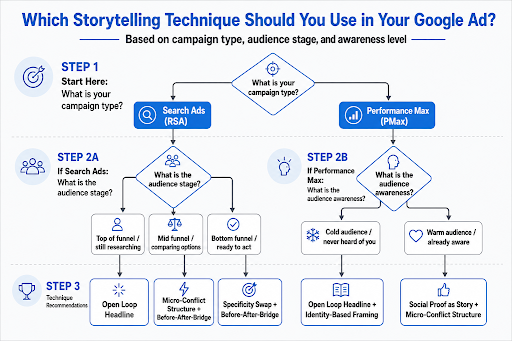
The Open Loop Headline
Start with a headline that creates curiosity without completing the thought. For example:
- “She asked Google once. Got the job.”
This headline implies a story, forces the brain to seek resolution, and compels a click. Such open loops work because our brains are neurologically wired to close incomplete narratives.
The Micro-Conflict Structure
Every story needs tension. In a Google Ad, introduce a pain point in Headline 1 and the resolution in Headline 2. Like:
- “Still Losing Clients to Competitors?” → “Here’s What Changed for 200 Agencies.”
This mirrors exactly what the searcher is already thinking when they type their query. Strong PPC ad examples like these usually outperform generic promotional headlines because they are more situation-specific.
The Specificity Swap
Always replace vague claims with hyper-specific proof points, such as:
- Instead of “Fast Results,” write “First 3 Leads in 72 Hours.”
Specific details like numbers, timeframes, and results feel more believable and professional. Google’s AI also prefers this because users are more likely to stay on pages with clear, concrete information.
Identity-Based Framing
People usually click on ads that reflect who they are or aspire to be. Make sure to use identity language in descriptions, in a way like:
- “Built for marketers who are done guessing.”
This technique works particularly well in RSAs where Google tests asset combinations; identity-anchored descriptions tend to achieve higher performance labels because they resonate with intent-specific audience signals.
The Before-After-Bridge in Descriptions
Google gives you 90 characters per description, which is actually enough to tell a mini story. The Before-After-Bridge (BAB) structure does it in three beats: here is the problem, here is the better version, here is how you get there. For example:
- “You’re tracking rankings, but revenue is flat. Our audit shows why and what to fix first.”
So, the problem, insight, and solution are all in one description. This structure is commonly used in high CTR ads because it quickly captures attention while clearly communicating value.
Social Proof as a Story Element
Embed the social proof as a narrative rather than a claim. Instead of:
- “Trusted by 5,000 businesses”, write “5,000 teams stopped second-guessing their ad spend.”
The second version shows a transformation and tells a story about people who changed, which is far more persuasive than a raw statistic.
Conclusion
PPC success in 2026 isn’t won at the bidding layer alone; it’s won at the sentence level also. Writers and SEO marketers who bring narrative craft into ad copy are the ones consistently turning impression share into revenue share. The algorithm responds to what humans respond to. Now, if your business is looking for PPC campaigns that do more than just attract clicks, Think Shaw is the right stop. From high-CTR ad campaigns to conversion-driven PPC management, we build ads that connect with real people and deliver measurable growth.
So, ready to turn scrolls into clicks and clicks into customers? Get in touch today!
FAQs
How often should Google Ads copy be refreshed to avoid fatigue?
For active campaigns, review the asset performance monthly. Poor-rated assets must be replaced immediately, and test replacements for low-Learning assets should be conducted every 4–6 weeks, particularly in high-volume campaigns where data accumulates faster.
What is the role of the description in a Google Ad & do people even read it?
Yes, especially on desktop. Descriptions reinforce the headline’s promise, add credibility, and carry the CTA. A weak description directly costs you conversions even when the headline works.
What is a good CTR for Google Search Ads?
It typically falls between 4% to 6% across all sectors. Anything above that for your category means your copy is resonating. If it is below, it means the message needs rethinking.
Does storytelling work for B2B Google Ads or only B2C?
It works strongly in B2B. The B2B buyers are humans with real pressures and deadlines. Copy that speaks to their specific frustration, not just their job title, converts better.
Should my Google Ad copy match my landing page exactly?
Not word-for-word, but the core message must align. A mismatch between ad promise and landing page content directly lowers your quality score and kills conversions.