
Managing a large ecommerce catalog is no longer just about adding products and generating traffic. As online stores expand to thousands or even millions of product pages, technical SEO for e-commerce becomes critical to maintaining search visibility, crawl efficiency, and overall site performance. Search engines allocate limited crawl resources, making issues such as duplicate content, faceted navigation, index bloat, and poor site architecture increasingly challenging for enterprise-level ecommerce websites. According to Google’s guidance on large sites, effective crawling and indexing depend on a well-structured technical foundation. This blog helps you learn the essential technical SEO strategies that help large e-commerce catalogs remain discoverable, scalable, and competitive in search results while delivering a seamless experience for both users and search engines.
Technical SEO Blueprint OverviewLarge ecommerce catalogs require a structured technical SEO framework to remain discoverable, scalable, and competitive in search results. Effective URL governance, crawl budget management, indexation control, internal linking, rendering optimization, and automation help search engines efficiently crawl and prioritize valuable pages. As catalogs generate millions of URLs through filters, variants, and pagination, technical SEO prevents crawl waste, index bloat, and delayed product discovery. Advanced strategies such as XML sitemap architecture, structured data automation, server-side rendering, hreflang implementation, and automated internal linking create a scalable foundation for long-term organic visibility and growth. |
What Is The Technical Seo Blueprint
The Technical SEO Blueprint is a structured framework that helps websites build a strong technical foundation for search engine visibility. Rather than being a single tool, it is a systematic approach that ensures search engines can efficiently crawl, render, index, and rank website content. For large ecommerce catalogs, following a Technical SEO Blueprint is essential for maintaining scalability, maximizing organic visibility, and supporting long-term search performance.
The blueprint focuses on key areas, including:
- URL Governance: Control URL growth
- Crawl Budget Management: Improve crawl efficiency
- Indexation Control: Reduce index bloat
- Internal Linking Architecture: Improve discovery
- Rendering & Performance: Enhance crawlability
- Monitoring & Automation: Maintain scalability
According to Google Search Central, crawl budget optimization becomes increasingly important for websites containing more than one million URLs or large volumes of frequently changing pages, making technical SEO a critical requirement for enterprise ecommerce catalogs.
Why Is Technical SEO Becoming Critical For Large Catalogs?
Without technical SEO, large catalogs face a fundamental invisibility problem: even the best products won’t rank if Google can’t find them. This is why following fact-backed reasons summarizes how technical SEO is now non-negotiable:
Catalog Growth Creates More URLs Than Products
Large catalogs rarely contain just product URLs. They also generate category pages, filtered views, parameterized URLs, pagination paths, sort orders, internal search pages, and product variants. A catalog with 100,000 products can easily create millions of crawlable URLs through faceted navigation SEO alone. Search engines must then decide which URLs to crawl and index, making technical controls essential.
For example, a category with 12 brands, 10 colors, 8 sizes, and 6 price ranges can generate thousands of unique filter combinations before multi-select filters are even considered.
Crawl Budget Becomes a Hard Resource Constraint
Large catalogs operate within a finite crawl budget, meaning Google allocates only a limited number of URLs it will crawl over a given period. In enterprise ecommerce environments, faceted navigation and parameter-driven URLs often consume a significant portion of that budget, diverting crawl activity away from primary category and product pages. At scale, this leads to:
- Important products are being crawled less frequently,
- New SKUs are taking longer to enter the index,
- Category pages are losing refresh priority,
- Seasonal or trending inventory is being discovered late.
Crawl budget for e-commerce for large catalogs is no longer theoretical; it becomes a direct limiter of revenue visibility velocity.
Botify’s enterprise crawl analysis found that websites exceeding one million pages experience a 33% reduction in crawl ratio compared to smaller sites, highlighting how crawl inefficiencies increase as catalogs scale.
Index Bloat Weakens Rankings
When your catalog has thousands of near-identical duplicate pages, Google’s index gets filled with junk instead of quality content, which lowers your overall rankings. Real product pages show up in Google Search Console with the “Discovered, currently not indexed” status, meaning Google found them but won’t add them to search results. About 18% of all crawled pages on large catalogs are broken with 404 or 500 errors, which wastes even more crawl budget. Your domain authority spreads thin across all these irrelevant duplicate URLs instead of building up on your real products.
At scale, this causes:
- Dilution of ranking signals across duplicate pages
- Confusion around canonical relevance
- Reduced perceived site quality due to low-value index ratios
Faceted Navigation Creates Exponential Crawl Waste
In large catalogs, faceted navigation can generate hundreds of thousands of URL combinations from a single category through filters such as brand, color, size, and price. These URLs often outnumber actual product pages, making technical SEO essential because it determines which facet combinations should be crawlable, indexable, canonicalized, or blocked. Without strict management, search engines waste crawl resources on low-value filtered states instead of discovering new products, processing inventory updates, and strengthening ranking signals for revenue-driving category pages. For large catalogs, technical SEO is the only mechanism that prevents faceted navigation from overwhelming crawl capacity and reducing the visibility of commercially important pages.
Technical SEO Directly Influences Product Discovery Speed
For large catalogs, visibility depends on how quickly new products can move from publication to indexation. Log-file analyses on enterprise ecommerce sites have shown that crawl waste from faceted URLs and internal search pages can consume the majority of Googlebot activity, delaying product discovery by weeks. After crawl optimization, indexing times have been reduced from multiple weeks to under two days
Technical SEO Strategies for Large Ecommerce Catalogs
XML Sitemap Index Architecture
Large catalogs should use a sitemap index that separates products, categories, and recently updated inventory into dedicated sitemap files. Automated updates, accurate lastmod timestamps, and inclusion of only canonical tags or URLs help search engines prioritize discovery and recrawling more efficiently.
Structured Data Automation
Automating Product Schema across the catalog ensures pricing, availability, SKU, brand, and review data remain synchronized with inventory changes. Category pages can also implement ItemList Schema, helping search engines better understand product relationships and catalog structure.
Server-Side Rendering for JavaScript-Based Catalogs
For JavaScript-heavy ecommerce platforms, server-side rendering ensures product titles, descriptions, prices, and internal links are available in the initial HTML response. This improves crawlability and reduces indexing delays that commonly affect large dynamic product inventories.
Edge Caching and Content Delivery Optimization
Large ecommerce sites use CDNs, edge caching, image optimization, and Brotli compression to reduce server response times. Faster content delivery improves crawl efficiency, supports higher crawl volumes, and ensures search engines can access inventory pages more consistently.
International SEO Through Hreflang Management
Multi-region catalogs should implement hreflang annotations through XML sitemaps to manage thousands of localized URLs efficiently. Combined with self-referencing canonical tags, this helps search engines serve the correct regional product pages while avoiding duplicate-content conflicts.
Automated Internal Linking Systems
Large catalogs rely on automated breadcrumbs, related-product modules, category hubs, and frequently bought-together sections to strengthen internal linking. These systems improve product discoverability, distribute ranking signals efficiently, and prevent important inventory from becoming isolated.
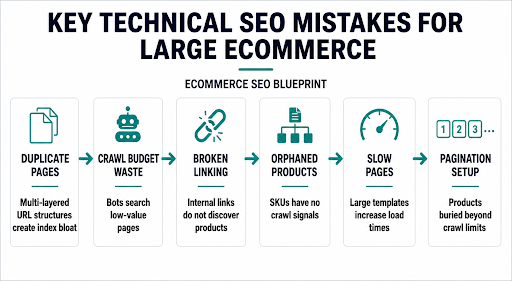
Common Technical SEO Mistakes That Hurt Large E-commerce Websites
Conclusion
For large ecommerce catalogs, technical SEO is ultimately about controlling scale. As product counts, category layers, and URL variations grow, even minor inefficiencies can multiply into significant visibility losses. By implementing structured crawl management, indexation governance, and scalable site architecture, businesses can create a stronger foundation for sustainable organic growth. Partnering with Think Shaw gives enterprise ecommerce brands access to specialized technical SEO strategies designed to improve crawl efficiency, maximize index value, and unlock the full search potential of complex catalogs.
Frequently Asked Questions: Large Catalog Technical SEO
Why do some products rank better than others in large catalogs?
Technical SEO improves internal linking, category hierarchies, and crawl paths, making it easier for search engines to prioritize products and categories that generate the most revenue and organic traffic.
What helps search engines find products buried deep within a catalog?
A strong technical structure reduces click depth through optimized navigation, contextual internal links, and effective pagination, helping search engines discover deeper product pages more efficiently.
How are seasonal products managed without losing SEO value?
Technical SEO supports inventory changes through proper redirects, status codes, sitemap updates, and internal linking adjustments, helping preserve ranking signals when products are added, removed, or updated.
Why do category pages sometimes compete against each other?
When category structures overlap, search engines can struggle to identify the most relevant page. Technical SEO uses keyword mapping, canonicals, and clear architecture to prevent cannibalization.
How does a technical SEO blueprint support long-term catalog growth?
It establishes a scalable framework for managing new products, categories, filters, and site updates while maintaining crawl efficiency, index quality, and organic search visibility.