You’ve been doing SEO right, with consistent content, decent rankings, and growing traffic. But the leads? Barely there. If that seems to be something familiar, the problem probably isn’t your effort. It’s the keywords you’re targeting. Generally, most businesses chase keywords that bring readers, not buyers. But no need to worry, as there’s a type of keyword built specifically for buyers, not browsers, that are called high-intent keywords. These are the phrases people type when they already know what they want and just need to find the right place to get it. So, we have this guide to show you exactly how to find them for your niche. Let’s dive in.
What Makes a Keyword “High-Intent” in the First Place
Not every search means the same thing. When someone types into Google, they’re either learning, comparing, or buying. Thus, your job is to show up for the buying ones. As every search falls into one of four types:
- Informational: “What is keyword research?”
- Navigational: “Ahrefs login.”
- Commercial: “Best SEO tools for small business.”
- Transactional: “Hire SEO consultant for eCommerce.”
The high-intent keywords fall in the last two. The volume is lower, but the people behind those searches are far more valuable. Even research from Penn State University, analysing over 130,000 web queries, found that more than 75% of all searches are informational, with transactional queries making up only around 12%. That’s exactly why a smart keyword research strategy focused on that 12% puts you ahead of your competitors who are chasing the wrong audience.
How To Think Like Your Buyer Before You Touch Any Tool
Before you open any tool like Ahrefs or Semrush, always step into your buyer’s shoes. Ask yourself: what does someone type when they’re done researching and ready to act? Buyers don’t search like learners. They use specific, urgent, outcome-driven language, like “hire,” “cost,” “near me,” and “best for my industry.”
So, all you have to do is map your buyer’s journey backwards. Start from the moment they pull out their card and work your way up. What did they need to be convinced of? What objections did they need resolved first? What comparisons did they run? Your keyword strategy should mirror that path, not the top of it, but the bottom, where decisions happen and money moves.
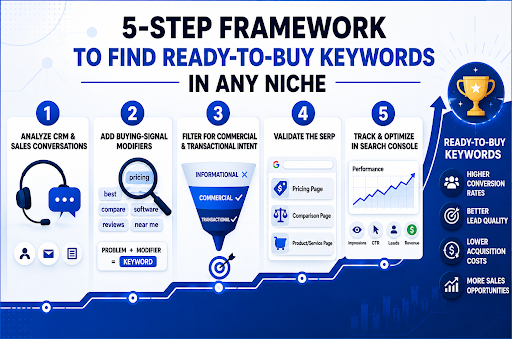
A Step-By-Step Process To Find Ready-To-Buy Searches In Your Niche
This is the exact process that powers SEO for leads, not just traffic.
Step 1: Start With What You Already Have
Your best keyword ideas aren’t in any tool, but they’re in your CRM and sales conversations. Ask your team what phrases prospects used right before they said yes. These are real buying moments that no tool will show you.
Step 2: Add Buying-Signal Modifiers
Take your main service keywords and combine them with action-focused phrases such as “pricing,” “cost,” “best for [industry],” “alternative to [competitor],” or “hire.” This is where your bottom-of-funnel keywords live.
Step 3: Filter by Intent Inside Your Tool
Open Ahrefs or Semrush and use the intent filter. Select “commercial” and “transactional” only. This removes all the informational noise instantly. Remember, high volume means nothing if the intent is wrong.
Step 4: Validate by Reading the SERP
This one step saves you from wasting months on the wrong keywords. Search the term yourself and look at what Google shows. If page one is full of blog posts and Reddit threads, it’s still an informational query. If you see service pages, pricing pages, and local business listings, that’s a transactional SERP, and it’s worth going after.
Where To Look Beyond the Obvious Keyword Tools
- Review platforms: Like the G2, Capterra, Trustpilot, and Amazon reviews, as they are like goldmines. Look at 3-star and 4-star reviews specifically; those are people who almost bought, which means they articulate the decision-making language clearly. Copy the exact phrases they use to describe what they were looking for.
- Reddit and niche forums: Surface the unfiltered questions buyers ask before spending money. Search your niche + “recommendations,” “which is better,” or “anyone used”, and you’ll find threads full of high-intent keywords hiding in plain sight.
- Competitor pricing and comparison pages: These are another powerful signal. If a competitor ranks for “[their brand] vs [your brand]” or has a dedicated pricing page, those are confirmed transactional keywords worth targeting. They’ve done the validation work for you.
- Your own Google Search Console: This data is underused. Filter by queries with a low click-through rate but decent impressions; these are often high-intent searches where you’re showing up, but your meta title or description isn’t matching the buyer’s intent clearly enough to earn the click.
Conclusion
It is clear that high-intent keywords aren’t just a shortcut, but they’re a smarter direction. When you align your content with what buyers actually search at the moment of decision, SEO stops being a traffic game and starts being a revenue engine. So if you’re ready to start attracting buyers, Think Shaw knows exactly how to make that happen for you. We specialise in data-driven SEO strategies, from in-depth keyword research and on-page optimisation to full-scale eCommerce and local SEO.
Ready to rank where it actually converts? Let’s get in touch today!
FAQs- About High-Intent Keyword Strategy
What is the difference between high-intent and long-tail keywords?
Long-tail keywords are specific and low-volume. The high-intent keywords signal buying readiness. They often overlap, but not all long-tail keywords carry purchase intent.
How many high-intent keywords should I target per page?
Focus on one primary high-intent keyword per page with 2–3 supporting variations to avoid keyword cannibalisation and keep content focused for both users and search engines.
Are high-intent keywords seasonal or evergreen?
Most are evergreen, but some spike seasonally, like “buy X for Christmas.” So, use Google Trends alongside your keyword tool to identify patterns before investing in seasonal content.
Do high-intent keywords work for B2B businesses?
Yes, especially well. B2B buyers research heavily before committing, making transactional phrases like “enterprise pricing” or “request a demo”, which is extremely valuable for lead generation.
Can I use high-intent keywords in paid ads, too?
Absolutely. High-intent keywords are even more valuable in PPC since you pay per click. Targeting buyers directly maximises your ad spend and improves conversion rates significantly.