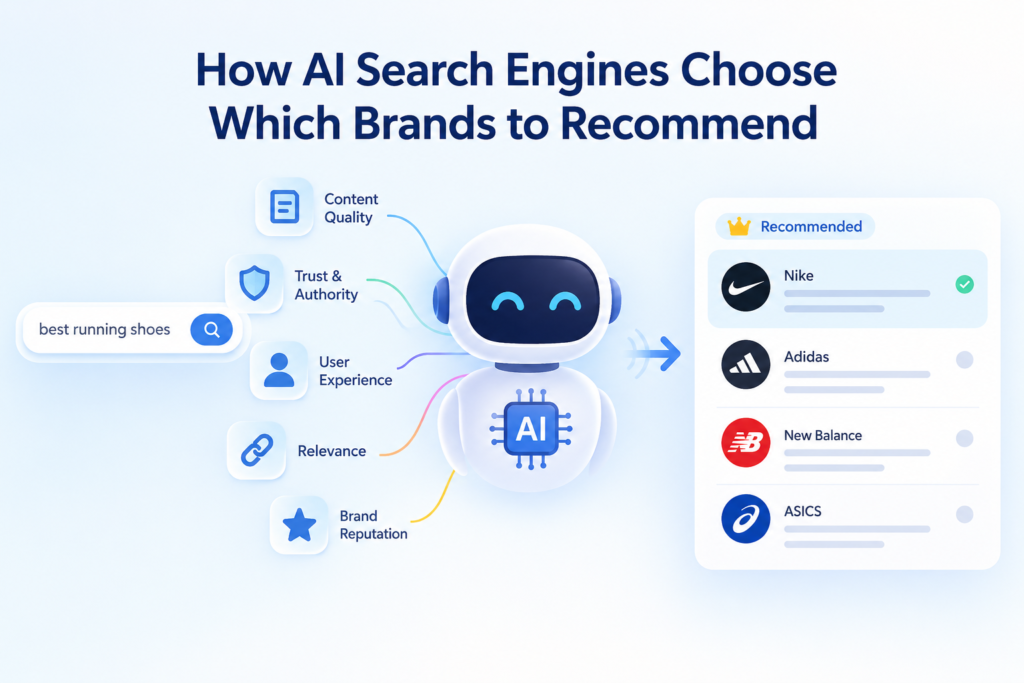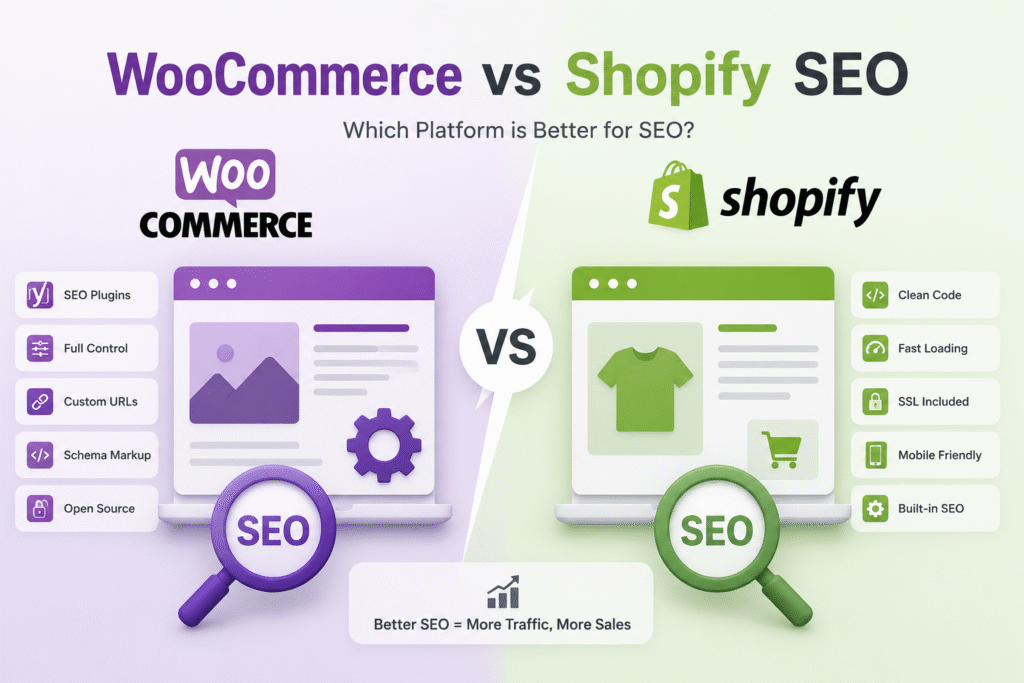
Your eCommerce platform is an SEO decision, and the data in 2026 makes that clearer than ever. Shopify’s Core Web Vitals pass rate sits at 75–78%, while WooCommerce trails at just 33–40% due to plugin bloat and inconsistent hosting quality. Yet speed alone doesn’t tell the full story. The WooCommerce vs Shopify SEO gap goes deeper than page speed, as an Ahrefs 2026 eCommerce SEO study found that WooCommerce stores rank for 34% more organic keywords on average than Shopify stores in the same niche, a gap largely driven by WordPress’s blogging depth and flexible URL architecture. Meanwhile, optimizing for Answer Engines and AI-generated search results has become as critical as traditional SEO in 2026, introducing an entirely new dimension to this rivalry. The answer isn’t simple, and it depends heavily on your team, your strategy, and how you define “winning” in search.
SEO Platform Comparison OverviewWooCommerce and Shopify both support strong eCommerce SEO, but they excel in different areas. Shopify delivers faster performance, stronger Core Web Vitals, built-in AI tools, and lower technical risk through its managed infrastructure. WooCommerce offers greater control over URLs, schema, international SEO, and content marketing, helping stores build broader keyword visibility and long-term topical authority. The ideal choice depends on whether your business prioritizes content-driven organic growth or streamlined product-focused SEO with minimal technical management. |
Shopify vs WooCommerce SEO: Core SEO Features Compared in 2026
URL Structure & Permalink Control
WooCommerce gives you total control over permalinks, categories, and slugs, while Shopify enforces fixed URL prefixes for products and collections that cannot be removed. WooCommerce lets you build keyword-rich, hierarchical URLs that reinforce topical relevance at every level. This matters most for stores managing large catalogues with complex taxonomies, where URL architecture directly impacts how search engines crawl and understand your site’s structure.
XML Sitemaps & Robots.txt Customization
Shopify auto-generates XML sitemaps, canonical tags, and SSL certificates on every store from day one, requiring zero configuration. WooCommerce via Yoast or Rank Math offers full sitemap customization across post types and taxonomies. The key limitation: Shopify’s robots.txt cannot be fully customized, which restricts crawl management for larger stores with dynamic filter pages, pagination variants, or faceted navigation, all common crawl budget killers on high-SKU eCommerce sites.
Structured Data & Schema Markup
Shopify ships baseline Product, Organization, and Breadcrumb schema automatically, while WooCommerce relies on plugins like Yoast or Rank Math, flexible but inconsistent without proper configuration. The 2026 differentiator is depth: SEO increasingly favors nested Product, Review, Offer, and BreadcrumbList schema that communicates context to Google’s knowledge graph, and WooCommerce allows merchants to implement and override any schema field, an advantage that Shopify’s theme-level schema simply cannot match.
Duplicate Content Management
On Shopify, duplicate content commonly appears between collection and product page URLs when canonicalization isn’t actively managed. Large Shopify catalogs frequently suffer from tag-based collection pages containing identical products under slightly different URLs. WooCommerce carries the same risk through misconfigured filters and layered navigation, but unlike Shopify, it provides direct access to robots.txt, noindex rules, and canonical overrides, giving technical SEOs precise control over exactly which pages get indexed.
Meta Titles, Descriptions & Redirect Management
One of the most overlooked technical SEO differences between the two platforms lies in metadata and redirect management; both allow per-page editing of meta titles and descriptions, but WooCommerce goes significantly deeper. Yoast SEO, with over 5 million active installations, provides granular control over metadata for every page type, along with integrated 301 redirects with URL change detection. On Shopify, changing a URL handle multiple times creates redirect chains that slow crawling and require periodic cleanup in Google Search Console, a technical debt that quietly accumulates in fast-moving stores.
Content & Blogging Architecture for SEO
WordPress is the default choice for content-led SEO, nested categories, editorial templates, and block editor patterns that scale across hundreds of articles. For a media-heavy SEO strategy built on guides, news, or programmatic content hubs, WordPress still leads decisively. Shopify’s blog, by contrast, is built for a store that occasionally publishes, not a brand whose primary acquisition channel is organic content.
Where WooCommerce and Shopify Truly Differ for SEO in 2026?
When comparing Shopify vs WooCommerce SEO on the surface, both platforms check the same SEO boxes. Dig deeper, and the differences are significant enough to change your ranking trajectory entirely.
| SEO Dimension | WooCommerce | Shopify |
| Core Web Vitals Pass Rate | 44% of stores pass the threshold | 65% of stores pass the threshold |
| Mobile Load Performance | Highly variable — best-in-class with the right hosting, slow on budget servers | Predictably fast — CDN-managed with no configuration required |
| Topical Authority | Ranks 34% more organic keywords on average in the same niche | Trails on keyword breadth due to the limited blogging infrastructure |
| AI Search Discoverability | Strong on content-layer entity signals and schema depth | Google and major LLMs recognise Shopify as a commerce platform, giving product listings a native advantage in AI Overviews and recommendation carousels |
| International SEO (20+ Markets) | Full ccTLD, subdirectory, and hreflang control via WPML or Polylang | Encounters friction above 20 markets and does not support independent ccTLDs with shared inventory |
| AI Content Workflow | Requires building a separate tool stack to match Shopify’s native output | End-to-end AI content tools built directly into the merchant dashboard |
| Technical Debt Risk | Plugin sprawl, inconsistent updates, and weak hosting create unstable sites that are hard to optimize | Fully managed infrastructure eliminates plugin conflicts and hosting failures |
| Migration SEO Risk | Following a migration SEO checklist with correct 301 redirects retains around 92% of rankings within two weeks | Active WordPress blogs migrating to Shopify face progressive content traffic decline over 12–18 months |
| Best Fit | Technical teams running content-driven, SEO-first stores | Non-technical teams running product-focused, conversion-first stores |
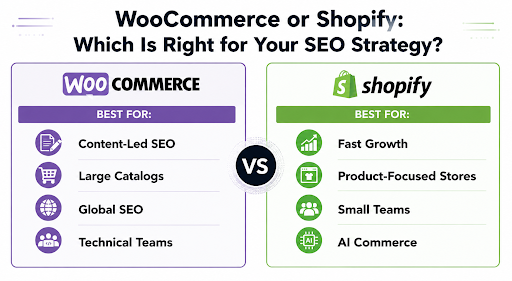
WooCommerce or Shopify: Which Is Right for Your SEO Strategy?
Each platform excels in different areas of SEO, making the decision less about finding a winner and more about choosing the solution that fits your long-term objectives.
Which Platform Wins SEO in 2026? (and Why)
Page Speed & Core Web Vitals: Shopify Wins by Default
Shopify delivers better SEO out of the box, 65% of Shopify stores pass Core Web Vitals thresholds versus 44% of WooCommerce stores. Shopify has a median mobile LCP of 2.6 seconds, while WooCommerce sits at 3.5 seconds, with a range spanning from 1.8 to over 6 seconds depending on hosting quality and plugin load. WooCommerce has a higher performance ceiling, but only for stores with managed hosting and disciplined plugin stacks. For everyone else, Shopify is consistently faster without any configuration.
Topical Authority & Keyword Coverage: WooCommerce Wins Long-Term
WooCommerce stores rank for 34% more organic keywords on average than Shopify stores in the same niche, controlling for domain authority, a gap largely driven by WooCommerce’s blogging capabilities and flexible URL structures. For businesses where a major share of growth comes from educational content, comparison pages, buying guides, and topical authority building, WooCommerce is usually the stronger long-term platform because of the WordPress content environment. This advantage compounds over time in ways Shopify’s basic blog simply cannot replicate.
International SEO: WooCommerce Offers Greater Control
For advanced internationalisation with hreflang and country subdirectories, WooCommerce with WPML or Polylang still offers the most technical control. Shopify Markets automates hreflang generation effectively for brands expanding into 5–10 markets, but stores with more than 20 active markets encounter friction in hreflang management and cannot support independent country-code top-level domains with shared product inventory. For global brands with complex multi-market SEO strategies, WooCommerce’s URL-level granularity gives it a decisive advantage.
AI-Powered SEO & Product Discoverability: Shopify Pulls Ahead
Shopify Magic covers product descriptions, email campaigns, blog posts, and customer segmentation natively, while WooCommerce relies on third-party plugins for comparable AI features, adding $30–$150 per month in additional tool costs. In 2026, Google and major LLMs recognise Shopify as a commerce platform, giving product listings a structural advantage in AI overviews, recommendation carousels, and agentic shopping features, without any additional optimization required from the merchant.
SEO Risk & Technical Debt: Shopify Is Safer for Non-Technical Teams
On WooCommerce, technical sprawl from too many plugins, inconsistent update practices, and weak hosting creates slow, unstable sites that are genuinely hard to optimize. Accumulated technical friction carries a real SEO cost because it drains time that should go to content strategy and link building — the two levers that actually move organic traffic over the long term. Shopify’s managed infrastructure eliminates this entire risk category, with no plugin conflicts, no hosting failures, and no accidental misconfigurations that can silently damage rankings overnight.
The Verdict: It Depends on Your Business Model
The honest WooCommerce vs Shopify SEO verdict in 2026 remains WooCommerce for content-led SEO and Shopify for product-led and AI-visible SEO. What has shifted is that the Shopify side of that verdict is growing faster than the WooCommerce side is shrinking. The question is not which platform has better SEO, but which platform lets you execute your SEO strategy without friction. Shopify suits teams without dedicated technical capacity; WooCommerce suits teams with technical capability who need full control. Your eCommerce platform SEO strategy ultimately begins with a business model decision, not a technical one.
Conclusion
The platform you choose sets the ceiling. Your SEO execution determines whether you ever reach it. WooCommerce and Shopify both have a clear path to page one, but only when matched to the right business model and backed by a consistent strategy.
Not sure which platform fits your store, or why your current one is not ranking as it should? Think Shaw is a Google-certified eCommerce SEO agency with a 50+ member team, delivering platform-specific strategies across both Shopify and WooCommerce, from technical audits and content optimization to conversion-focused web design, all under one roof, tailored to your exact business goals.
Hundreds of eCommerce stores, on both Shopify and WooCommerce, trust Think Shaw to turn your platform into a ranking machine. Find out why!
FAQs About WooCommerce vs Shopify SEO
Can I switch from Shopify to WooCommerce without losing my SEO rankings?
Yes, but only with proper preparation. Map every old URL to its new destination using 301 redirects before going live. Changing platforms without this step causes downtime that temporarily impacts your SEO, and in many cases, the ranking loss becomes permanent if redirects are missed or delayed.
Which platform is better for SEO if I have no technical background?
Shopify. A non-technical marketing lead can handle 90% of daily operations with zero risk to the core site. Its fixed URL structure prevents common beginner SEO mistakes, misconfigured robots.txt, broken sitemaps, and accidental noindex tags, that non-technical WooCommerce users frequently make without realizing the ranking damage caused.
Which platform handles product variant SEO better?
WooCommerce. Shopify caps product variants at 2,048 combinations per product and does not create individual URLs for variants, meaning each variant cannot be independently optimized for a unique keyword. WooCommerce allows unlimited custom fields and variant configurations without hitting platform restrictions, a meaningful advantage for stores targeting long-tail search traffic.
Can Think Shaw help me choose between WooCommerce and Shopify for SEO?
Absolutely. Think Shaw is a Google-certified digital marketing agency with hands-on experience delivering eCommerce SEO services across both Shopify and WooCommerce. Our team conducts in-depth store audits, identifies platform-specific ranking gaps, and recommends the right setup based on your business model, technical capacity, and long-term SEO goals, not a one-size-fits-all answer.
What eCommerce SEO services does Think Shaw offer for Shopify and WooCommerce stores?
Think Shaw’s eCommerce SEO services cover brand visibility, web standards evaluation, audience targeting, content strategy, and conversion-focused optimization, all tailored specifically to your platform. Whether you need a full technical audit, keyword strategy, schema implementation, or ongoing SEO management, Think Shaw handles it across both Shopify and WooCommerce under one roof.