Hiring ecommerce SEO services without the right groundwork is one of the fastest ways to waste a sizeable budget. Yet most brands do exactly that, rushing into agency partnerships before their own house is in order. The result? Slower timelines, misaligned strategies, and ROI that never materialize. With global ecommerce competition tightening and Google’s algorithms growing increasingly sophisticated, the margin for error is shrinking faster than ever. Poor preparation doesn’t just slow campaigns down; it actively undermines them. Before you invest in an ecommerce SEO agency, there are critical internal mistakes that quietly sabotage even the best-laid campaigns. This blog walks through seven of the most costly ones, and what smart brands do instead.
Ecommerce SEO Readiness SummarySuccessful ecommerce SEO starts long before hiring an agency. Brands often undermine results by relying on default platform settings, ignoring crawl budget, skipping technical audits, lacking keyword-to-URL mapping, neglecting internal linking, overlooking competitor benchmarking, and using duplicate product descriptions. To maximize ROI, businesses should establish technical baselines, define revenue-focused KPIs, verify platform expertise, review sample deliverables, secure ownership of SEO assets, monitor crawl health, and align content strategies with site architecture and growth objectives. |
The Ecommerce SEO Mistakes That Cost Brands Before They Even Start
1. Relying on Default Platform SEO Settings
Shopify and WooCommerce ship with auto-generated canonical tags, duplicate collection URLs, and unoptimized pagination structures. Without manual configuration, these defaults create crawl inefficiencies that quietly work against your rankings. Googlebot ends up wasting crawl budget on low-value system-generated pages while high-priority product and category pages go underindexed. Most brands never catch this because the site looks and functions perfectly fine on the surface.
2. Ignoring Crawl Budget on Large Product Catalogues
Faceted navigation on large catalogues generates hundreds of thousands of parameterized, thin URLs, size filters, color variations, and sort orders, none of which should rank. Without a defined robots.txt directive or noindex strategy on these filtered pages, search engines dilute domain authority across URLs that were never intended to appear in SERPs, leaving your actual money pages with far less ranking power than they deserve.
3. Skipping a Baseline Technical Audit
A site that loads and converts feels SEO-ready, but it rarely is. Without auditing Core Web Vitals scores, crawl errors, broken internal links, redirect chains, and indexation gaps beforehand, there is no performance baseline to work from. Any agency inheriting this site spends the first several billing cycles identifying problems that should have been documented and resolved before the engagement even began.
4. No Keyword-to-URL Mapping Architecture
Without a documented map of which URLs target which keywords, keyword cannibalization becomes inevitable. Product pages, category pages, and blog posts end up competing for the same queries, splitting link equity and suppressing all of them in SERPs simultaneously. This is one of the most common and most expensive structural problems agencies uncover, and one that takes significant time and resources to untangle retroactively.
5. Unstructured Internal Linking Across Category Hierarchies
When internal linking has no deliberate architecture, PageRank flows randomly across the site. Category pages, which carry the highest commercial intent and the greatest ranking potential, often receive fewer internal links than informational blog posts. This starves them of the authority needed to compete for high-volume transactional queries, creating a site where the most important pages are paradoxically the least supported ones.
6. No Competitor SERP Benchmarking
Entering an SEO engagement without competitor data means starting without a strategy. Brands often have no visibility into how rivals are capturing featured snippets, dominating People Also Ask results, or structuring long-tail category pages to win niche traffic. Without this intelligence mapped out beforehand, your ecommerce SEO firm’s early months are spent building context that the brand itself should have already gathered and documented.
7. Treating Product Descriptions as Inventory Copy
Manufacturer-supplied product descriptions are syndicated across thousands of ecommerce sites simultaneously. Brands that never replace them with original, semantically rich copy are feeding Google content it has already indexed elsewhere, a direct signal of thin, duplicate content. This suppresses product page rankings before ecommerce SEO experts have touched the account, meaning the agency spends early resources fixing a foundational content problem rather than building on a clean slate.
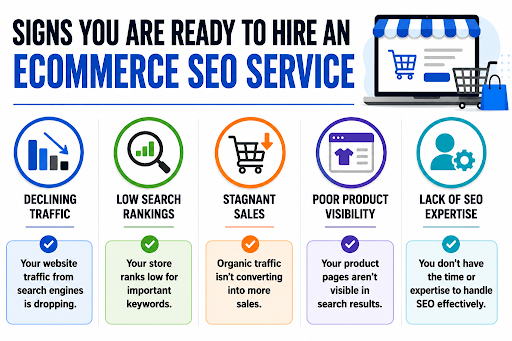
Signs You Are Ready to Hire an Ecommerce SEO Service
Before you start evaluating agencies, it helps to know whether your business is actually positioned to make the most of ecommerce SEO service.
The Right Way to Hire an Ecommerce SEO Agency
Audit Your Site’s Technical Health Before Outreach
Before approaching any agency, run a crawl using Screaming Frog or Sitebulb to document existing issues, broken links, redirect chains, missing metadata, and crawl errors. Presenting a pre-existing audit signals organizational maturity and allows agencies to scope work accurately from day one, rather than spending their early retainer budget on discovery that they could have handled independently.
Define Measurable KPIs Tied to Revenue, Not Just Rankings
Rank improvements mean nothing without business impact. Before hiring, establish KPIs around organic revenue contribution, conversion rate by landing page, and assisted conversion value in GA4. This aligns both parties on outcomes that actually move the business and gives you a clear, objective framework for evaluating agency performance beyond rankings and traffic numbers alone.
Verify Their Experience With Your Specific Platform
Shopify, Magento, WooCommerce, and BigCommerce each carry distinct technical SEO constraints. An agency experienced in one may lack the hands-on expertise to navigate another effectively. Ask for specific examples of hreflang implementation, schema markup deployment, and crawl budget management on your exact platform before committing to any ecommerce SEO agency or onboarding process.
Request a Sample Deliverable, Not Just a Proposal
A polished pitch deck reveals very little about execution quality. Ask shortlisted agencies for a sample technical audit, keyword mapping document, or content brief from a comparable ecommerce client. Actual deliverables expose the depth of their process, the tools they rely on, and whether their output standard genuinely matches what your internal team can action.
Clarify Ownership of All SEO Assets
Many brands discover that post-engagement, the ecommerce SEO company retains ownership of link profiles, content assets, or proprietary reporting dashboards. Before signing, confirm in writing that all produced content, acquired backlinks, keyword research documents, and analytics configurations remain the brand’s property, unconditionally, regardless of whether the agency relationship continues or is terminated early.
Establish a Crawl and Indexation Monitoring Protocol
Agree upfront on how the agency will monitor Google Search Console coverage reports, index status fluctuations, and crawl anomalies regularly. Without a defined monitoring cadence, indexation drops and crawl issues can go undetected for weeks, compounding into ranking losses that take significantly longer to recover from than they would have taken to prevent.
Align on Content Velocity That Matches Your Site Architecture
Publishing frequency should be determined by your site’s existing authority, internal linking capacity, and topical cluster gaps, not arbitrary monthly content targets. Ask prospective agencies how they calculate content velocity and whether their publishing plan is mapped to a deliberate topic cluster strategy that channels authority toward your highest-converting category and product pages.
Conclusion
The brands that win at ecommerce SEO don’t just avoid mistakes; they partner with the right people from day one. Think Shaw is a Google-certified agency that has driven over 6 million leads for clients across industries, delivering 540+ #1 rankings on Google. Whether you’re launching a new store, scaling an existing one, or fixing a campaign that never took off, we’re ready to take it from here.
Your competitors are already investing in SEO. Don’t fall behind, let Think Shaw drive the rankings and revenue you deserve.
FAQs About Hiring Ecommerce SEO Services
What makes ecommerce SEO different from standard SEO services?
Ecommerce SEO involves managing significantly more complex site architecture, including product and category page optimization, faceted navigation, schema markup for pricing and availability, and crawl budget allocation across thousands of URLs. It requires platform-specific expertise and a deeper understanding of purchase-intent keyword targeting compared to standard service or informational websites.
Can ecommerce SEO services help with international or multilingual stores?
Yes. Experienced ecommerce SEO agencies implement hreflang tags to signal language and regional targeting to search engines, create geo-specific content strategies, and manage international URL structures, whether subdirectories, subdomains, or country-code domains, ensuring each market receives a properly optimized and indexed version of your store.
How do ecommerce SEO agencies handle algorithm updates mid-campaign?
Experienced agencies monitor Google Search Console and third-party rank trackers consistently for traffic anomalies tied to core updates. Upon identifying shifts, they cross-reference affected URLs against update patterns, diagnose root causes, typically content quality or E-E-A-T gaps, and refine the strategy proactively to protect and recover rankings as quickly as possible.
How do agencies handle seasonal demand fluctuations in ecommerce SEO?
Experienced agencies, like Think Shaw, plan content calendars and link-building pushes around your peak trading periods, building authority and indexing new pages well in advance of high-demand seasons. This ensures category and product pages are already ranking strongly before seasonal traffic surges, rather than optimizing reactively after the peak demand window has passed.
What role does content play in an ecommerce SEO campaign?
Content is the foundation of long-term ecommerce SEO success. Agencies develop topic cluster strategies that connect informational blog content to commercial categories and product pages, building topical authority across your niche. This signals to Google that your store is a credible, comprehensive resource, directly improving the ranking potential of your highest-converting pages.