A website migration is one of the highest-risk, highest-reward moves in a long-term SEO strategy. Whether you’re switching CMS platforms, moving to a new domain, restructuring your URL architecture, or rebuilding the entire front end, a single misstep can wipe out years of accumulated rankings, backlinks, and organic revenue in a matter of days. This Site Migration SEO Checklist breaks down exactly what to audit, preserve, redirect, and monitor — using the same Website Migration SEO Checklist logic that experienced SEO teams rely on to protect visibility through platform changes, redesigns, and domain moves. Treat this Migration SEO Checklist as your operational playbook: skip a step, and you risk months of recovery work; follow it in order, and migration becomes a controlled, measurable process rather than a gamble.
| Expert Overview Of Site Migration SEO Checklist?
A site migration SEO checklist ensures a website retains its search rankings when switching platforms, domains, or URL structures. Core steps include pre-migration benchmarking, one-to-one URL mapping with 301 redirects, preserving titles, schema, and internal links, plus post-launch monitoring for three to six months. Most ranking losses stem from broken redirects, leftover noindex tags, or bundling content changes with the platform switch. Following this checklist protects both traditional rankings and AI-driven answer visibility. |
Why Site Migrations Put Rankings at Risk
Search engines rank URLs, not brands. The moment a URL structure, server response, or content signal changes without proper mapping, search engines have to re-evaluate trust signals almost from scratch. This is why a well-executed SEO Site Migration Checklist focuses less on the redesign itself and more on preserving every signal — technical, content, and authority-based — that convinced search engines to rank the old pages in the first place.
- Redirect chains and broken 301s that dilute link equity and confuse crawlers
- Loss of internal linking structure that previously distributed authority to key pages
- Accidental noindex tags or blocked staging environments left live post-launch
- Content or structural changes bundled together with the platform switch, making it impossible to isolate the cause of ranking drops
- Missing structured data or schema markup that previously supported rich results and AI-driven answer visibility
Pre-Migration Planning and Benchmarking
Every reliable Migration SEO Checklist starts before a single line of code changes on the live site. This phase establishes the baseline you’ll compare against for months after launch, and it’s where most of the real protective work happens.
Audit and Document the Current Site
- Run a full crawl of the existing site to capture every indexable URL, status code, and canonical tag
- Export current keyword rankings, organic traffic, and top-converting landing pages as your recovery benchmark
- Document existing backlink profiles and identify which pages carry the most external authority
- Record current page titles, meta descriptions, header tags, and schema markup for every priority URL
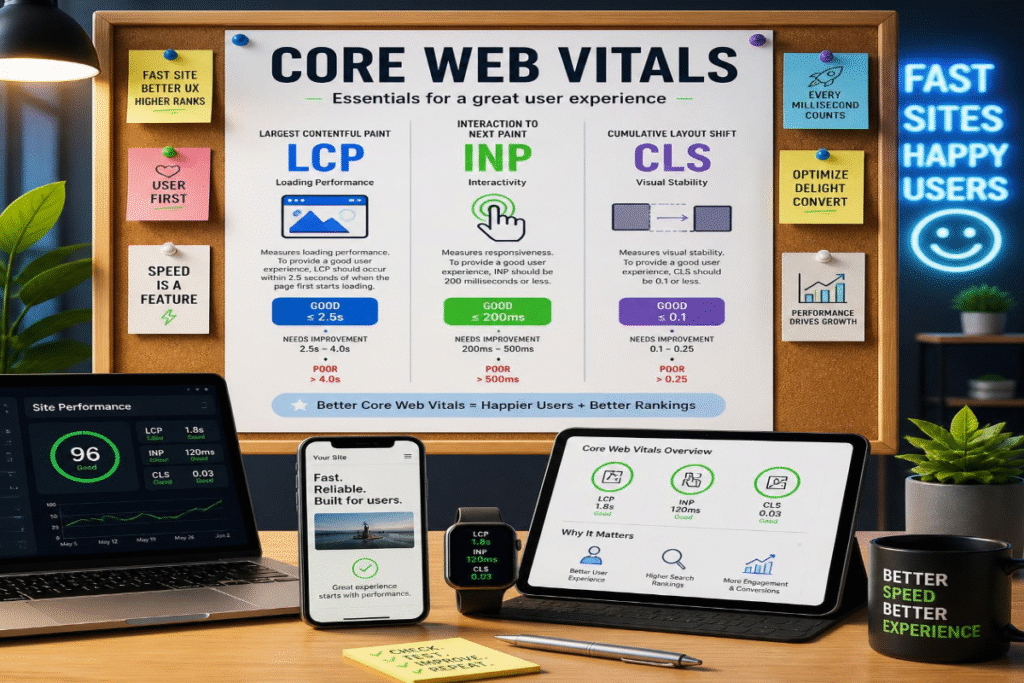
- Capture Core Web Vitals and page speed benchmarks so post-launch performance can be fairly compared
Define Scope and Migration Type
Not all migrations carry equal risk. Clarify upfront whether this is a platform change only, a full domain move, a URL restructuring, a content consolidation, or a combination — because each type demands a different redirect and monitoring strategy.
Build the Staging Environment
- Develop and test the new site on a noindexed, access-restricted staging environment
- Never test redirect logic or content changes directly on the live production domain
- Validate mobile responsiveness, page speed, and Core Web Vitals on staging before any launch decision is made
URL Mapping and Redirect Strategy
This is the single most decisive phase in any Website Migration SEO Checklist. Redirect strategy errors are the leading cause of catastrophic ranking loss during platform changes.
- Create a complete one-to-one URL mapping from every old URL to its corresponding new URL — never rely on blanket or homepage-only redirects
- Implement 301 permanent redirects exclusively; avoid 302 temporary redirects for anything meant to be permanent
- Eliminate redirect chains by pointing old URLs directly to their final destination rather than through multiple hops
- Preserve redirects for backlink-heavy pages as a top priority to retain external authority signals
- Update all internal links to point directly to new URLs rather than relying on redirects to carry internal link equity
- Maintain the redirect map indefinitely rather than removing it after a few weeks post-launch
Preserving On-Page and Technical SEO Signals
A platform switch often resets templates, plugins, or content management logic. Every signal that previously told search engines what a page is about needs to be carried over deliberately, not assumed.
| SEO Element | Migration Action |
| Title tags and meta descriptions | Migrate exactly as-is unless a content update is explicitly planned and tested separately |
| Header tag hierarchy (H1–H3) | Preserve structure to maintain topical relevance signals and content readability |
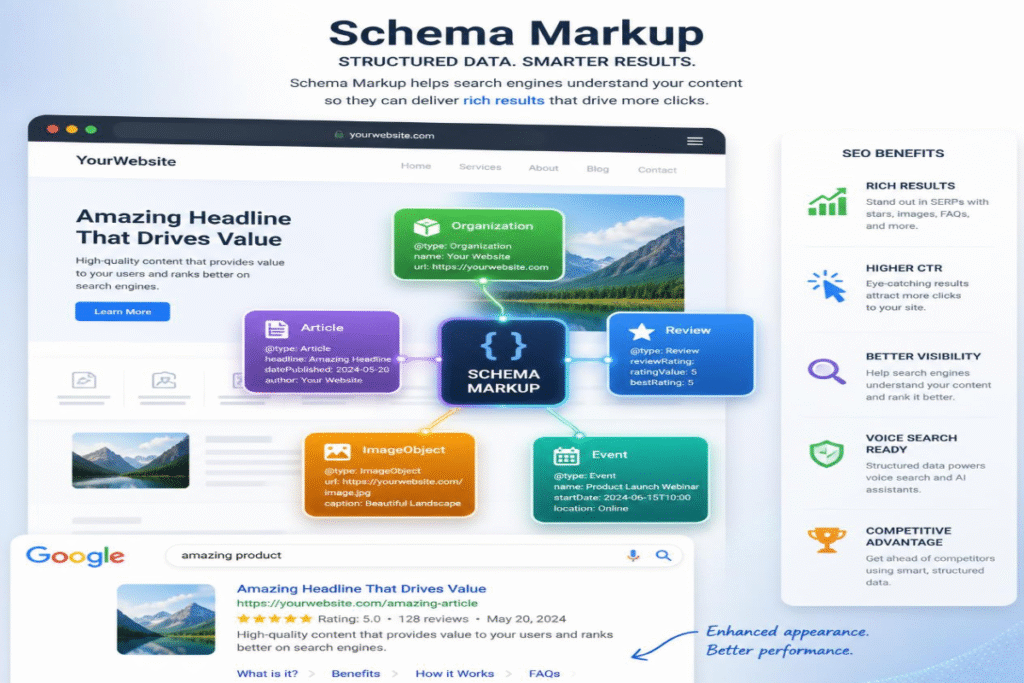
| Schema and structured data | Re-implement identically on the new platform to protect rich result and AI-answer eligibility |
| Canonical tags | Audit for accuracy to prevent duplicate content conflicts during the transition window |
| Image alt text and file structure | Migrate alt attributes and avoid renaming image files without corresponding redirects |
| XML sitemap | Regenerate and submit a clean, updated sitemap reflecting only live new URLs |
| Robots.txt | Review carefully to ensure no unintended blocking of critical new-site sections |
Launch-Day Execution Checklist
Launch day is where planning meets execution. A tight, ordered sequence prevents avoidable indexing delays and crawl errors in the critical first hours.
- Schedule the migration during a low-traffic window to minimize user and crawler disruption
- Remove all noindex tags and staging access restrictions before the new site goes live
- Confirm DNS propagation and SSL configuration are fully complete before announcing launch
- Submit a Change of Address request in Google Search Console if the domain itself has changed
- Upload and submit the new XML sitemap immediately after launch
- Verify analytics and conversion tracking are firing correctly on the new platform
- Spot-check a sample of high-priority redirects and internal links directly on the live site
Post-Launch Monitoring Timeline
Ranking recovery after a migration is rarely instant, and the modern expectation for monitoring windows has extended well beyond the older two-to-four-week assumption.
| Timeframe | What to Monitor |
| First 48 hours | Crawl errors, 404s, and redirect failures in Search Console, checked hourly where possible |
| Weeks 1–4 | Keyword ranking fluctuations, indexation status of new URLs, organic traffic trends |
| Months 1–3 | Backlink retention, Core Web Vitals stability, conversion rate changes |
| Months 3–6 | Full ranking recovery assessment against pre-migration benchmarks, structured data visibility in AI-driven results |
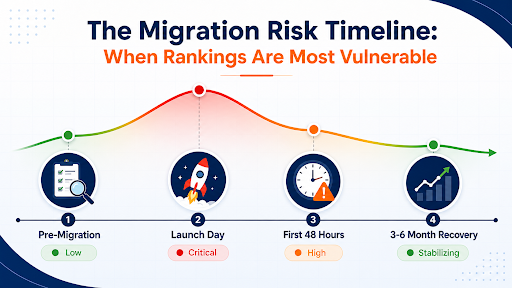
The Migration Risk Timeline: When Rankings Are Most Vulnerable
Not every phase of a site migration carries the same level of ranking risk. Vulnerability spikes sharply on launch day and remains elevated through the first 48 hours, before gradually stabilizing over the following months. The visual below maps this risk curve across four key stages, making it easy to see exactly when close monitoring matters most.
AEO and AI-Overview Readiness After Migration
Search visibility is no longer limited to traditional rankings. A modern Migration SEO Checklist must also confirm that AI-driven answer engines and overview features can still parse, trust, and cite the migrated site correctly.
- Validate that structured data (FAQ, Article, Organization schema) renders correctly on the new platform
- Check that content remains clearly extractable in scannable, well-labeled sections for answer engines
- Confirm that authorship, contact, and trust signals (author bios, credentials, contact details) migrated intact to support EEAT evaluation
- Monitor whether AI answer engines continue citing key pages in the weeks following launch, and address any drop in citation visibility
EEAT Preservation Through the Transition
Experience, Expertise, Authoritativeness, and Trustworthiness signals accumulate slowly, and a migration can inadvertently strip or bury them if templates change without care.
- Keep author bylines, credentials, and about-page content intact and easily accessible on the new platform
- Preserve original publish and last-updated dates where accurate, rather than resetting them by default
- Maintain visible trust elements such as reviews, certifications, and case studies in equivalent or improved placement
- Retain internal links to cornerstone, high-authority content so trust signals continue flowing through the site architecture
Common Migration Mistakes That Erase Rankings
- Bundling a content overhaul, redesign, and platform switch into a single simultaneous change with no way to isolate what caused a ranking drop
- Using mass or homepage-only redirects instead of precise one-to-one URL mapping
- Leaving temporary 302 redirects in place long after launch
- Forgetting to remove staging noindex tags before going live
- Failing to update internal links, leaving them dependent on redirects indefinitely
- Assuming rankings will recover within a few weeks and stopping monitoring too early
Final Pre-Launch Sign-Off
Before declaring a migration complete, confirm every item below has been verified — this final pass is what separates a controlled Website Migration SEO Checklist execution from a reactive scramble.
- Full 301 redirect map tested and live with no chains
- Updated XML sitemap submitted and indexing confirmed
- Robots.txt reviewed and noindex tags removed
- Schema markup validated on new templates
- Analytics and conversion tracking verified
- Internal linking updated to final URLs
- Baseline rankings, traffic, and backlink data archived for post-launch comparison