A thoughtful website design can establish a stronger foundation for search performance while making information easier for visitors to access and understand. Factors such as page organization, content presentation, user pathways, and the technical implementation of visual elements can determine if SEO efforts translate effectively into search visibility. However, SEO performance and Google rankings are not identical concepts. SEO encompasses the broader process of making a website accessible and understandable to search engines, while rankings reflect how Google’s systems assess individual pages against competing results for particular searches. This makes website design an important part of the relationship between technical implementation, content quality, and search performance. This guide explains how a website design influences SEO and how those effects contribute to its ranking potential.
Website Design’s SEO & Ranking Impact OverviewEffective website design strengthens SEO by improving content accessibility, search engine understanding, and overall page performance. Google’s evaluation considers semantic structure, responsive implementation, efficient navigation, rendering behavior, and Core Web Vitals such as LCP, INP, and CLS. Technical optimizations like streamlined code, optimized media, consistent mobile experiences, and stable layouts create a stronger foundation for visibility, helping webpages compete more effectively in organic search results over time through smarter implementation. |
How Website Design Affects SEO and Google Rankings
Google’s ranking systems evaluate how effectively a webpage functions, not simply how attractive it looks. A technically sound website design helps search engines process content with fewer obstacles, making indexing more efficient and improving the likelihood that important pages appear in search results.
HTML structure influences content understanding
Search engines rely heavily on semantic HTML to identify page sections. Elements like header, main, article, section, and footer provide structural meaning that helps Google distinguish primary content from supporting elements. A properly organized document also creates a logical heading hierarchy, allowing crawlers to interpret topic relationships more accurately.
Responsive design supports mobile-first indexing
Google predominantly uses the mobile version of a webpage for indexing and ranking. Responsive websites that serve identical content across devices avoid inconsistencies that can occur with separate mobile versions. Flexible layouts, scalable images, and adaptive navigation ensure that mobile crawlers receive the same valuable content available on desktop. Google’s Mobile-First Indexing Best Practices explains why maintaining equivalent content and important links across mobile and desktop versions matters for search visibility.
Navigation affects crawl efficiency
Website navigation determines how easily Google’s crawler discovers important pages. Shallow site architecture, where valuable pages remain within a few clicks of the homepage, improves crawl efficiency. Breadcrumb navigation adds contextual relationships between pages, while descriptive internal links help search engines understand topical relevance throughout the website.
JavaScript rendering can delay indexing
Modern websites frequently rely on JavaScript frameworks to generate content dynamically. However, content that appears only after extensive client-side rendering may take longer for Google to process. Server-side rendering or hybrid rendering approaches often improve content discoverability by delivering meaningful HTML immediately instead of requiring crawlers to execute multiple rendering steps.
| Build a website that supports your business goals; get a professionally designed website tailored to your business type, audience, and digital growth objectives. |
Core Web Vitals and Design Performance
Core Web Vitals are Google’s real-world page experience metrics that evaluate how users experience a webpage after it loads. Unlike synthetic speed tests alone, these signals use field data collected from actual Chrome users to assess loading performance, responsiveness, and visual stability.
Largest Contentful Paint (LCP)
LCP measures how quickly the largest visible content element appears on the screen. Google considers an LCP of 2.5 seconds or faster a good user experience. Design decisions that commonly improve LCP include compressing hero images, prioritizing above-the-fold assets, reducing render-blocking CSS, and serving modern image formats like WebP or AVIF. The Web.dev LCP guidance provides detailed recommendations for identifying and improving the resources that determine LCP.
Interaction to Next Paint (INP)
INP measures how quickly a page responds after users interact with it. Heavy JavaScript execution, complex animations, and overloaded event handlers can increase input delay. Breaking large scripts into smaller tasks, minimizing unnecessary third-party scripts, and reducing main-thread blocking help improve responsiveness.
Cumulative Layout Shift (CLS)
CLS measures unexpected visual movement during page loading. Layout instability often occurs when images lack predefined dimensions, advertisements load without reserved space, or fonts swap unexpectedly after rendering. Reserving space for dynamic elements and specifying width and height attributes prevent disruptive layout shifts that negatively affect page experience.
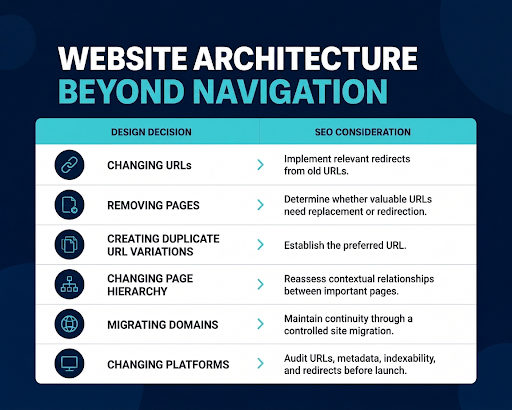
Website Changes and Their SEO Impact
Website architecture goes beyond menus and navigation by defining how content is organized, connected, and understood by search engines. A well-planned structure helps preserve topical relevance, discoverability, and the value of established content as a website evolves. The following infographic therefore highlights the importance of how website design decisions can influence these technical relationships and the SEO signals that support a site’s visibility.
Website Design Tactics That Improve SEO
Instead of treating SEO as a separate optimization layer, these design tactics strengthen the technical foundation that supports Google’s ranking systems.
Prioritize semantic page construction
Build pages using meaningful HTML elements rather than generic containers. Clear document structure improves accessibility while helping search engines interpret content relationships more effectively. Google’s SEO JavaScript guidance also emphasizes ensuring that important content is available in the rendered HTML.
Reduce render-blocking resources
Load critical CSS first, defer non-essential JavaScript, and eliminate unused code. Faster rendering allows important content to become available sooner for both users and crawlers.
Optimize media without sacrificing quality
Serve responsive images through srcset, compress large assets, enable lazy loading for below-the-fold images, and use modern formats that reduce file size without noticeable quality loss.
Create predictable navigation patterns
Maintain consistent menus across pages, implement breadcrumb navigation, and use descriptive anchor text for internal links. This strengthens crawl paths while distributing authority across important pages.
Design for mobile consistency
Ensure that structured data, metadata, headings, and primary content remain identical between desktop and mobile layouts. Since Google indexes the mobile version, missing mobile content can reduce search visibility.
Stabilize dynamic content
Reserve layout space for advertisements, embedded videos, and interactive widgets before they load. This minimizes layout shifts while improving real-world page experience measurements.
Conclusion
Now, as you have gone through the blog, you must have understood that the strongest results come when design and digital strategy are considered together from the beginning. To answer this effectively, Think Shaw brings website design, UI/UX, and SEO expertise together. Our web design team develops engaging, responsive websites across business, e-commerce, blog, and service requirements, while SEO specialists provide tailored optimization strategies.
| Turn your website into a stronger organic growth channel. Work with Think Shaw’s SEO specialists for customized strategies built around your market, competitors, keywords, and growth goals. |
FAQs About Website Design’s Impact on SEO & Google Ranking
How can I tell if my website design is hurting my SEO?
A drop in organic traffic, poor search visibility, or declining engagement can indicate design-related SEO issues.
How often should a website design be updated for SEO?
Review your website every 2–3 years and make ongoing improvements as user expectations and search standards evolve.
What should businesses prioritize before launching a new website?
Plan your content structure, URL strategy, and SEO requirements before development begins to avoid costly fixes later.
Can changing my website’s URL structure affect Google rankings?
Yes, changing URLs without proper 301 redirects can reduce traffic and make pages harder for Google to reconnect with previous signals.
Should every important page have its own unique design purpose?
Yes, pages designed around a specific user intent often perform better than layouts reused without contextual adjustments.