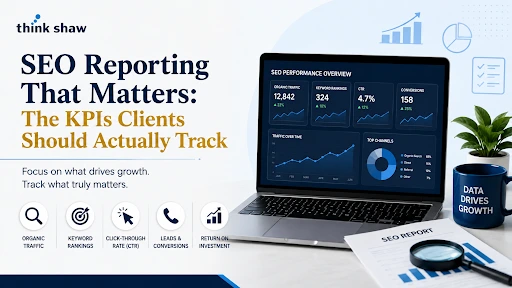
Most SEO reports lead with the wrong number. A client sees keyword rankings moving up and assumes everything is working, without ever finding out whether those rankings brought in a single lead. SEO Metrics only matter when they connect to something a business actually cares about: revenue, qualified leads, or retained customers. SEO KPIs worth reporting go beyond position tracking and pull in organic conversion rate, engaged sessions, and increasingly, visibility inside AI-generated answers. SEO Reporting built around this broader set of SEO Performance Metrics gives clients an honest picture of progress instead of a vanity dashboard that looks good but proves nothing.
| Expert Overview of SEO Reporting and KPIs |
| Most SEO reports lead with the wrong number. A client sees keyword rankings moving up and assumes everything is working, without ever finding out whether those rankings brought in a single lead. SEO Metrics only matter when they connect to something a business actually cares about: revenue, qualified leads, or retained customers. SEO KPIs worth reporting go beyond position tracking and pull in organic conversion rate, engaged sessions, and increasingly, visibility inside AI-generated answers. SEO Reporting built around this broader set of SEO Performance Metrics gives clients an honest picture of progress instead of a vanity dashboard that looks good but proves nothing. |
Why Ranking Reports Alone Are Misleading Clients
A page one ranking for a keyword nobody searches with buying intent is a hollow win, yet it’s still the first thing most agencies screenshot into a monthly report. Rankings measure visibility for a single query, not whether that visibility translates into business results, which is exactly why Keyword Ranking Metrics need context before they mean anything to a client.
- A keyword can rank first and still generate almost no clicks if search volume or intent is weak
- Ranking improvements on branded terms often reflect existing brand awareness rather than new SEO impact
- Position tracking tools can show different rankings for the same keyword depending on location and personalization
- Clients remember the ranking number, not the caveat explaining why it doesn’t matter, so leading with rankings alone sets the wrong expectation from month one
Organic Traffic Metrics That Actually Signal Progress
Raw visitor counts tell you almost nothing on their own. Organic Traffic Metrics become useful the moment they’re broken down by segment, since a spike in irrelevant traffic looks identical to a spike in qualified traffic on a basic pageview chart.
| Metric | What It Actually Tells You |
| Total organic sessions | Baseline visibility trend, but meaningless without quality context |
| Non-branded organic traffic | Whether new visibility is being earned, rather than just capturing existing brand searches |
| Engaged sessions or time-on-page | Whether visitors are actually finding the content relevant, not just landing and leaving |
| Landing page performance by segment | Which specific pages are driving traffic that matters, rather than an aggregate site-wide number |
| New vs. returning organic visitors | Whether SEO is expanding reach or mostly re-engaging people who already knew the brand |
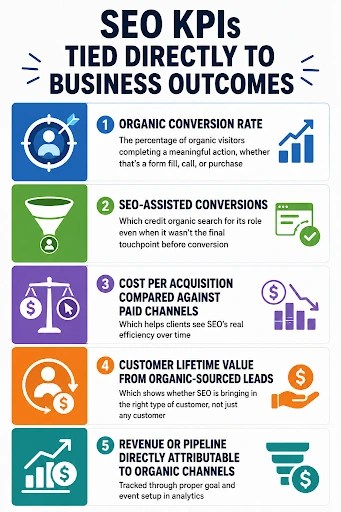
SEO KPIs Tied Directly to Business Outcomes
The KPIs that hold up in a client conversation are the ones that connect directly to pipeline or revenue, not the ones that are easiest to pull from a rank tracker. Building SEO Reporting around outcome-based metrics forces the strategy itself to stay focused on what actually grows the business.
- Organic conversion rate, the percentage of organic visitors completing a meaningful action, whether that’s a form fill, call, or purchase
- SEO-assisted conversions, which credit organic search for its role even when it wasn’t the final touchpoint before conversion
- Cost per acquisition compared against paid channels, which helps clients see SEO’s real efficiency over time
- Customer lifetime value from organic-sourced leads, which shows whether SEO is bringing in the right type of customer, not just any customer
- Revenue or pipeline directly attributable to organic channels, tracked through proper goal and event setup in analytics
Technical Health Metrics Clients Rarely See, But Should
A site can have great content and strong backlinks and still lose ground because of technical issues nobody’s reporting on. These SEO Analytics rarely make it into a client-facing deck, yet they often explain exactly why performance stalled or dropped in a given month.
- Indexation status, since pages excluded from Google’s index cannot generate any organic traffic regardless of content quality
- Crawl errors and broken internal links, which quietly waste crawl budget and interrupt link equity flow across the site
- Core Web Vitals performance on high-value pages, since page experience issues can suppress rankings even with strong content
- Site speed trends over time, particularly on mobile, since slow-loading pages lose both rankings and conversions
AI Visibility Metrics Are Now Part of Serious SEO Reporting
Search no longer ends at a list of blue links. A growing share of queries get answered directly inside AI Overviews, chat-based assistants, and other generative answer surfaces, which means SEO Performance Metrics now have to account for visibility inside those answers, not just traditional rankings.
- AI Overview inclusion rate, tracking how often a brand’s content gets pulled into Google’s AI-generated answer boxes
- Citation frequency across AI assistants, measuring how often tools like ChatGPT or Perplexity reference the brand when answering relevant questions
- Share of voice within AI answers, comparing how often a brand appears relative to competitors across the same set of prompts
- Sentiment within AI-generated mentions, since being cited negatively or inaccurately can hurt more than not being cited at all
Building a Reporting Framework Clients Actually Understand
The best SEO Reporting doesn’t just list numbers, it tells a story connecting effort to outcome in language a non-technical stakeholder can follow without a glossary.
- Lead every report with the business outcome metric first (leads, conversions, revenue), then support it with supporting SEO Metrics underneath
- Use a consistent, small set of core KPIs month over month, rather than rotating which numbers get highlighted based on what looks best
- Explain the why behind a dip or spike directly in the report, rather than leaving a client to interpret a chart on their own
- Separate long-term brand-building metrics (like domain authority growth) from short-term performance metrics (like monthly conversions) so expectations stay realistic
Common Reporting Mistakes That Erode Client Trust
- Leading every report with keyword rankings while burying or omitting conversion data entirely
- Reporting vanity metrics like total backlinks or total keywords ranked without any context on quality or relevance
- Changing which KPIs get highlighted each month depending on which numbers happened to look good
- Never explaining a traffic or ranking drop, leaving the client to assume the worst about the strategy
- Ignoring AI visibility entirely, even as a growing share of relevant searches now get answered before a click ever happens
Frequently Asked Questions About SEO Reporting and KPIs
Which single SEO metric matters most to clients?
There isn’t one universal answer, but organic conversion rate or SEO-assisted conversions tend to matter most because they connect search visibility directly to business results rather than just traffic volume. Rankings and impressions support the story, but they shouldn’t be the headline metric on their own.
How often should SEO KPIs be reported to clients?
Monthly reporting works well for most ongoing SEO engagements, paired with a deeper quarterly review that looks at trends over a longer window rather than single-month fluctuations. Weekly reporting is rarely necessary and can create pressure to react to normal short-term variance.
Should keyword rankings be included in reports at all?
Yes, but only as supporting context alongside traffic and conversion data, not as the primary measure of success, since a ranking improvement with no traffic or conversion impact tells an incomplete story. Framing rankings as one input among several keeps client expectations grounded.
What’s the difference between organic traffic and organic conversion rate?
Organic traffic counts how many visitors arrive through unpaid search results, while organic conversion rate measures what percentage of those visitors complete a meaningful action like a form fill or purchase. A site can have rising traffic and flat or declining conversion rate, which signals a different problem than a traffic issue.
How do you measure visibility in AI Overviews and AI assistants?
Tracking typically involves monitoring how often a brand’s content is cited or referenced when relevant prompts are run through tools like AI Overviews, ChatGPT, or Perplexity, often using specialized tracking tools or manual prompt testing. This is still an evolving measurement area, so combining automated tools with periodic manual checks currently gives the most reliable picture.
Why do SEO results sometimes look flat even when strategy is working?
SEO impact often shows up gradually and can be masked by short-term fluctuations, seasonality, or algorithm updates, meaning a quarter-over-quarter view usually tells a more accurate story than any single month. This is why explaining trend context in reporting matters as much as the numbers themselves.