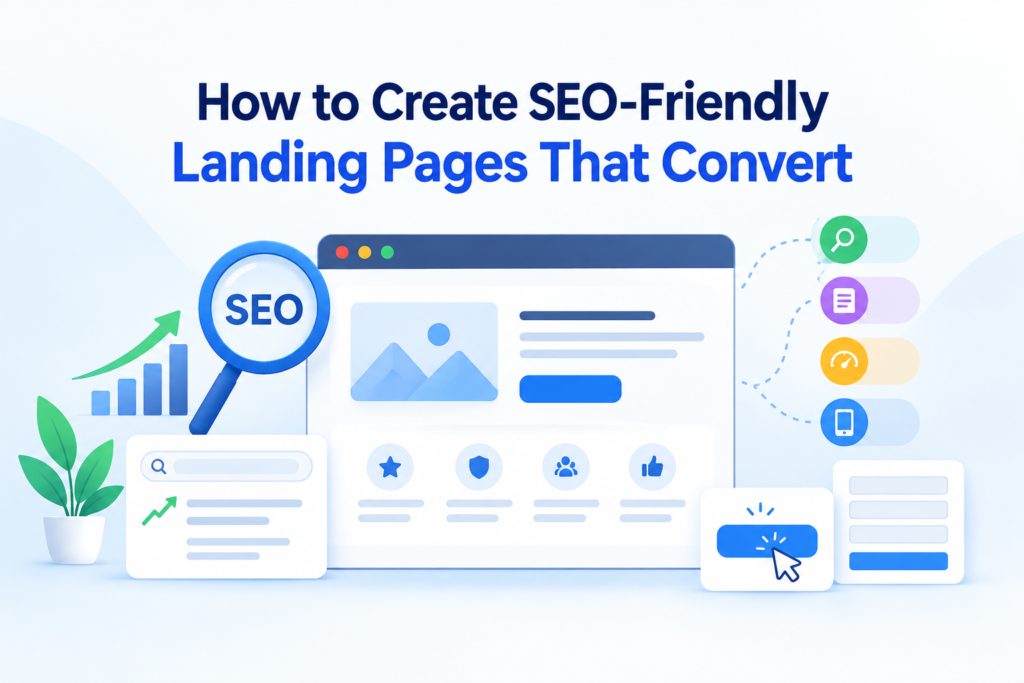
A landing page can attract qualified organic traffic yet still fail if visitors cannot quickly understand its value or take the intended action. Creating SEO-friendly landing pages that convert requires more than adding keywords to copy. Page structure, search intent, content relevance, Core Web Vitals, mobile usability, internal linking, metadata, and clear conversion paths all influence how effectively a page performs in search and with users. At the same time, trustworthy, experience-backed content and transparent information help strengthen credibility and align with Google’s E-E-A-T principles. By combining technical SEO with user-focused design and conversion optimization, businesses can build landing pages that earn visibility, engage visitors, and generate measurable results.
SEO-Friendly Landing Page SummaryEffective landing pages combine search intent, keyword strategy, on-page SEO, useful content, technical accessibility, Core Web Vitals, and mobile performance to attract qualified visitors. Conversion success also depends on clear messaging, compelling value propositions, benefits, trust signals, social proof, objection handling, strong CTAs, and simple forms. Ongoing measurement through Search Console and GA4 helps identify visibility, engagement, conversion gaps, audience patterns, and opportunities for continuous landing-page improvement and optimization. |
What Makes a Landing Page SEO-Friendly?
Keyword Research and Search Intent Alignment
Map the primary query to its dominant search intent using SERP analysis, query modifiers, and competitor page types. Identify supporting long-tail terms, entities, and related subtopics. Google’s SEO Starter Guide can also help establish a strong foundation for understanding how search engines discover and interpret useful web content. Build one focused keyword cluster around the landing page rather than targeting unrelated queries with conflicting user expectations.
On-Page SEO Elements That Improve Relevance
Optimize the <title>, H1, meta description, URL slug, image alt attributes, and relevant heading elements around the page’s core topic. Maintain natural keyword placement and semantic consistency. Ensure the title and visible page content accurately represent the landing page’s actual offer and purpose.
Content Structure That Supports Rankings and Conversions
Organize content into scannable sections that answer user questions progressively, using descriptive H2s, H3s, concise paragraphs, lists, and supporting evidence. Address important objections and decision factors while demonstrating first-hand expertise. Avoid thin, duplicated, or search-engine-first copy that provides little additional value.
Technical SEO: Crawlability, Indexing, and Canonicalization
Ensure search engines can access the landing page through crawlable links and properly rendered HTML. Configure robots.txt, meta robots, XML sitemaps, and canonical tags according to indexing requirements. Use URL Inspection to verify crawlability, rendered resources, indexing status, and canonical selection in Google Search Console.
Page Speed, Core Web Vitals, and Mobile Performance
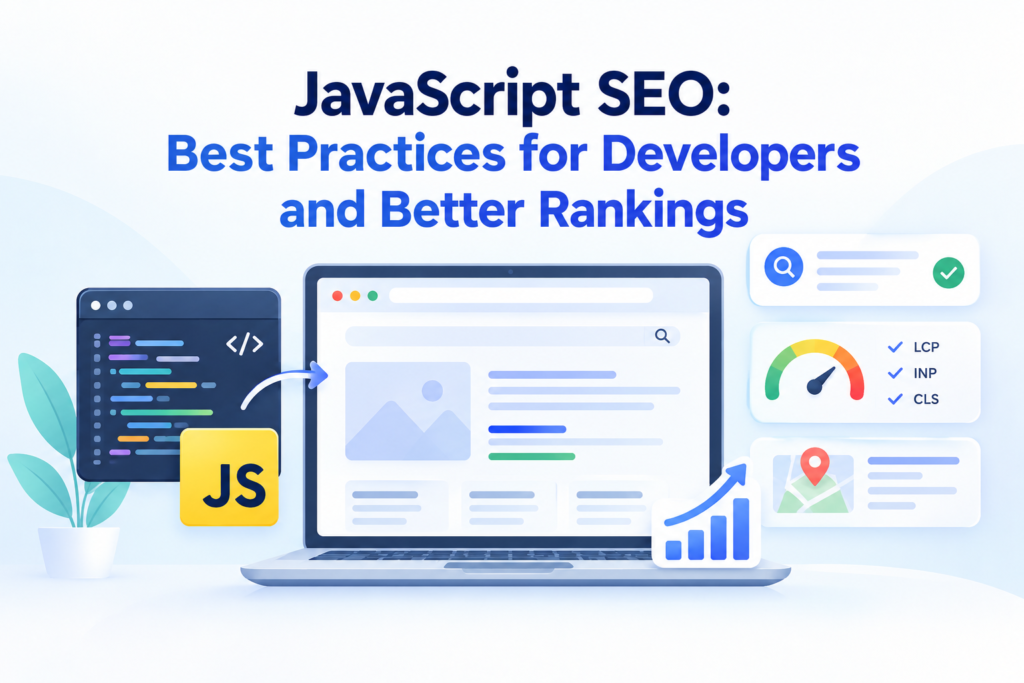
Optimize images, CSS, JavaScript, fonts, and server response times to improve loading and responsiveness. Target Core Web Vitals thresholds of LCP ≤2.5 seconds, INP <200 milliseconds, and CLS <0.1. Use responsive layouts and test real-user performance through Search Console and performance tools.
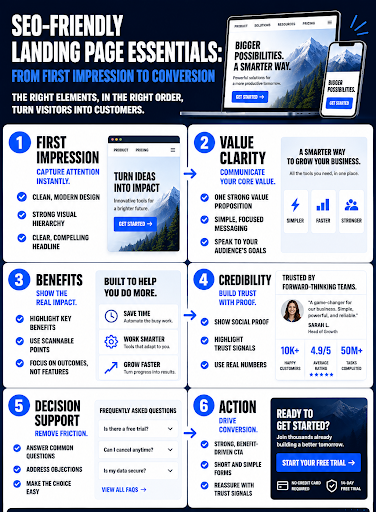
SEO-Friendly Landing Page Essentials: From First Impression to Conversion
A successful landing page needs to do more than attract visitors from search; it must guide them toward taking action. From a compelling first impression and clear value proposition to trust signals, social proof, objection handling, and a strong call to action, every element can influence the visitor’s decision. The infographic below highlights the essential components of an SEO-friendly landing page and shows how they work together to create a clear, credible, and conversion-focused user experience.
| Turn SEO-friendly landing pages into powerful conversion tools with Think Shaw’s data-driven strategies designed to attract qualified traffic and grow your business! |
Tracking Performance and Refining Your Strategy
Monitor Organic Search Visibility
Use Google Search Console to track impressions, clicks, CTR, and average position for individual landing pages and their associated queries. Compare these metrics over consistent date ranges to identify ranking movements, declining visibility, emerging queries, and pages gaining search demand.
Measure Landing Page Engagement
Analyze GA4 metrics such as sessions, active users, engagement rate, and average engagement time at the landing-page level. Segment results by device, country, and traffic source to identify behavioral differences and determine whether specific audience segments interact differently with the page.
Track Key Events and Conversion Rates
Configure meaningful GA4 key events for actions such as form submissions, purchases, bookings, downloads, or qualified lead requests. Compare conversions against landing-page sessions to calculate conversion rates and determine which organic entry pages generate measurable business outcomes rather than simply attracting traffic.
Identify Performance Gaps Between Traffic and Conversions
Compare Search Console search performance with GA4 behavioral and conversion data. A page with deep impressions but weak CTR may need stronger search-result messaging, while high organic traffic with poor conversions can indicate an offer, messaging, or funnel problem.
Use Segmentation to Find Optimization Opportunities
Break performance data down by device category, country, traffic source, landing page, and user behavior instead of relying only on aggregate metrics. Segment-level analysis can expose problems hidden within overall averages, such as mobile users converting substantially less than desktop visitors.
Test Changes and Compare Before-and-After Results
Treat landing-page optimization as an iterative process. Establish a baseline before changing headlines, CTAs, forms, layouts, or offers, then compare subsequent performance against the same measurement period. Prioritize changes supported by statistically meaningful trends rather than reacting to short-term fluctuations.
Conclusion
Creating a landing page that ranks and converts requires the right combination of SEO expertise, strategic content, technical optimization, and conversion-focused design. With Think Shaw, businesses can turn underperforming landing pages into stronger digital assets built to attract qualified traffic and generate meaningful results. Our experienced team combines SEO, web design, UI/UX, and data-driven strategies to create online experiences aligned with your business goals. Whether you need better organic visibility, stronger user engagement, or more qualified leads, Think Shaw can help you build a strategy focused on measurable growth.
| Drive more qualified traffic and turn clicks into customers with Think Shaw’s SEO strategies built for measurable growth! |
FAQ’s About SEO-Friendly Landing Pages
Can a landing page rank without having a blog-style format?
Yes. A landing page can rank when its content appropriately satisfies the search intent. Service pages, product pages, lead-generation pages, and other focused formats can perform organically when they provide relevant, useful information and a strong overall user experience.
How often should an SEO landing page be updated?
Update a landing page when its information, offerings, evidence, regulations, pricing, or user expectations change—not simply according to a fixed publishing schedule. Review performance and factual accuracy periodically, then make substantive improvements where they provide genuine value to visitors.
Can paid search landing pages also be optimized for organic SEO?
Yes, but their objectives may differ. Paid-search pages often prioritize campaign-specific messaging and minimal distractions, while organic pages generally need broader topical coverage. A carefully planned structure can support both acquisition channels without compromising the intended conversion experience.
What makes an SEO landing page different from a regular webpage?
An SEO landing page is typically built around a defined acquisition objective, target audience, and search opportunity. Its content, information architecture, messaging, and conversion journey are intentionally aligned so organic visitors can quickly understand the offering and complete the desired business action.
Can multiple landing pages target similar services?
They can, provided each page serves a meaningfully distinct audience, location, service variation, or search intent. Pages created solely to target slightly different keyword combinations can become redundant. Each indexable URL should have a clear purpose and provide distinct value to users.