A headless CMS separates content management from the frontend, giving businesses greater flexibility in how digital experiences are built and delivered. As this architecture becomes more common, SEO teams and developers need to consider how content is presented and made accessible to search engines. Unlike a traditional CMS, SEO implementation can depend more heavily on the frontend and development framework. For websites adopting this approach, understanding the relationship between headless architecture and search visibility is essential. Headless CMS SEO brings these considerations together, helping teams build technically sound websites without limiting the flexibility of modern web development.
Here’s what to know before optimizing a headless CMS for search.
Headless CMS SEO: Key Benefits, Challenges, PracticesHeadless CMS SEO connects structured content management with frontend development to support search visibility across flexible digital experiences. Its benefits include greater performance control, scalable content delivery, reusable architecture, and technical flexibility. Challenges can involve JavaScript rendering, dynamic metadata, URL consistency, and crawl signals. Effective implementation requires semantic HTML, stable URLs, internal linking, consistent content models, structured data, image optimization, correct status codes, and thorough deployment testing. |
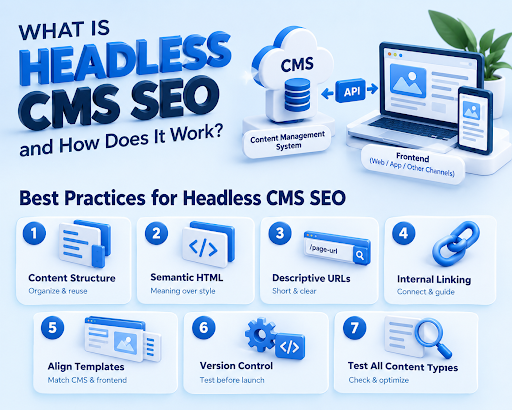
What Is Headless CMS SEO and How Does It Work?
Headless CMS SEO refers to optimizing a website that uses a headless content management system. In simple terms, the CMS manages and stores the content, while a separate frontend displays it to visitors. The two systems communicate through APIs, allowing the same content to be used across different digital experiences. SEO implementation is therefore built around how the website is developed and connected to its CMS.
Best Practices for Headless CMS SEO
- Create a consistent content structure: Organize content into clearly defined fields and content types so important information can be reused accurately across templates and channels.
- Use semantic HTML: Structure headings, paragraphs, lists, navigation, and other page elements according to their intended meaning rather than visual appearance.
- Build descriptive page paths: Use short, meaningful URL structures that reflect the subject of each page and remain stable as content evolves.
- Establish strong internal linking: Connect related pages contextually to create logical pathways between important content and help users navigate the site.
- Keep content and templates aligned: Make sure CMS fields map consistently to the appropriate frontend components, particularly when multiple templates or content types are involved.
- Maintain version control: Document frontend and CMS changes so SEO-related functionality can be tested before updates reach production.
- Test across content types: Check different page templates, dynamic content, and newly published entries rather than assuming one successful implementation applies universally.
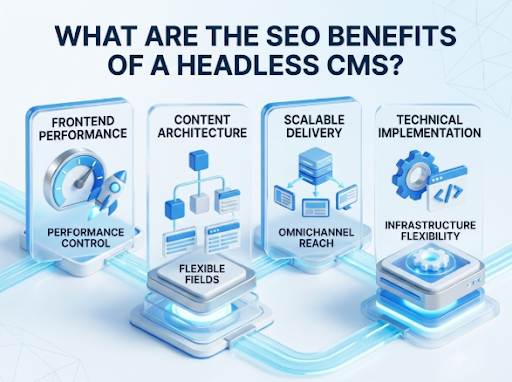
What Are the SEO Benefits of a Headless CMS?
Greater Frontend Performance Control
A headless architecture gives developers freedom to use modern frameworks, caching, CDNs, and rendering strategies without being tied to a CMS theme. This can reduce unnecessary frontend overhead and support stronger Core Web Vitals when implemented correctly. According to Google’s June 2026 CrUX report, 55.3% of origins had good Core Web Vitals, highlighting the importance of real-world website performance.
More Flexible Content Architecture
Structured content models allow teams to separate information into reusable fields rather than relying on fixed page templates. This makes content easier to maintain across large websites and different frontend experiences. It can also support clearer relationships between entities, products, services, and supporting content when the frontend is built around a well-defined information architecture.
Scalable Omnichannel Content Delivery
A single content repository can serve multiple frontend experiences through APIs, including websites, applications, and other digital interfaces. This reduces the need to recreate the same information separately for every platform. For organizations managing large content libraries or multiple digital properties, this architecture can make content governance and publishing workflows considerably more scalable.
Stronger Technical Implementation Flexibility
Developers can choose frameworks and infrastructure suited to the website’s requirements rather than depending on the CMS’s built-in presentation layer. This provides greater control over frontend architecture, JavaScript usage, caching, image delivery, and deployment. However, these advantages depend on implementation quality; headless architecture does not automatically produce better rankings or SEO performance.
| If you’re planning or refining a headless website, our team can help you build an SEO-ready foundation without compromising your development goals. |
Headless CMS SEO Best Practices for Developers and SEO Teams
The following practices focus on areas that require coordination between the CMS, frontend, and deployment environment.
| Area | Best Practice |
| Structured Data | Generate valid JSON-LD from CMS data and keep schema properties synchronized with the content rendered on each page. |
| Image SEO | Store descriptive alt text, image dimensions, and relevant media metadata in the content model so frontend components can output them consistently. |
| Pagination | Define a consistent pagination architecture for category, listing, and archive pages so important content remains discoverable without creating unnecessary URL variations. |
| HTTP Status Handling | Ensure frontend routes return the correct HTTP status codes, particularly 404 responses for removed pages rather than serving soft-404 content with a successful status. |
| Preview & Deployment Testing | Test SEO-critical output in staging or preview environments before deployment, including rendered HTML, status codes, structured data, and indexability directives. |
Conclusion
A headless CMS can provide the flexibility, scalability, and technical control modern websites need, but strong SEO depends on thoughtful implementation. With the right strategy, your architecture can support search visibility without restricting development possibilities. Think Shaw can help align your SEO and development efforts to build a stronger digital foundation and turn technical flexibility into measurable growth.
| Your website should give your developers flexibility without making SEO harder than it needs to be. If you’re considering headless or already working with it, we’re here to help you get it right. |
Frequently Asked Questions About Headless CMS SEO
What are the benefits of a headless CMS?
A headless CMS offers frontend flexibility, content reuse, omnichannel delivery, scalability, and greater control over the technology stack used to build digital experiences.
What are the drawbacks of a headless CMS?
Common drawbacks include higher development requirements, greater technical complexity, fewer built-in visual editing features, and increased dependence on specialized frontend resources.
What are some SEO best practices for a CMS?
Prioritize crawlable content, clear information architecture, descriptive URLs, strong internal linking, accurate metadata, structured data, accessibility, and consistent technical monitoring.
Which headless CMS is the best in 2026?
There is no universal winner; evaluate platforms according to content modeling, integrations, scalability, editorial workflows, developer experience, localization, and long-term project requirements.
Is a headless CMS better than WordPress for SEO?
Neither architecture is inherently better for rankings. SEO performance depends on implementation quality, technical configuration, content quality, and how effectively the frontend serves users and crawlers.