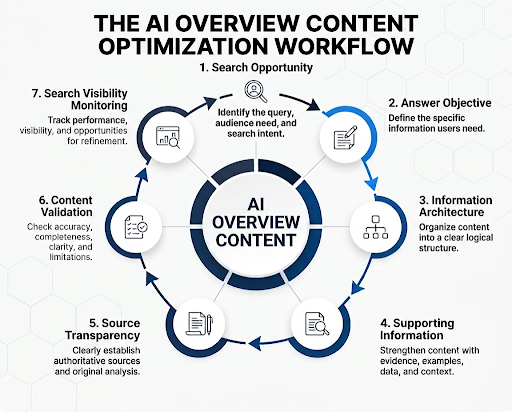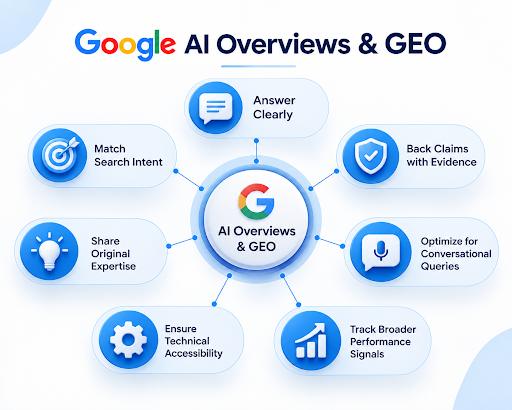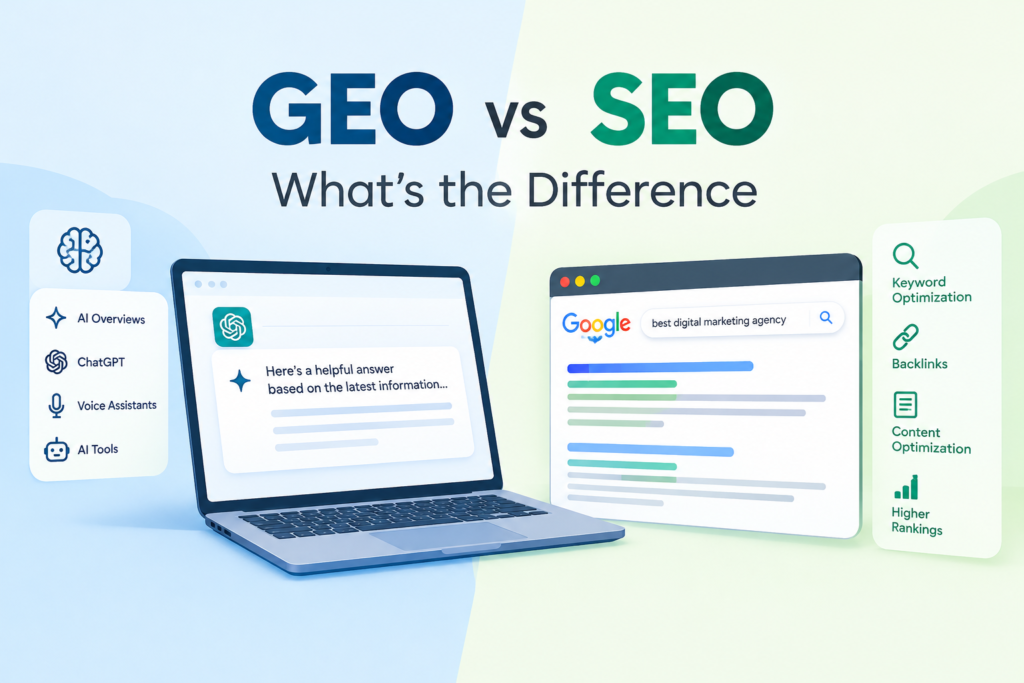
Search is evolving from traditional results pages toward AI-generated responses that synthesize information from multiple sources. This shift has introduced Generative Engine Optimization (GEO) alongside the established practice of Search Engine Optimization (SEO). While SEO focuses on improving a website’s visibility in search engine results, GEO is concerned with how content is discovered, interpreted, cited, and represented by generative AI systems. The two approaches overlap in important areas, and Google confirms that foundational SEO practices remain relevant for its AI-powered search features. Understanding GEO vs. SEO therefore requires examining how their objectives, processes, and search environments differ.
GEO and SEO Search Strategy SummaryGEO and SEO address different aspects of modern search visibility. SEO strengthens traditional search performance through technical optimization, relevant content, and search intent, while GEO focuses on making information clear and useful for AI-generated responses. Combining both supports broader visibility, stronger semantic understanding, evidence-based authority, and adaptable content strategies. Businesses can integrate technical SEO, question-focused content, factual accuracy, structured information, and performance measurement to remain discoverable across evolving search experiences. |
Why Are Both GEO and SEO Necessary for Modern Search?
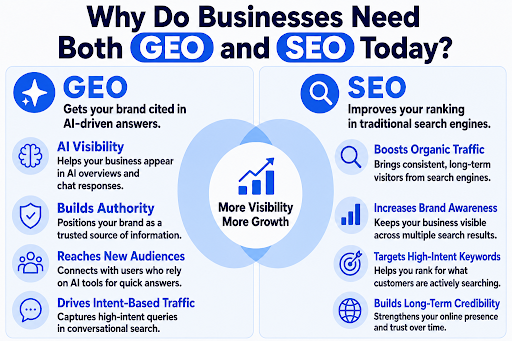
SEO and GEO support different aspects of modern search visibility. SEO helps search engines crawl, index, and rank webpages in traditional results, while GEO helps make content clear, relevant, and trustworthy for AI-generated responses. As search increasingly blends organic listings with AI-driven answers, combining both approaches creates broader visibility. Strong technical SEO provides the foundation, while GEO strengthens content structure, context, and usefulness for generative search experiences.
GEO vs SEO: How Do They Differ?
A clear comparison of their core differences helps explain how each approach supports visibility across traditional and AI-driven search experiences.
| Comparison Point | SEO (Search Engine Optimization) | GEO (Generative Engine Optimization) |
| Main Goal | Improves a website’s visibility and rankings in traditional search engine results by aligning content and technical elements with search engine requirements. | Improves the chances of content being understood, retrieved, and referenced in AI-generated answers. |
| Search Environment | Primarily targets traditional search engines where users receive a list of webpages, such as organic search results and featured snippets. | Targets generative search experiences where AI systems synthesize information from different sources to provide a direct response. |
| Content Approach | Focuses on search intent, keyword relevance, topic coverage, headings, internal linking, and useful content that satisfies the user’s query. | Emphasizes clear, direct, fact-based content that AI systems can easily interpret, extract, and connect with specific questions or topics. |
| Technical Focus | Covers crawling, indexing, site structure, mobile usability, page speed, canonical URLs, XML sitemaps, and structured data. | Builds on strong technical SEO while emphasizing semantic clarity, well-organized information, consistent entities, and machine-readable context. |
| Visibility Measurement | Performance is commonly measured through rankings, impressions, clicks, organic traffic, click-through rates, and conversions. | Measurement can include AI mentions, citations, source inclusion, and the frequency with which content appears in generated responses. |
| Authority & Trust | Supports visibility through accurate information, useful content, expertise, and signals that help search engines assess quality and relevance. | Prioritizes authoritative, well-supported information that generative systems can use when forming accurate responses and identifying reliable sources. |
| Explore smarter SEO and GEO solutions designed to strengthen your website’s visibility across modern search experiences. |
What Are the Benefits of Combining GEO and SEO?
Combining GEO and SEO creates a broader search strategy that supports visibility across traditional search engines and AI-powered search experiences. Here it comes: the key benefits become clearer when both approaches work together.
Broader Search Visibility Across Multiple Search Experiences
SEO helps pages compete for traditional organic results, while GEO helps content become more useful for AI-generated answers. Combining both allows the same high-quality content to serve users across different search interfaces.
Stronger Semantic Understanding of Content
SEO encourages clear topic targeting and structured content, while GEO emphasizes contextual relationships between entities, concepts, and factual statements. Together, they make content easier for search systems and AI models to interpret accurately.
Better Alignment With Search Intent
Both approaches rely on understanding what users are actually looking for. Combining keyword research, search intent analysis, conversational queries, and question-focused content helps address informational needs more precisely.
Greater Authority Through Evidence-Based Content
SEO benefits from demonstrating expertise and content quality, while GEO favors information that can be confidently retrieved and referenced. Using credible sources, specific evidence, expert insights, and accurate claims strengthens the content’s overall reliability.
Improved Content Structure and Accessibility
Clear headings, concise sections, descriptive links, structured data, and logical page architecture support SEO while also making information easier for AI systems to identify and process. This creates content that is technically accessible and easier to understand.
How Can Businesses Integrate GEO and SEO Into One Strategy?
Businesses can integrate GEO and SEO by treating them as complementary parts of one search strategy rather than managing them as separate channels. Strong technical SEO provides the foundation for crawling, indexing, and content discovery, while GEO focuses on making information clear, structured, authoritative, and useful for AI-generated responses.
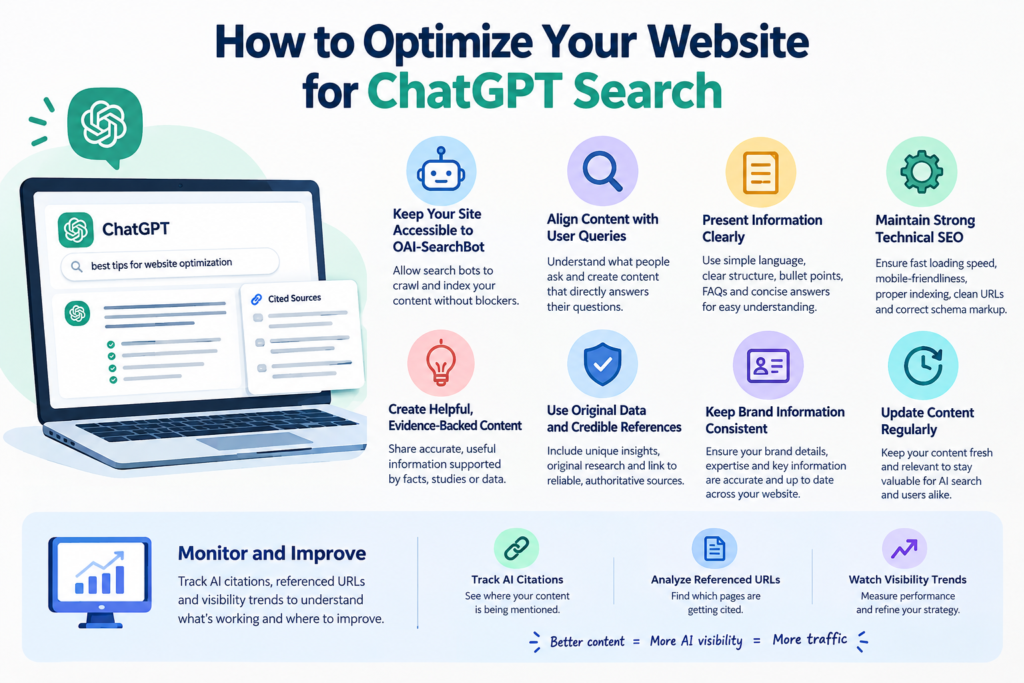
- Build a strong technical SEO foundation: Ensure important pages are crawlable, indexable, internally linked, mobile-friendly, and supported by accurate structured data. These fundamentals help search systems access and understand website content.
- Create content around search intent and questions: Research the topics, queries, and questions users actually search for, then provide direct and complete answers. Clear question-and-answer structures can also make important information easier for AI systems to identify.
- Strengthen factual depth and expertise: Support important claims with reliable sources, original information, examples, data, and relevant expertise. Bing specifically recommends evidence-backed content, clear structure, and demonstrated subject expertise for improving visibility in AI-generated answers.
- Improve semantic clarity and content structure: Use descriptive headings, logical sections, concise explanations, tables where appropriate, and consistent terminology. This helps both search engines and AI systems understand relationships between topics, entities, and concepts.
- Keep important information accurate and current: Regularly review pages for outdated statistics, facts, product details, and references. Bing notes that freshness can influence how quickly updated content is reflected across search and AI experiences.
- Measure both traditional and AI visibility: Track organic impressions, clicks, rankings, and conversions alongside AI citations and referenced pages. Bing Webmaster Tools now provides AI Performance insights showing where and how site content is cited in supported AI-generated answers.
Conclusion
Modern search requires more than traditional rankings, making the combination of SEO and GEO increasingly valuable for businesses seeking stronger digital visibility. At Think Shaw, we help businesses build search strategies that align with evolving search behaviours, from organic results to AI-generated answers. By combining technical SEO with content-focused GEO practices, businesses can create a stronger, more adaptable online presence.
| Ready to strengthen your search visibility across Google and AI platforms? Connect with Think Shaw for a tailored strategy. |
FAQs About GEO vs. SEO
Is GEO replacing SEO?
No. GEO is not a replacement for SEO. Businesses still need SEO fundamentals, while GEO addresses visibility within newer AI-driven search experiences.
Does GEO work for every type of business?
GEO can be relevant to most businesses that depend on online discovery, particularly those providing information, products, services, or expertise that users may research through AI tools.
How long does it take to see GEO results?
GEO does not have a fixed timeline. Visibility can vary based on content quality, authority, competition, search behaviour, and how individual AI systems retrieve information.
Can small businesses use GEO without a large marketing budget?
Yes. Small businesses can begin with existing content by improving factual accuracy, answering customer questions clearly, demonstrating expertise, and maintaining consistent information across their digital presence.
How can I tell if my website is ready for GEO?
Review whether your important information is accurate, clearly written, independently supported, easy to navigate, and sufficiently detailed for someone researching your products, services, or expertise.