AI search has changed how authority is established and surfaced online. Google’s AI Overviews and AI Mode can use multiple related searches to identify supporting pages, meaning a brand’s visibility increasingly depends on how clearly its expertise is demonstrated across relevant, crawlable sources. Brand authority for AI search is therefore not simply about ranking for keywords; it is about building a consistent body of evidence that connects a brand with a subject, demonstrates first-hand experience and expertise, and earns trust from users and other reputable sources. Google’s current guidance confirms that traditional SEO remains foundational for generative AI features, while helpful, original, people-first content remains central to search visibility. Building authority requires aligning content quality, authorship, technical accessibility, topical depth, and credible external recognition into one consistent digital presence.
AI Search Brand Authority OverviewBrand authority in AI search depends on consistent evidence of expertise, trust, topical relevance, and a clearly defined digital identity. Strong authority combines original, expert-led content, recognizable entities, structured information, credible external mentions, and interconnected topical coverage. Measuring progress requires monitoring generative AI visibility, branded query coverage, independent mentions, citation patterns, and competitor performance. Sustainable visibility comes from people-first content, technical accessibility, transparent authorship, and continuous authority development. |
What is Brand Authority in AI Search?
Brand authority in AI search refers to the strength and consistency of evidence connecting a brand with a particular subject, expertise, or entity across its digital presence. It is not a standalone Google ranking factor or a score assigned to a brand.
Rather, it is a practical way to evaluate whether search systems can reliably understand who a brand is, what it is knowledgeable about, and whether its information is trustworthy. Google states that its systems use multiple signals to identify content demonstrating experience, expertise, authoritativeness, and trustworthiness (E-E-A-T), with trust being the most important component.
For AI-powered search experiences, authority is strengthened when a brand consistently publishes accurate, original, well-attributed information and is supported by credible references, recognized expertise, and a clear topical identity. Google also recommends transparent authorship and demonstrable creator expertise where appropriate.
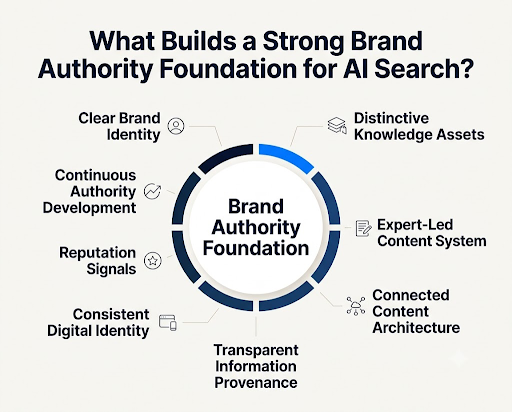
What Builds a Strong Brand Authority Foundation for AI Search?
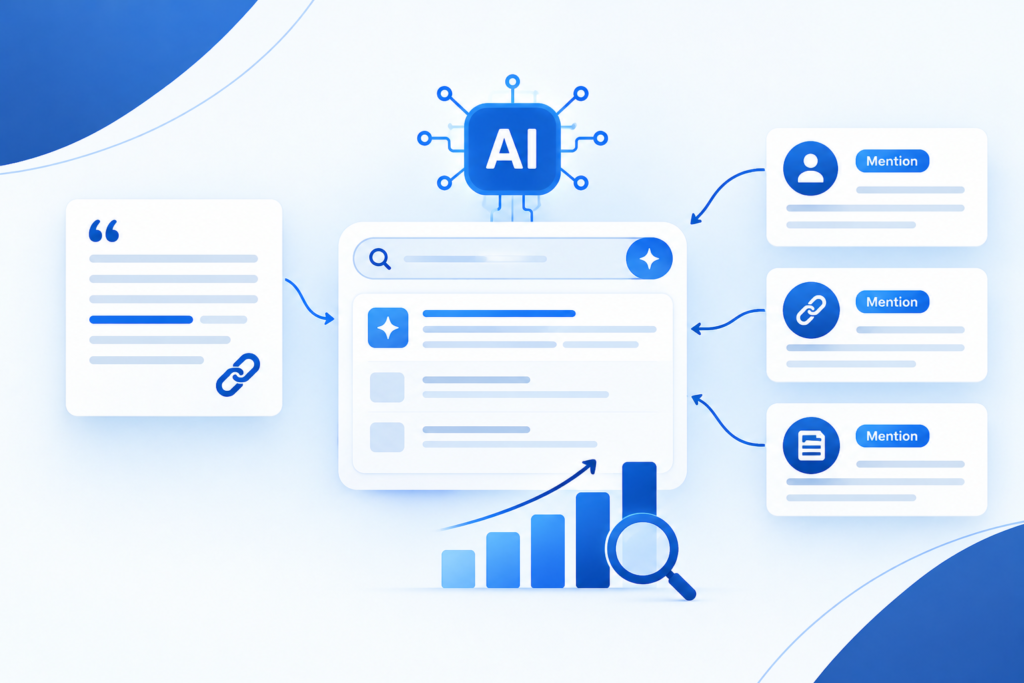
A strong brand authority foundation for AI search is built from interconnected elements that make a brand easier to understand, evaluate, and associate with its area of expertise. From a consistent digital identity and expert-led content to distinctive knowledge assets and transparent information, each component contributes to a stronger overall foundation. The infographic below highlights the key structural elements that support a credible and recognizable brand presence across AI-powered search environments.
| Strengthen your digital presence with a strategy built for evolving search, stronger credibility, and meaningful long-term visibility! |
Why Brand Authority Matters More Than Ever for AI Search Visibility
AI Search Can Synthesize Information Across Multiple Queries
AI-powered search can expand a user’s query into related searches to gather information from multiple sources before generating a response. Google explains that AI Overviews and AI Mode may use a query fan-out technique, issuing multiple related searches across subtopics and data sources to develop a response. This process means visibility is no longer limited to one keyword-result pairing. Strong topical relevance across interconnected queries can increase opportunities for a brand’s content to become a supporting source.
Entity Recognition Becomes Critical to Brand Visibility
AI search systems need to distinguish organizations, products, services, and people when interpreting web information. Consistent entity signals, including standardized brand references, descriptive content, structured data, and connected topical pages, can help search systems establish these relationships. Google explains that Organization structured data can help it better understand an organization’s details and disambiguate it from other organizations. Clear entity representation reduces ambiguity and strengthens how a brand is understood within relevant search contexts.
Original Evidence Gives AI Systems More Useful Information to Surface
When competing pages provide similar information, original evidence can make a source more distinctive. Proprietary research, first-hand findings, case studies, documented methodologies, and original analysis provide information that cannot be easily replicated through generic rewriting. Google’s guidance for generative AI features emphasizes creating valuable, non-commodity content with unique perspectives and information rather than simply recycling material already available elsewhere. This makes evidence-based content particularly useful for differentiated search visibility.
Consistent Expertise Can Strengthen Recognition Across Search Journeys
AI search can introduce users to brands during informational research that precedes commercial searches. Consistently addressing related questions within a defined subject area can strengthen a site’s topical association. This requires meaningful coverage rather than publishing numerous keyword variations. Google emphasizes comprehensive, useful content created for people rather than pages produced primarily to capture search traffic.
Source Selection Makes External Recognition More Valuable
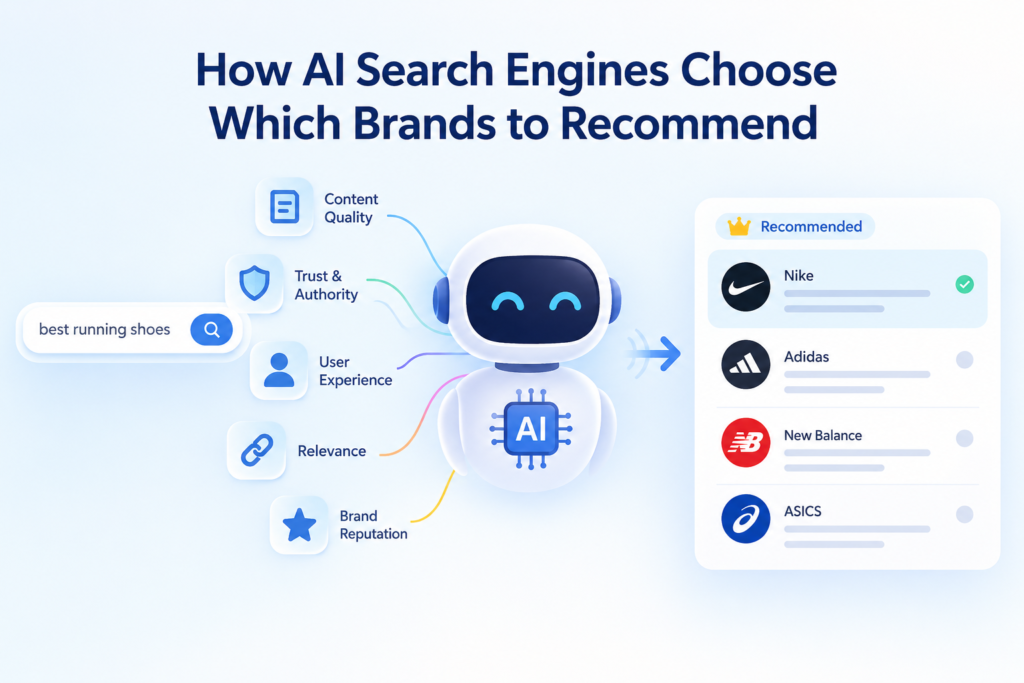
AI-generated responses can incorporate information from external web sources, making a brand’s broader digital reputation increasingly relevant. References from credible publications, industry organizations, expert resources, and reputable websites can provide contextual evidence about relevance and credibility. However, external mentions should not be treated as guaranteed ranking factors or direct triggers for AI citations.
How to Measure Your Brand Authority in AI Search
Track Visibility in Google’s Generative AI Performance Reporting
Google Search Console provides a dedicated performance report for generative AI features, allowing site owners to assess how content is discovered through AI-powered Search experiences. Use this data to establish baseline impressions, clicks, queries, and page-level performance, then compare changes over time rather than relying on conventional keyword rankings alone.
Measure Brand-Associated Query Coverage
Build a tracked query set containing branded searches, category terms, problem-based questions, and high-intent queries associated with your expertise. Search Console’s Performance reporting provides metrics such as clicks, impressions, and click-through rate that can be analyzed across search data. Measure how frequently your domain appears across these query groups and whether visibility expands beyond navigational searches.
Monitor Brand Mentions Across Independent Sources
Measure how frequently your brand is referenced by relevant third-party websites, publications, professional organizations, and industry resources. Categorize each mention by source relevance, topical relationship, context, and whether it identifies your organization as an information source rather than merely naming it. This creates a more meaningful authority baseline than counting mentions without evaluating their quality.
Analyze Citation and Source Inclusion Patterns
Track which of your pages are cited or surfaced when AI-generated responses address topics within your expertise. Record the query, cited URL, surrounding subject, and competing sources appearing alongside it. Comparing these patterns over time can reveal which content assets consistently provide information that AI search experiences consider relevant enough to include.
Benchmark Authority Against Relevant Competitors
Create a recurring competitor benchmark using the same query set, topic categories, citation observations, and third-party mention criteria. Compare share of relevant visibility, source inclusion, branded-query presence, and topical coverage rather than relying only on average keyword position. This establishes whether your authority is strengthening relative to competing entities within the same search landscape.
Conclusion
Building lasting visibility in AI search requires more than publishing content; it requires a digital strategy designed to strengthen your brand’s authority and search presence. Think Shaw combines SEO expertise, content strategy, technical optimization, and data-driven execution to help businesses compete in evolving search environments. Partner with Think Shaw to build stronger visibility, credibility, and sustainable organic growth.
| Turn your brand into a trusted AI search presence with Think Shaw’s strategic expertise. Build authority. Get discovered! |
FAQ’s About Building Brand Authority for AI Search
How Does Brand Consistency Affect AI Search?
Consistent brand information across your website, author profiles, business listings, and digital properties reduces ambiguity around your organization. Maintain accurate business names, descriptions, services, and organizational details across relevant platforms. This gives search systems clearer contextual information when interpreting different references to the same brand.
Does Structured Data Help Build Brand Authority for AI Search?
Structured data helps search engines interpret entities, relationships, and page content in a machine-readable format. Relevant schema types, such as Organization, Person, Article, or Product, can add contextual clarity. However, markup must accurately represent visible content and cannot independently establish authority or guarantee AI-search inclusion.
How Does Author Expertise Support Brand Authority?
Author expertise establishes context around who created or reviewed published information. Relevant experience, qualifications, professional background, and transparent author profiles can help demonstrate subject-matter competence. Credentials should be genuine and directly relevant to the topic rather than added solely for SEO purposes or perceived authority.
Can User Reviews Influence Brand Authority in AI Search?
Authentic reviews can contribute to a broader understanding of a business’s reputation by documenting real customer experiences. Their usefulness depends on relevance, authenticity, and the credibility of the platform hosting them. Reviews should be viewed as reputation evidence rather than a direct ranking signal for AI-generated search results.
Should Brands Create Separate Content Specifically for AI Search?
Brands generally should not create content solely to manipulate AI-generated results. Instead, develop useful pages that address genuine audience needs, demonstrate relevant expertise, and provide independently valuable information. Content should prioritize users while maintaining crawlability, clear organization, and technical accessibility for search-engine systems.