AI is fundamentally changing how paid advertising campaigns are managed in 2026, shifting marketers from manual optimization toward automated, data-driven decision-making. Modern advertising platforms use machine learning to analyze conversion signals, audience behavior, device data, location, timing, and engagement patterns to optimize bids, targeting, budgets, and ad delivery in real time. AI-powered bidding can evaluate thousands of auction-time signals to determine when and where an ad is most likely to generate a valuable conversion. This makes campaign management faster, more scalable, and increasingly predictive. However, automation does not replace strategic oversight. Accurate conversion tracking, attribution, audience segmentation, creative testing, budget controls, and meaningful performance goals remain essential. Understanding how AI works within paid advertising is therefore critical for achieving efficient and measurable campaign performance in 2026.
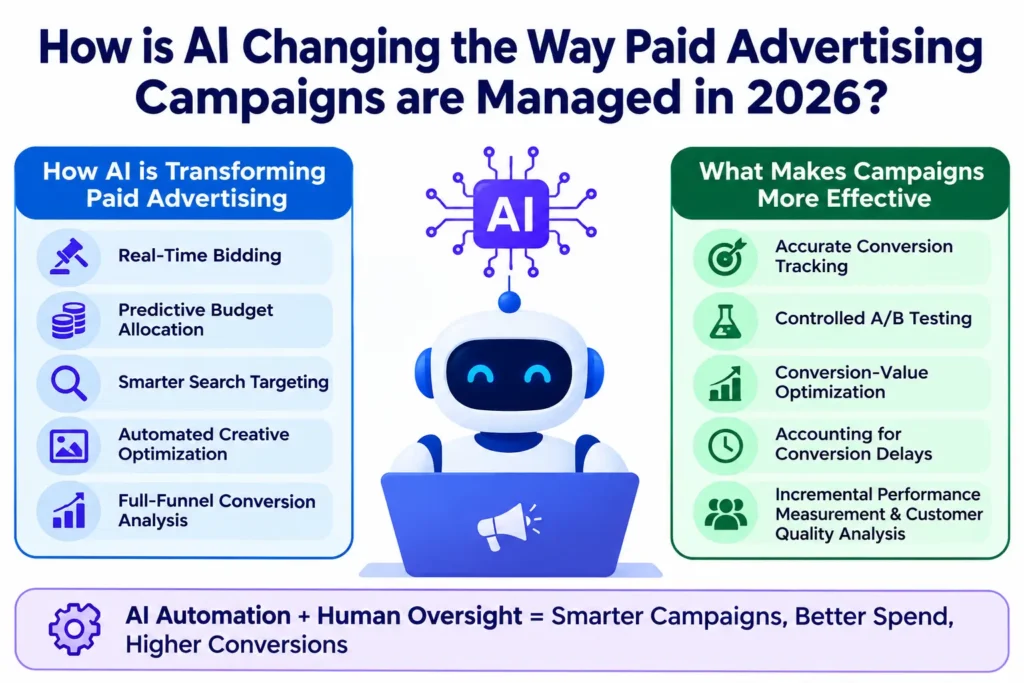
Summary of AI-Powered Paid AdvertisingAI is transforming paid advertising through real-time bidding, predictive budget allocation, smarter search targeting, automated creative optimization, and full-funnel conversion analysis. Effective campaign management also depends on accurate conversion tracking, controlled A/B testing, conversion-value optimization, accounting for conversion delays, incremental performance measurement, and customer-quality analysis. Combining AI automation with strategic human oversight helps businesses improve personalization, optimize advertising spend, increase conversion efficiency, and achieve stronger, measurable returns from paid campaigns in 2026. |
How is AI Transforming Paid Advertising Campaign Management?
AI-Powered Real-Time Bidding
Auction-level optimization is reducing the need for frequent manual bid adjustments. Smart Bidding analyzes contextual signals such as device, location, time, language, operating system, and user intent to determine an appropriate bid for each auction. Strategies from Google such as Target CPA and Target ROAS use these predictions to pursue defined conversion goals.
Predictive Budget Allocation
Changing consumer demand can now influence how advertising budgets are distributed. Demand-led pacing capabilities can respond to fluctuations in interest by allocating more budget during high-demand periods while maintaining campaign spending limits. This reduces dependence on manual daily budget adjustments and helps advertisers capture valuable opportunities when demand increases.
Smarter Search Targeting
Beyond manually selected keywords, advertising platforms can identify additional search opportunities using machine-learning models. Google’s AI Max uses search-term matching and real-time intent signals to discover relevant queries while retaining advertiser controls. It can also incorporate website content and campaign inputs to connect advertisements with changing search behavior.
Automated Creative Optimization
The selection and delivery of advertising assets can now adapt dynamically to individual users and contexts. AI-powered campaign systems can combine headlines, descriptions, images, videos, and other advertiser-provided assets while optimizing their delivery. This creates a more responsive relationship between creative variations, audience context, and campaign performance than static ad rotation.
Full-Funnel Conversion Optimization
Customer-journey data allows advertising systems to evaluate more than immediate leads or purchases. Journey-aware bidding can incorporate signals from different stages, including form submissions, phone calls, and subsequent sales. By connecting these downstream outcomes with advertising interactions, bidding models can make optimization decisions that better reflect broader business performance.
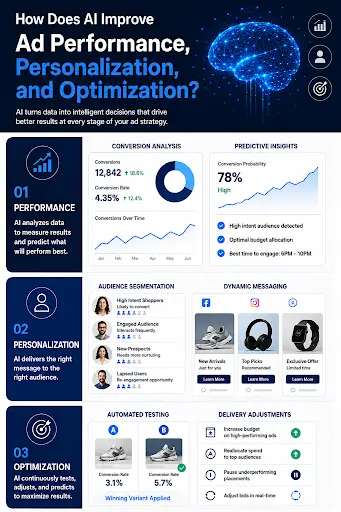
How Does AI Improve Ad Performance, Personalization, and Optimization?
AI improves advertising by using machine learning to match ads with user intent, personalize creative and landing-page experiences, identify high-value audiences, and continuously optimize targeting and delivery. These capabilities help advertisers improve relevance, conversion efficiency, and measurable campaign performance.
Ways to Optimize Paid Advertising Campaign Management
Build a Reliable Conversion Measurement Framework
Before optimizing campaigns, establish accurate conversion tracking for meaningful business actions such as qualified leads, purchases, booked appointments, or revenue. Configure primary conversion actions correctly and use consistent attribution settings. Because automated bidding relies on conversion data, inaccurate or incomplete measurement can cause optimization toward low-value actions instead of genuine business outcomes.
Use Controlled A/B Testing
Test significant campaign changes through controlled experiments instead of changing multiple variables simultaneously. Compare a control group against a treatment group while keeping other campaign conditions consistent. Google recommends sufficient traffic, appropriate experiment duration, and adequate conversion volume to produce more reliable results. Testing one variable at a time makes performance differences easier to attribute.
Optimize for Conversion Value
For businesses with different customer values, optimize campaigns around revenue or conversion value rather than treating every conversion equally. Assign meaningful values to purchases, qualified leads, or other outcomes and evaluate performance using ROAS and conversion value. This helps advertising systems prioritize outcomes that contribute more directly to business revenue.
Account for Conversion Delays
Avoid making optimization decisions immediately after launching or modifying a campaign. Analyze the average time between an ad interaction and the resulting conversion, then allow sufficient time for that conversion data to accumulate. Google recommends considering conversion cycles when evaluating automated bidding and experiments, particularly for campaigns with longer customer journeys.
Monitor Incremental Performance
Do not evaluate campaigns solely through attributed conversions. Use controlled measurement approaches, such as conversion-lift studies or properly structured experiments, to determine whether advertising generated additional conversions that would not otherwise have occurred. This distinguishes incremental impact from conversions that may have happened without the advertising exposure.
Segment Performance by Profitability and Customer Quality
Evaluate campaigns using profit margin, customer lifetime value (LTV), lead quality, and revenue, rather than CPA or conversion volume alone. Assign different conversion values to high-value customers or qualified leads, then feed these values into value-based bidding. This enables optimization toward customers generating greater long-term business value.
Conclusion
AI is transforming paid advertising, and having the right digital marketing expertise can make that technology work harder for your business. Think Shaw offers result-oriented paid advertising solutions across Google Ads, Bing Ads, Facebook Ads, display, and mobile advertising. With an experienced team and a focus on measurable growth, we help businesses build effective campaigns designed to generate qualified leads, conversions, and stronger returns from their advertising investment.
| Ready to turn your advertising strategy into measurable growth? Connect with Think Shaw’s digital marketing experts and start building stronger campaigns today! |
FAQ’s About AI in Paid Advertising Campaign Management
Can AI manage an entire paid advertising campaign without human involvement?
AI can automate bidding, targeting, budget adjustments, and optimization, but human oversight remains necessary for strategic decisions, brand positioning, compliance, creative direction, and evaluating broader business objectives.
What data does AI need to optimize paid advertising campaigns effectively?
AI typically relies on conversion data, audience interactions, campaign history, search behavior, customer signals, website activity, and performance metrics to identify patterns and make optimization decisions.
How does AI detect underperforming advertising campaigns?
AI compares current performance against historical patterns, predicted outcomes, and defined campaign objectives. Significant deviations in metrics such as conversion rate, CPA, or ROAS can trigger optimization signals.
Can AI identify fraudulent clicks and invalid advertising traffic?
Yes, advertising platforms use automated systems to analyze traffic patterns, repeated interactions, suspicious activity, and unusual behavior to identify and filter potential invalid clicks or fraudulent activity.
How does AI handle sudden changes in consumer behavior?
Machine-learning systems can detect emerging behavioral patterns through incoming performance signals and adjust predictions accordingly. However, significant market disruptions may still require marketers to reassess campaigns manually.
What are the risks of relying too heavily on AI for paid advertising?
Overreliance can create risks when tracking is inaccurate, objectives are poorly configured, data is insufficient, or automated decisions conflict with business priorities, profitability, or brand requirements.