Search engine optimization has evolved far beyond publishing keywords and building backlinks. Today, businesses must decide not only how to invest in SEO but also who should own it.
Should you build an in-house team that understands your brand inside out, or partner with an agency that brings specialized expertise and proven processes?
The answer depends less on which approach is “better” and more on your company’s growth stage, resources, and long-term objectives. From startups seeking rapid visibility to established enterprises scaling organic growth, each model offers distinct advantages and trade-offs. This guide explores the differences between SEO agency vs. in-house SEO, helping you make an informed, strategic decision that supports sustainable search performance and measurable business growth.
In-House vs. Agency SEO: Decision OverviewSelecting between an SEO agency or in-house SEO depends on your business stage, available resources, and long-term growth objectives. While in-house teams provide deep brand knowledge and internal alignment, agencies offer specialized expertise, scalability, and faster execution. Many growing businesses benefit from a hybrid approach that combines both models. Evaluating costs, ROI, operational needs, and future expansion plans helps businesses choose an SEO strategy that delivers sustainable organic growth. |
In-House SEO vs. Agency SEO: What’s the Real Difference?
At a high level, both in-house SEO teams and SEO agencies aim to improve organic visibility, rankings, and revenue. The difference lies in depth of expertise, scalability, resource availability, and operational efficiency. Here’s how SEO agency vs. in-house SEO compare:
| Factor | In-House SEO | SEO Agency |
| Expertise | Limited to the skills of your internal team. | Access to specialists in technical SEO, content, link building, analytics, and AI search optimization. |
| Industry Experience | Deep knowledge of one brand and industry. | Experience across multiple industries with proven SEO frameworks and best practices. |
| Scalability | Requires hiring and training to grow. | Can quickly scale resources and campaigns based on business needs. |
| Cost | Includes salaries, benefits, software, and training costs. | Predictable monthly retainer with access to a full team and premium SEO tools. |
| Execution Speed | Dependent on internal bandwidth and priorities. | Faster implementation through established workflows and dedicated specialists. |
| SEO Tools | Businesses purchase and manage their own tool stack. | Enterprise-grade SEO tools are typically included as part of the service. |
| Business Understanding | Strong knowledge of internal processes, products, and brand voice. | Requires onboarding but provides valuable external insights and competitive analysis. |
| Best For | Established businesses with long-term SEO resources and consistent workloads. | Startups, SMBs, and growing companies seeking expertise, flexibility, and faster results without expanding internal teams. |
Which SEO Model Fits Your Business Stage?
Understanding where your business stands today helps you choose an SEO approach that delivers the greatest impact without overspending or limiting future growth. Let’s see which SEO model fits your business stage in this comparison on SEO agency vs. in-house SEO:
Early-Stage Startups: Prioritize Speed and Specialized Expertise
Best fit: SEO Agency
Why it works:
Startups typically operate with lean teams, limited budgets, and aggressive growth targets. Hiring an experienced in-house SEO professional can be expensive, especially when additional investments in SEO tools, content creation, and technical resources are required. When you outsource SEO to an agency, this provides immediate access to specialists who can build a scalable SEO foundation, conduct keyword research, optimize technical performance, and create a content strategy without the time and cost of recruiting an internal team.
Small Businesses: Maximize ROI Without Expanding Headcount
Best fit: SEO Agency
Why it works:
Small businesses often have limited marketing resources and require measurable returns from every investment. Rather than employing multiple SEO specialists, partnering with an agency provides access to technical SEO, local SEO, content optimization, and performance reporting under one predictable monthly cost. This enables business owners to stay focused on operations while SEO professionals manage organic growth.
Scaling Companies: Balance Growth With Strategic Execution
Best fit: Agency-led or Hybrid SEO Team
Why it works:
As businesses expand into new markets, launch additional products, or increase content production, SEO becomes more complex. Scaling companies often benefit from an agency’s ability to quickly increase resources while supporting technical improvements, topical authority, and competitive analysis. Many organizations at this stage also begin building an internal marketing team that collaborates with external SEO experts.
Mid-Market Businesses: Combine Internal Knowledge With External Expertise
Best fit: Hybrid (In-House + SEO Agency)
Why it works:
Mid-market organizations usually have established marketing teams and consistent organic traffic goals. However, advanced SEO initiatives, such as technical audits, site migrations, international SEO, or AI search optimization, often require SEO outsourcing for expertise. A hybrid model allows internal teams to manage day-to-day marketing while agencies handle high-impact SEO projects and strategic execution.
Enterprise Organizations: Build Internal Leadership, Augment With Specialists
Best fit: In-House SEO supported by an SEO Agency
Why it works:
Large enterprises typically maintain dedicated in-house SEO teams that work closely with product, engineering, and content departments. However, even enterprise organizations frequently partner with SEO agencies for large-scale technical projects, international expansion, algorithm recovery, digital PR, or enterprise content strategies. Rather than replacing internal teams, agencies serve as strategic partners that add specialized capabilities.
Comparing Costs, ROI, and Long-Term Value
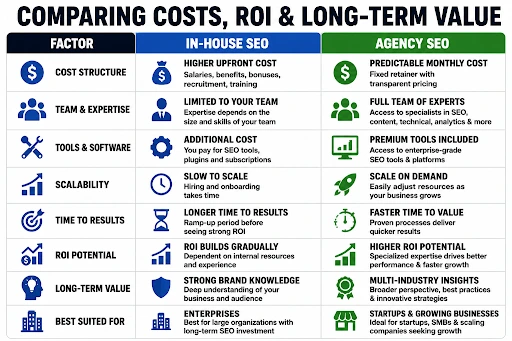
Choosing between an in-house SEO vs. SEO agency isn’t just about monthly costs; it’s about the overall value each model delivers over time. While in-house teams require significant investment in salaries, hiring, training, and SEO tools, agencies provide immediate access to experienced specialists, established processes, and enterprise-grade technology under a predictable pricing model.
The infographic below compares the two approaches across key factors, including cost, scalability, expertise, ROI, and long-term business value, helping you identify whether an SEO agency or in-house SEO aligns best with your organization’s growth stage and strategic objectives.
How to Decide: A Practical Framework for Choosing the Right SEO Model?
Choosing between an in-house SEO team and an SEO agency should be based on your business goals, available resources, and growth plans rather than cost alone.
- Start by assessing whether you have the budget to hire and retain experienced SEO professionals, invest in premium tools, and support ongoing training.
- Next, consider the complexity of your SEO needs. Businesses expanding into competitive markets, launching new products, or requiring technical SEO expertise often benefit from an agency’s broader capabilities and scalability.
- Conversely, organizations with established marketing departments and long-term SEO priorities may gain greater value from an in-house team.
Many growing businesses achieve the best results through a hybrid approach, combining internal brand knowledge with the specialized expertise and flexibility of an experienced SEO agency.
Conclusion
The most effective SEO strategy is one that evolves alongside your business, adapting to changing priorities, market conditions, and growth opportunities. Having the right partner can make that transition smoother by providing strategic direction, measurable outcomes, and the flexibility to scale when needed. At Think Shaw, we help businesses build sustainable organic growth through data-driven SEO strategies tailored to their unique objectives and stage of growth.
Ready to turn SEO into a long-term growth engine? Get in touch with us today and discover how our experts can help you achieve lasting search success.
Your In-House vs. Agency SEO Questions Answered
What should I look for when choosing an SEO agency?
Evaluate proven case studies, transparent reporting, industry experience, ethical SEO practices, communication processes, and measurable performance metrics rather than guaranteed rankings.
Can an in-house SEO team and an agency work together?
Absolutely. A hybrid model allows internal teams to manage brand strategy while agencies contribute technical expertise, advanced SEO initiatives, and additional execution capacity.
Can SEO support other digital marketing channels?
Yes. Strong SEO improves website visibility, strengthens content marketing, supports paid campaigns with better landing pages, and increases overall digital marketing effectiveness.
Is it difficult to switch SEO agencies if business needs change?
No. A smooth transition is possible when website access, analytics, documentation, and reporting are properly managed, ensuring minimal disruption to ongoing SEO performance.
Which SEO model is more flexible for changing business priorities?
SEO agencies generally offer greater flexibility by adjusting resources, campaign scope, and specialist involvement without the delays associated with recruiting or restructuring internal teams.