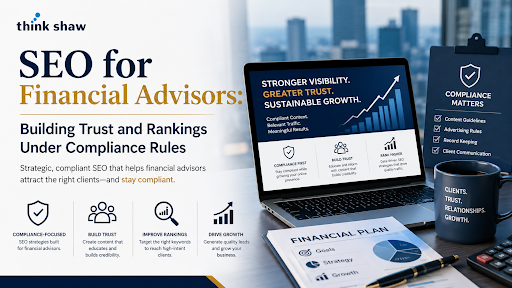
SEO for Financial Advisors carries a burden most industries never face: every page, testimonial, and performance claim published online is also a regulated advertisement under SEC and FINRA rules. Financial Advisor SEO succeeds when it builds authentic trust and search visibility without violating the SEC Marketing Rule’s requirements around testimonials, performance claims, and disclosures. SEO for Wealth Management firms in 2026 depends heavily on Google’s EEAT and YMYL standards, since financial content directly shapes decisions about a person’s savings, retirement, and long-term security. Financial Services SEO done correctly treats compliance not as friction that slows down marketing, but as the exact credibility layer that convinces both regulators and search engines that a firm deserves to be trusted.
| Expert Overview of Financial Advisor SEO |
| SEO for Financial Advisors carries a burden most industries never face: every page, testimonial, and performance claim published online is also a regulated advertisement under SEC and FINRA rules. Financial Advisor SEO succeeds when it builds authentic trust and search visibility without violating the SEC Marketing Rule’s requirements around testimonials, performance claims, and disclosures. SEO for Wealth Management firms in 2026 depends heavily on Google’s EEAT and YMYL standards, since financial content directly shapes decisions about a person’s savings, retirement, and long-term security. Financial Services SEO done correctly treats compliance not as friction that slows down marketing, but as the exact credibility layer that convinces both regulators and search engines that a firm deserves to be trusted. |
Why Financial Advisor SEO Is Inseparable From Compliance
Most businesses can publish marketing content the same day they write it. Financial advisors cannot, because nearly everything published online, including blog posts, testimonials, and social content, qualifies as an advertisement under the SEC Marketing Rule, Rule 206(4)-1. This means SEO for Financial Advisors has to be built alongside compliance review from the first draft, not after content goes live.
- The SEC Marketing Rule prohibits untrue or misleading statements and requires that all material claims be substantiated and archived
- FINRA Rule 2210 governs communications with the public for broker-dealers, requiring content to be fair, balanced, and not misleading
- Marketing materials, including website copy and social posts, must be retained for at least five years under SEC recordkeeping rules
- Compensated testimonials and endorsements require clear, prominent disclosures about compensation and any material conflicts of interest
Google Treats Financial Content as YMYL for a Reason
Financial guidance falls directly into Google’s Your Money or Your Life category because bad information can materially affect someone’s savings, retirement, or financial stability. This pushes Financial Planner SEO into a stricter quality tier, where thin or generic content simply cannot compete against well-sourced, credential-backed material.
- Content needs a clearly identified author with verifiable financial credentials, not an anonymous or generic byline
- Generic AI-written financial explainers without advisor review tend to underperform against specific, well-substantiated guidance
- Outdated tax figures, contribution limits, or regulatory references actively damage trust signals and need scheduled review
- Sites lacking transparent fee structures, fiduciary status, and firm information struggle to rank regardless of content depth
Building EEAT the SEC Marketing Rule Actually Allows
Since November 2022, the SEC Marketing Rule has permitted testimonials and endorsements for registered investment advisers, but only with specific disclosures in place. This makes it possible to build strong EEAT signals for SEO for Wealth Management without stepping outside regulatory boundaries.
| EEAT Signal | Compliance-Safe Way to Build It |
| Experience | Reference years in practice and general client situations handled, using anonymized case examples rather than specific guarantees |
| Expertise | Display CFP, CFA, CPA, or ChFC designations prominently, with links to FINRA BrokerCheck or SEC IAPD for verification |
| Authoritativeness | Publish advisor-authored articles, secure mentions in industry publications, and list speaking engagements or association memberships |
| Trustworthiness | Maintain clear fee disclosures, fiduciary status statements, compliance disclaimers, and transparent firm contact details |
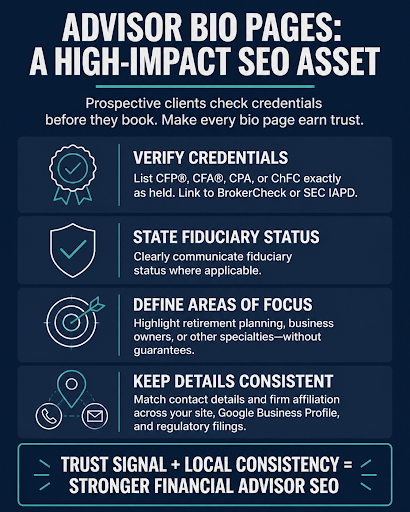
Advisor Bio Pages Carry Outsized Weight in Financial Advisor SEO
Prospective clients researching a financial advisor almost always check credentials before booking a consultation, which makes the advisor bio page one of the highest-leverage assets in any Financial Advisor Marketing strategy.
Content Strategy That Ranks Without Triggering a Compliance Review Failure
The most effective content for financial advisors educates without crossing into specific investment advice or performance predictions that would require far heavier disclosure and substantiaSEO for Financial Advisorstion than most blog content can support.
- Focus on general financial education, such as how different account types work, rather than specific investment recommendations
- Include required disclosures and disclaimers clarifying that content is general information, not individualized financial advice
- Avoid presenting performance figures without required context, since the Marketing Rule imposes strict standards on any performance advertising
- When referencing hypothetical scenarios, label them clearly as hypothetical rather than implying likely real-world outcomes
- Review and update content whenever tax law, contribution limits, or relevant regulations change, since outdated figures create both SEO and compliance risk
Local SEO for Financial Advisors and Wealth Management Firms
Even though financial planning can be delivered remotely, a large share of searches still carry local intent, particularly from people who prefer meeting an advisor in person before committing to a long-term relationship.
- Keep name, address, and phone number consistent across the website, Google Business Profile, and directories such as BrokerCheck or NAPFA
- Maintain accurate service categories on the Google Business Profile so the firm surfaces for the right type of financial search
- Build separate pages for each office location if the firm operates in multiple cities, rather than one generic contact page
- Encourage client reviews where compliance permits, ensuring any solicited feedback includes required disclosures about compensation or relationship status
Testimonials and Endorsements: Where the Marketing Rule Gets Strict
The SEC Marketing Rule technically allows testimonials now, but the disclosure requirements are detailed enough that most compliance failures in financial marketing trace back to this exact area.
- Disclose clearly whether the person giving the testimonial is a current client and whether they received compensation
- Disclose any material conflicts of interest, such as an ownership stake or referral relationship with the advisor
- Include a not-representative disclosure when featuring a single testimonial or a curated selection rather than a full, unfiltered sample
- Maintain records of every testimonial and its required disclosures for the SEC’s minimum five-year retention period
AEO Readiness for Financial Advisor Searches
As more prospective clients ask AI assistants direct questions like how much does a financial advisor cost or do I need a fiduciary, Financial Services SEO increasingly depends on whether content is structured clearly enough for these tools to extract and cite accurately.
- Structure FAQ content with direct, clear answers followed by appropriate disclaimers about seeking individualized advice
- Use accurate schema markup for advisor profiles, service offerings, and firm information so answer engines surface verifiable details
- Avoid phrasing that could be misread by an AI tool as personalized investment advice rather than general education
- Periodically check how AI assistants describe the firm and its services, correcting any outdated or inaccurate information promptly
Common Compliance Mistakes That Undermine Both SEO and Regulatory Standing
- Publishing testimonials without required disclosures about compensation, client status, or conflicts of interest
- Using performance figures or guarantees without the substantiation and context the Marketing Rule requires
- Letting outdated tax figures or contribution limits sit live on the site long after they change
- Treating advisor bio pages as an afterthought rather than a primary trust-building and SEO asset
- Publishing AI-generated content without compliance review, since the Marketing Rule applies equally regardless of how content was created
Conclusion
Financial advisor SEO works best when visibility and compliance strengthen each other. By publishing credential-led, up-to-date educational content, building transparent advisor profiles, and reviewing every claim carefully, firms can earn durable rankings and client confidence. Think Shaw helps financial advisors create compliance-conscious SEO strategies that support local discovery, EEAT, and AI search readiness without sacrificing credibility.
Ready to turn your website into your most trusted digital introduction? Book a Think Shaw “Trust-to-Search” strategy session and map the compliant growth opportunities already hiding on your site.
Frequently Asked Questions About Financial Advisor SEO and Compliance
Can financial advisors legally use client testimonials for marketing?
Yes, since the SEC Marketing Rule took effect in November 2022, registered investment advisers can use testimonials and endorsements, but only with clear disclosures about compensation, client status, and any conflicts of interest. Firms should confirm their specific disclosure language with compliance before publishing any testimonial.
How does Google’s YMYL classification affect financial advisor rankings?
YMYL content faces stricter quality evaluation, meaning generic or unsubstantiated financial content tends to underperform compared to well-sourced material with clear author credentials and current information. Firms that keep content accurate and properly attributed tend to see more stable, durable rankings.
Is it safe to publish articles that reference specific investment performance?
Performance advertising falls under strict SEC Marketing Rule requirements around context, time periods, and fee disclosure, so any reference to performance figures should go through compliance review before publishing. Most firms find it safer to focus content on general financial education rather than specific performance claims.
Do financial advisor blog posts need compliance disclaimers?
Yes, since blog content published by a registered investment adviser or broker-dealer generally qualifies as an advertisement under SEC or FINRA rules, requiring appropriate disclaimers clarifying that the content is general information rather than personalized advice. This applies even to educational content that doesn’t mention specific products.
How often should financial content be reviewed for accuracy?
Financial content should be reviewed at least annually, or immediately after changes to tax law, contribution limits, or relevant regulations, since outdated figures damage both search trust signals and regulatory standing. Firms publishing frequently often benefit from a rolling review calendar rather than a single yearly pass.
Does using AI to write financial content create compliance risk?
Yes, the SEC has explicitly stated that using AI tools does not reduce an advisor’s compliance obligations, meaning AI-generated marketing content must go through the same review and substantiation process as human-written content. Skipping this review because content was AI-assisted is one of the more common compliance gaps firms encounter.