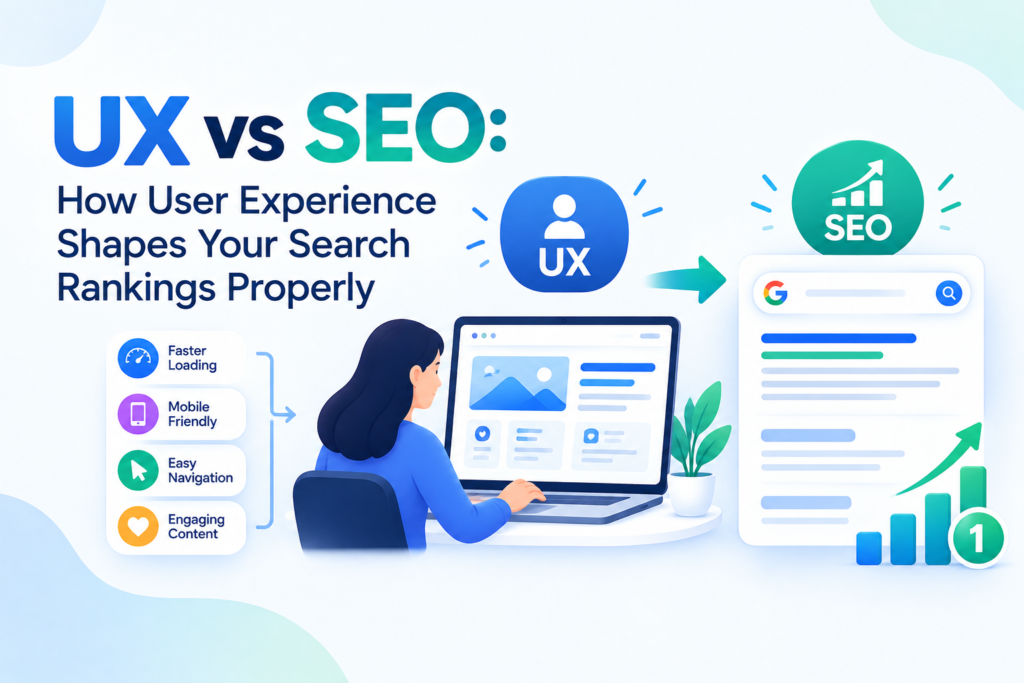
Every business website exists to do one thing well: connect people with the information or product they’re searching for. That’s where UX and SEO come into the picture. Yet many businesses treat them as separate, even competing priorities, like design versus rankings, users versus algorithms. In reality, they share the same goal, and search engines have learned to reward that alignment: how people experience your site directly shapes how well it performs in organic search. With that in mind, we have this guide that breaks down where UX and SEO overlap and how to design for both at once.
All About UX vs SEOUX and SEO both influence how well a website performs in organic search — UX shapes how users experience a while SEO determines how discoverable that experience is to search engines. Google’s ranking systems now treat user experience signals, like page speed and mobile usability, as direct inputs into search performance. Aligning both disciplines, rather than treating them separately, is what sustains long-term organic visibility. |
Understanding UX and SEO
What Do You Mean by UX
User Experience (UX) refers to how a visitor interacts with and feels about your website. This includes:
- How easy it is to navigate
- How quickly pages load
- How clearly information is presented
Good UX removes friction, guiding users naturally toward what they came to find, whether that’s an answer, a product, or a service.
What Do You Mean by SEO
Search Engine Optimization (SEO) is the process of improving a website’s visibility on search engines through keywords, technical structure, and content quality. It helps search engines understand what a page is about so it can be matched with relevant user queries and ranked accordingly.
| Struggling to Tell If Your Website Speaks to Users or Just to Search Engines?
Our team evaluates your site against both UX principles and SEO fundamentals, so you know exactly where the gaps are before they cost you traffic or trust. |
How UX vs SEO Impacts Organic Search Performance
Search engines increasingly evaluate websites the way real users do, like favoring pages that are fast, clear, and genuinely useful. The table below breaks down how each discipline contributes to organic performance.
| Factor | UX Contribution | SEO Contribution |
| Page Speed | Faster load times keep visitors engaged instead of bouncing within the first few seconds | Measured directly through Core Web Vitals like LCP, which search engines use as a ranking signal |
| Mobile Design | With its help, you can browse smoothly on any device | It powers mobile-first indexing by search engines |
| Content Layout | Makes information easy to scan and digest | Improves chances of ranking in featured snippets |
| Navigation | Logical menus and internal links help users reach what they need in fewer clicks | Clean navigation improves crawlability and helps distribute link equity across key pages |
| Engagement Signals | Intuitive design encourages users to stay longer and explore more pages | Longer sessions and lower bounce rates signal to algorithms that content matches search intent |
| Trust Elements | Builds visitor confidence in the brand | Strengthens EEAT evaluation by search engines |
Each row reflects the same idea: strong UX creates the conditions that SEO needs to succeed, and strong SEO ensures that good UX actually gets discovered. Google’s own Search Central documentation confirms this link directly, noting that Core Web Vitals measure real-world user experience, like Loading speed and visual stability, and factor into how pages are ranked.
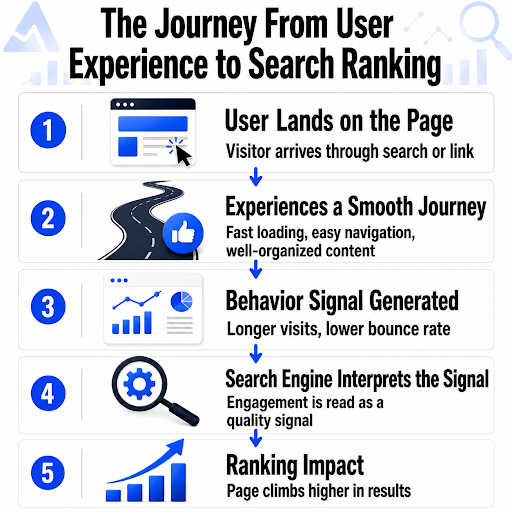
UX Signal to SEO Ranking Factor
The link between UX and SEO isn’t just an idea; it happens in real time, every time someone visits your site. One small moment of ease, like a fast load or a clear layout, can turn into a signal search engines actually notice and respond to. This is exactly how that happens, step by step:
Aligning UX and SEO Together
Bringing UX and SEO into one strategy comes down to a few practical habits, applied consistently across every page.
- Speed & Responsiveness: Prioritize page speed and mobile responsiveness so users and search engines both experience the site the same way.
- Content Structure: Always structure content with clear headings and short paragraphs to improve readability and search engine parsing. Even according to the U.S. General Services Administration’s Digital.gov, clear, concise content builds trust and helps users complete their intended actions, which means content structure benefits both usability and search visibility.
- Navigation: Make sure to design intuitive navigation paths that reduce clicks and help both visitors and crawlers find key pages.
- Trust & Authorship: Back up your content with credible sources and clear authorship to build trust and support search visibility.
- Keyword Integration: Weave the target keywords naturally into headings and body copy, always without disrupting readability or user flow.
- Performance Tracking: Monitor UX and SEO metrics together, like bounce rate and rankings, to catch issues before they compound.
Conclusion
Now, from the above, it must be clear to you that UX and SEO aren’t competing checklists; instead, they are two lenses focused on the same website, working toward the same outcome. So, if you’re looking for professional help, check out Think Shaw. Our team brings years of hands-on experience delivering both UX design and SEO strategy under one roof, so nothing gets lost in translation.
| Let us turn your UX and SEO alignment into a real strategy for your website, one that’s designed to perform and built to last.
|
FAQs- About UX vs SEO
Which comes first in a project: UX design or SEO strategy?
Ideally, both start together. SEO defines intent and structure while UX shapes how that structure is experienced.
Should UX audits and SEO audits be done together or separately?
Together works best, since overlapping issues like slow load times or confusing navigation affect both disciplines simultaneously and are easier to fix jointly.
Do UX and SEO teams use different tools?
Yes, UX relies on tools like Hotjar or Figma, while SEO uses platforms like Search Console or Ahrefs.
How do businesses measure success when combining UX and SEO efforts?
Businesses can measure it through shared metrics like organic traffic, engagement rate, conversion rate, and search ranking movement over time.
Can a highly optimized SEO page still deliver poor UX?
Yes, over-stuffed keywords, excessive internal links, or ad-heavy layouts can rank initially, but they slow load times and frustrate users.