For SaaS companies, organic search has become one of the most sustainable and cost-effective channels for customer acquisition. According to HubSpot research, users who discover software solutions through search engines often have higher purchase intent because they are actively looking for answers, tools, or platforms to solve a specific problem. Unlike paid advertising, which stops generating traffic once the budget ends, SEO creates long-term visibility and compounds over time. However, ranking on Google is no longer just about inserting keywords into blog posts. SaaS brands must understand search intent, create authoritative content, optimize technical performance, and guide users toward conversions.
In this blog, we will explore how a SaaS SEO strategy increases visibility, attracts qualified traffic, and drives more product signups through organic search. Let’s begin!
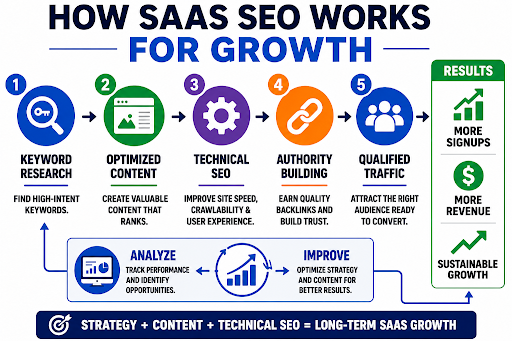
SEO for SaaS Companies Growth OverviewAn effective SaaS SEO strategy combines search intent optimization, high-converting content strategies, and technical website performance to drive sustainable organic growth. Targeting high-intent keywords, building funnel-focused content, and creating product-led resources help attract qualified users with stronger conversion potential. At the same time, technical SEO factors such as site speed, mobile responsiveness, structured data, crawlability, and conversion-optimized landing pages improve visibility and user experience. Consistent content updates, behavioral analytics, and trust-building elements further strengthen rankings, increase engagement, and support long-term SaaS signup growth through organic search. |
Understanding SaaS SEO and Search Intent
Understanding SaaS SEO requires aligning organic search strategies with user intent across the entire customer acquisition funnel. Unlike traditional SEO, SaaS SEO strategy focuses on capturing high-intent queries that indicate product evaluation, comparison, or problem-solving behavior. Search intent is typically categorized into informational, navigational, commercial, and transactional stages, each requiring tailored content architecture and keyword targeting. Effective SaaS SEO combines semantic keyword clustering, SERP analysis, internal linking, and intent-driven landing pages to improve topical authority and conversion potential. By mapping content to user intent, SaaS companies can attract qualified traffic with a significantly higher likelihood of product signups and revenue generation.
Creating High-Converting Content for Organic Growth
Here are some SaaS content marketing strategies to power your content for growth:
Build Content Across the Entire SaaS Funnel
High-converting SaaS SEO content supports users at every stage of the buyer journey. Top-of-funnel (TOFU) content educates users about industry problems, middle-of-funnel (MOFU) content compares tools and solutions, while bottom-of-funnel SEO (BOFU) pages focus on product-specific intent. For example:
- TOFU: “How to improve remote team collaboration.”
- MOFU: “Best collaboration software for remote teams.”
- BOFU: “Asana vs Trello comparison.”
This funnel-based approach increases organic visibility while gradually nurturing users toward conversion.
Target High-Intent Keywords Instead of Pure Traffic Keywords
A successful SaaS keyword strategy prioritizes keywords that indicate buying intent rather than focusing only on search volume. Queries such as “best CRM software for startups,” “Slack alternatives,” or “project management tool pricing” typically attract users who are already evaluating solutions. These keywords usually generate lower traffic than broad informational searches, but they produce significantly higher conversion potential because the user is closer to making a purchasing decision. SaaS companies should build content around problem-aware and solution-aware searches to increase trial signups and demo requests.
Create Product-Led SEO Content Instead of Generic Blog Posts
Modern SaaS SEO performs best when content naturally integrates the product into the user journey. Product-led SEO content demonstrates how the software solves a real operational problem rather than simply discussing the topic theoretically. Tutorials, workflow guides, use-case pages, and feature-driven articles help readers visualize practical implementation. This improves engagement metrics, reduces bounce rates, and increases free-trial conversions because users can immediately connect the content with a usable solution.
Use Comparison and Alternative Pages Strategically
Comparison pages consistently perform well in SaaS SEO because they target users with strong commercial intent. Searches including terms like “vs,” “alternative,” or “competitor comparison” usually indicate that the user is evaluating software before purchasing. Well-optimized comparison pages SEO can capture competitor traffic while positioning the SaaS product as a stronger solution. These pages should include transparent feature analysis, pricing comparisons, usability insights, and business-specific advantages to build trust and credibility.
Optimize Content for Topical Authority and Semantic SEO
Google increasingly evaluates websites based on topical depth and subject authority rather than isolated keyword usage. SaaS companies should build topic clusters around core product categories using interconnected blog posts, landing pages, guides, and resource hubs. Semantic SEO techniques such as related entity optimization, contextual internal linking, and comprehensive coverage improve search engine understanding of expertise within a niche. Strong topical authority enhances rankings for competitive SaaS keywords and improves long-term organic visibility.
Include Strong Conversion Elements Within Content
Traffic alone does not generate SaaS growth unless content is optimized for conversions. High-performing SaaS content includes strategically placed calls-to-action such as
- Free trial buttons
- Demo requests
- Downloadable templates
- Interactive product walkthroughs
Conversion elements should align naturally with the user’s search intent instead of interrupting the reading experience. Contextual CTAs embedded within educational content generally outperform aggressive promotional messaging because they maintain user trust while encouraging action.
Continuously Refresh and Update Existing Content
SEO performance in SaaS is highly dynamic because search trends, algorithms, and competitor strategies constantly evolve. Updating existing content with current statistics, product enhancements, new integrations, and refreshed keyword targeting helps maintain rankings and relevance. Content refreshes also improve crawl frequency and signal content accuracy to search engines. SaaS companies that regularly optimize historical content often achieve faster ranking improvements than businesses relying solely on publishing new articles.
Technical SEO and Conversion Optimization for SaaS Websites
Let’s take a look at what leading companies are deploying in their strategies for technical SEO and conversion optimization for SaaS websites:
Improve Website Speed and Core Web Vitals
A vital SaaS SEO strategy is improving website speed and core web vitals. Page speed directly affects both search rankings and user conversions. Google considers Core Web Vitals, including Largest Contentful Paint (LCP), Interaction to Next Paint (INP), and Cumulative Layout Shift (CLS), as important performance indicators for user experience. SaaS websites often contain heavy scripts, dashboards, animations, and third-party integrations that can slow loading times. A slow website increases bounce rates and reduces trial signups because users expect immediate access to information and product experiences. Optimizing image compression, reducing JavaScript execution, enabling caching, and using content delivery networks (CDNs) significantly improve performance and user retention.
Build a Scalable and Crawlable Site Architecture
Technical SEO for SaaS platforms requires a well-structured architecture that allows search engines to efficiently crawl and index pages. SaaS websites typically contain multiple product pages, integrations, feature pages, help documentation, blogs, and pricing sections. Without a clear hierarchy and internal linking, important pages may receive limited crawl attention or authority distribution. Organizing content into logical topic clusters and maintaining shallow click depth improves discoverability for both users and search engines. Strong architecture also enhances user navigation, reducing friction during the decision-making process.
Optimize Mobile Experience and Responsive Design
A significant percentage of SaaS-related searches now originate from mobile devices, especially during early-stage research. Google primarily uses mobile-first indexing, meaning the mobile version of a website heavily influences ranking performance. Poor mobile responsiveness negatively impacts usability, engagement metrics, and conversion rates. SaaS companies should ensure responsive layouts, readable typography, touch-friendly navigation, and optimized mobile forms to create seamless experiences across devices. A frictionless mobile experience improves both SEO visibility and lead generation potential.
Implement Structured Data for Better SERP Visibility
Structured data helps search engines better interpret website content and can improve search result visibility through rich snippets. SaaS websites can use schema markup for FAQs, reviews, products, pricing, software applications, and articles. Rich results improve click-through rates because they provide additional information directly within search engine results pages (SERPs). For example, the FAQ schema can increase SERP real estate, while the review schema can strengthen credibility and trust. Enhanced visibility often leads to higher-quality organic traffic and improved conversion opportunities.
Reduce Technical Errors That Harm Rankings
Technical issues such as broken links, duplicate pages, incorrect redirects, crawl errors, orphan pages, and indexation problems can significantly reduce SEO performance. SaaS websites frequently experience these issues because of constant product updates, landing page experiments, and changing site structures. Regular technical audits help identify and resolve problems that prevent search engines from efficiently accessing important content. Maintaining clean technical infrastructure improves crawl efficiency, preserves ranking authority, and strengthens overall website health.
Optimize Landing Pages for Conversion Intent
Ranking for keywords alone is insufficient unless landing pages are optimized to convert visitors into users. High-converting SaaS landing pages focus on clarity, trust, and reduced friction. Essential conversion elements include:
- Clear value propositions
- Benefit-focused headlines
- Social proof and testimonials
- Product screenshots or demos
- Simplified signup forms
- Strong call-to-action buttons
Users arriving from organic search often compare multiple solutions simultaneously, so landing pages must immediately communicate relevance and business value. Effective conversion optimization improves trial signups without requiring additional traffic acquisition.
Use Data Analytics and Behavioral Tracking
Technical SEO and conversion optimization rely heavily on performance measurement. SaaS companies should monitor metrics such as organic traffic, keyword rankings, bounce rates, session duration, conversion paths, and signup completion rates. Behavioral tracking tools like heatmaps and session recordings help identify friction points within the user journey. Data-driven optimization allows SaaS businesses to continuously refine page layouts, CTAs, and content positioning based on actual user behavior rather than assumptions. This iterative approach improves both SEO efficiency and conversion performance over time.
Strengthen Security and Website Trust Signals
Website security is an important ranking and trust factor, particularly for SaaS businesses handling sensitive user data. HTTPS encryption, secure authentication systems, transparent privacy policies, and compliance certifications improve user confidence and search engine credibility. Visitors are more likely to abandon signup flows if they perceive security risks or trust issues. Strong trust signals support both higher search visibility and improved conversion rates by reassuring users about platform reliability and data protection.
Conclusion
SEO has become a long-term growth driver for SaaS companies looking to build sustainable visibility and increase product adoption without depending entirely on paid acquisition channels. As search algorithms and customer behaviors continue to evolve, SaaS brands must adopt data-driven SEO strategies that deliver measurable business outcomes. At Think Shaw, we help SaaS businesses strengthen their digital presence through advanced SEO, content marketing, technical optimization, and conversion-focused strategies designed to improve rankings, engagement, and long-term signup growth.
Connect with our team to strengthen your search visibility and build a scalable organic growth engine for your business today.
Frequently Asked Questions About SaaS SEO
What is topical authority in SaaS SEO?
Topical authority refers to a website’s perceived expertise within a subject area, built through comprehensive, interconnected, and high-quality content coverage.
Why are comparison pages valuable for SaaS SEO?
Comparison pages target users evaluating competing tools, making them highly effective for capturing commercial-intent traffic and influencing purchasing decisions.
What role does keyword clustering play in SaaS SEO?
Keyword clustering organizes related search terms into strategic topic groups, helping SaaS websites improve semantic relevance and overall ranking potential.
Can technical SEO improve SaaS conversions?
Yes, technical SEO improves website speed, usability, crawlability, and navigation, creating smoother user journeys that support stronger conversion rates and signup performance.
What are SERP features in SEO?
SERP features include rich snippets, FAQs, featured snippets, reviews, and knowledge panels that improve search visibility and click-through rates.