BigCommerce SEO works differently right from the setup stage. While many platforms require third-party apps just to handle basic technical SEO, BigCommerce builds several of these capabilities directly into the platform, and a structural difference that shapes how easily your store gets crawled, indexed, and ranked. For merchants trying to understand why their rankings aren’t matching their product quality, these platform-level details are often the missing piece. In this guide, we’ll break down what makes BigCommerce’s approach genuinely different from other platforms, which BigCommerce SEO services it handles automatically without manual setup, and where you’ll still need to step in yourself.
BigCommerce SEO Key InsightsBigCommerce provides several built-in SEO advantages, including direct robots.txt access, automatic 301 redirects, native schema markup, server-side rendering, and streamlined handling of product variants and faceted navigation. The platform also automates essential SEO elements such as canonical tags, XML sitemaps, URL customization, CDN-powered performance optimization, and Google Merchant Center integration. These features help improve crawlability, indexing, search visibility, site performance, and long-term organic growth while reducing the need for extensive third-party tools. |
What Sets BigCommerce Apart From Other E-Commerce Platforms?
Direct Robots.txt Access
BigCommerce gives store owners direct Google robots.txt access through the admin panel, requiring no developer help or code workaround, unlike Shopify. This matters most for large catalogs, where crawlers often waste budget on filter and sort parameter URLs. With direct control, you can redirect that crawl activity toward product and category pages that actually drive revenue and rankings. This level of control is one reason a BigCommerce SEO agency can implement crawl optimization strategies more efficiently on the platform.
Automatic 301 Redirects on URL Changes
Whenever a product or category URL changes, BigCommerce automatically generates a 301 redirect, with no app required. This default protection safeguards accumulated search authority during catalog reorganization, product updates, or category restructuring, where unmanaged broken links would otherwise erase months of ranking progress. Store owners get this coverage out of the box, with no manual redirect configuration needed.
Native Product and Breadcrumb Schema Markup
Product pages on BigCommerce automatically receive Product schema, covering price, availability, ratings, and brand data, alongside native BreadcrumbList schema. This structured data unlocks rich results in search listings, including star ratings, price snippets, and stock status, which boost click-through rates before shoppers even land on the page. No theme customization or third-party app is required for this baseline coverage. This built-in schema support provides a strong foundation for a BigCommerce SEO company to expand structured data opportunities as a store grows.
Server-Side Rendering (SSR)
Rather than relying on heavy client-side JavaScript, BigCommerce renders content server-side, so pages reach browsers and search crawlers almost instantly. This eliminates the crawl delays and indexing friction common on JavaScript-dependent storefronts, where bots often struggle to render content before evaluating it. The result is faster, more reliable indexing, with no extra rendering configuration or third-party performance tools needed.
Built-In Handling for Product Variants and Faceted Navigation
Instead of generating separate duplicate pages, BigCommerce keeps product variants under a single URL, while faceted filters, like size, color, and price, canonicalize back to the base category page by default. This built-in behavior protects category authority and crawl budget, avoiding the thin, duplicate URL sprawl that filter combinations typically create on less structured platforms.
Multi-Storefront SEO Configuration
With BigCommerce’s Multi-Storefront feature, merchants running multiple stores or targeting different markets can configure distinct SEO settings, like custom URLs, meta tags, and sitemaps, for each storefront, all from a single back office. This removes the need for separate platform instances or duplicated technical setups when scaling into new regions or brand segments.
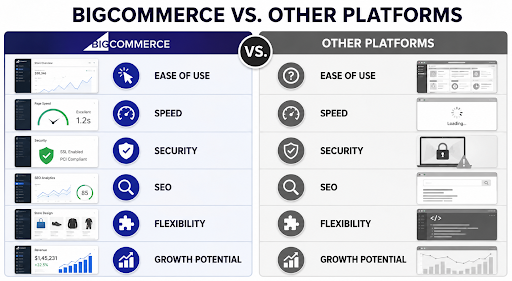
The comparison below provides a quick overview of the platform capabilities that often make BigCommerce a preferred choice for growing online businesses, highlighting key differences in SEO, performance, flexibility, security, and scalability compared to other ecommerce platforms.
The SEO Essentials BigCommerce Handles Automatically
Full URL Customization
BigCommerce generates clean, hierarchical URLs by default, with no forced parameter strings, session IDs, or legacy query strings. Product, category, brand, and blog pages each have independently configurable URL prefixes, so a messy inherited structure can be fixed without a full rebuild. Search engines read these URLs without ambiguity, and internal linking maps cleanly to your actual catalog hierarchy. A BigCommerce SEO company can use this flexibility to create URL structures that better support category targeting and long-term organic growth.
Automatic Canonical Tags
Canonical tags apply automatically on every product page, while filtered URLs that are generated from size, color, price, or material selections, and canonicalize back to the base category page by default. This prevents the duplicate-content dilution that faceted navigation typically causes, protecting your category page’s ranking authority without requiring any manual tagging or ongoing upkeep from store owners.
Self-Updating XML Sitemaps
BigCommerce generates and maintains XML sitemaps covering products, categories, and content pages, updating automatically as items are added or removed. The sitemap submits directly to Google Search Console, allowing new and updated pages to get discovered promptly instead of waiting on Google’s natural crawl schedule to reach them on its own.
CDN-Delivered Assets and Image Optimization
Site assets are served through a built-in CDN, keeping load times low regardless of a shopper’s location. Paired with image optimization, this directly supports Core Web Vitals metrics like Largest Contentful Paint (LCP), a live Google ranking signal, with mobile scores weighted more heavily since Google indexes mobile versions first.
Native Google Merchant Center Integration
BigCommerce integrates directly with Google Merchant Center, syncing product data, pricing, availability, images, and descriptions for Google Shopping listings without manual uploads or third-party feed apps. This keeps product feeds continuously updated as inventory changes, reducing listing errors and disapprovals that hurt visibility on Shopping-related searches, while saving store owners from managing separate feed files. Many BigCommerce SEO services also include product feed optimization to help merchants improve visibility across Google Shopping results.
Conclusion
BigCommerce gives store owners a genuine head start on SEO, but a strong platform is only half the equation. The other half is knowing how to use it. That’s exactly where Think Shaw, the Bigcommerce seo company, comes in. We help BigCommerce merchants turn platform advantages into real rankings, real traffic, and real revenue. From technical fixes to content that actually converts, our team knows what it takes to make your store stand out in search.
Ready to dominate search rankings? Think Shaw delivers powerful, results-driven SEO that turns traffic into revenue. Get started today!
FAQ’s About BigCommerce SEO
Does BigCommerce affect Core Web Vitals scores?
Yes. BigCommerce speeds up your site with built-in CDN delivery and image optimization, which helps improve Core Web Vitals, as a key factor Google uses for rankings. This matters even more on mobile, since Google looks at your mobile site first.
Will migrating to BigCommerce hurt my existing search rankings?
Not if it’s done right. BigCommerce automatically redirects old URLs to new ones, protecting your rankings. But mistakes during migration can still hurt you, so that’s why Think Shaw handles every migration carefully to keep your rankings safe.
Does BigCommerce support rich snippets like star ratings in search results?
Yes. BigCommerce automatically adds product details like price and availability to help your listings stand out in search. You can also add extra features like star ratings and reviews using simple theme tweaks or apps.
Is BigCommerce’s blogging platform good for SEO content?
Yes. BigCommerce comes with a built-in blog feature that’s great for SEO. You can write posts around the keywords you want to rank for, right from your store, without needing any extra tools or plugins.
Do I need to manually submit my BigCommerce sitemap to Google?
Not really, BigCommerce auto-generates and updates your sitemap automatically. But submitting it to Google Search Console speeds up indexing. Think Shaw handles this setup, monitors your sitemap for errors, and ensures every new page gets discovered and indexed quickly.