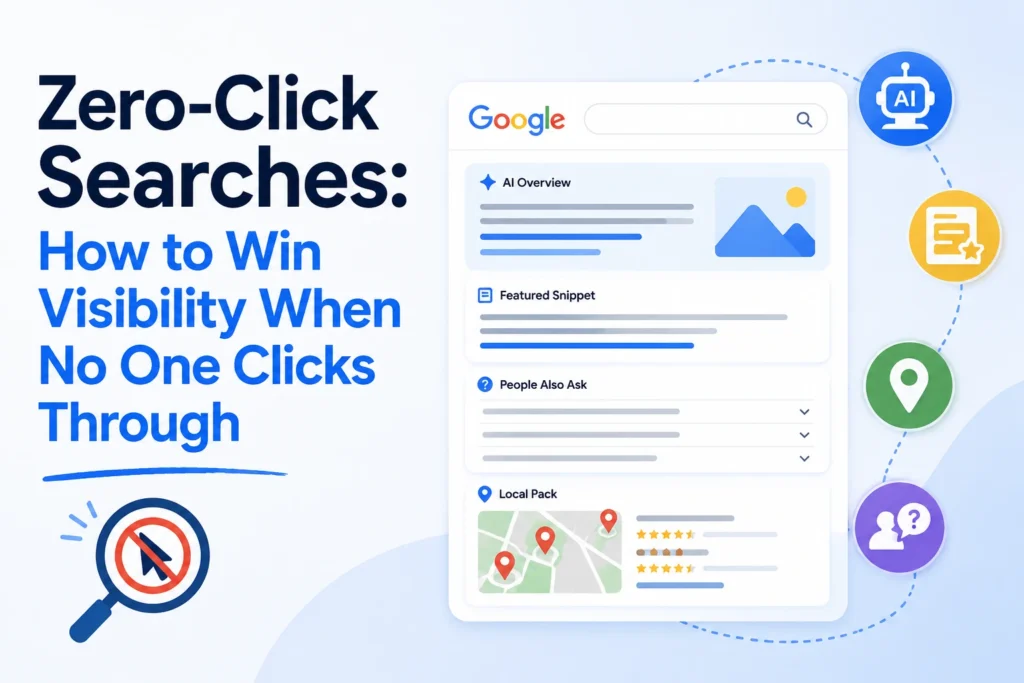
Search visibility no longer guarantees a website visit. More users now find answers directly on the results page through AI Overviews, featured snippets, People Also Ask boxes, knowledge panels, and local listings. As a result, a strong organic ranking may generate awareness without delivering the click marketers once expected. Seer Interactive reported that organic click-through rate for queries showing AI Overviews declined from 1.41% to 0.64% year over year, highlighting how search behaviour is evolving. But fewer clicks do not mean fewer opportunities to be seen. Brands that publish accurate, experience-led, well-structured content can still earn trust at the exact moment users are researching, comparing, and forming purchase decisions, often before they ever visit a website.
This guide explains how zero-click searches are reshaping SEO and how businesses can strengthen brand visibility, authority, and discoverability, even when users do not click through to their websites.
Zero-Click Search Strategy OverviewZero-click searches deliver answers through AI Overviews, featured snippets, People Also Ask results, knowledge panels, and local packs, often reducing the need for website visits. Success now relies on visibility, authority, and brand recall alongside traffic. Clear, evidence-backed, question-led content, consistent business information, schema markup, and strong local profiles improve citation potential. Track impressions, SERP features, branded searches, and assisted conversions to measure the value of search visibility beyond clicks. |
What Are Zero-Click Searches and Why Are They Changing SEO?
| Zero-click searches are search queries that end without a user visiting an external website because the answer is delivered directly in the search results. |
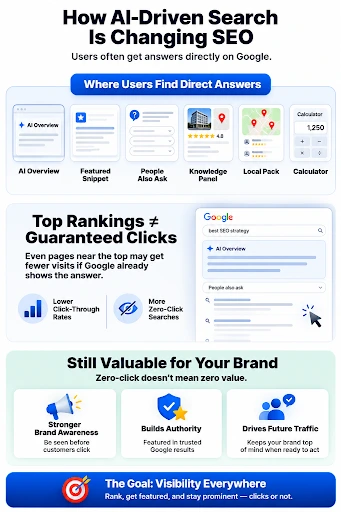
A user may find what they need in an AI Overview, featured snippet, People Also Ask result, knowledge panel, local pack, calculator, definition box, or other direct-answer feature. This changes the traditional SEO model: even a page ranking near the top of Google may receive fewer visits if the results page already satisfies the searcher’s intent.
However, lower click-through rates do not automatically mean lower search value. Being quoted in an AI-generated answer, shown in a featured snippet, or appearing prominently in local results can improve brand awareness and establish authority before a prospective customer is ready to act.
For example, someone searching “what is GEO in SEO” may read an AI Overview that cites your company’s explanation. They may not click immediately, but if the information is helpful and credible, they may later search for your brand when they need SEO or content-optimization support.
This is why zero-click SEO should focus on more than rankings and traffic. The objective is to build topical authority, create strong brand recall, and own relevant search-result features. For GEO, that means publishing factual, clearly structured information that generative search systems can understand, extract, and confidently attribute to your brand.
Where Can Brands Win Zero-Click Visibility?
Wondering how to optimize for Zero-Click searches? Zero-click visibility can appear across several Google and AI-driven search surfaces. Each one favors a different content format, but all reward relevance, clarity, accuracy, and a strong match to user intent.
| Zero-click surface | Best content format | Visibility value |
| AI Overviews | Concise explanations supported by evidence and credible sources | Brand mentions, citations, and perceived authority |
| Featured snippets | Direct 40–60 word answers, numbered steps, bullets, and comparison tables | Highly visible top-of-results exposure |
| People Also Ask | Question-based headings followed by concise answers | Coverage for related searches and user concerns |
| Local pack | Complete business profiles, reviews, categories, and location details | Calls, directions, local discovery, and trust |
| Knowledge panel | Consistent entity details across authoritative sources | Brand recognition, credibility, and identity confirmation |
AI Overviews
AI Overviews SEO synthesizes information from multiple sources to answer a user’s query directly in Google Search. Brands can improve their likelihood of being cited by offering precise, evidence-backed content that answers a question early, uses clear terminology, and includes useful supporting context.
Featured Snippets
Featured snippets commonly surface for definitions, processes, lists, comparisons, and quick factual questions. To compete, place a direct answer immediately below a relevant heading, then expand with examples or supporting detail. Tables are particularly useful when users need to compare options, features, or processes.
People Also Ask
People Also Ask boxes reveal the follow-up questions users commonly explore. Build these questions into your content as natural H3 headings and answer each one directly. This improves topic coverage while making your content easier for search engines and generative systems to interpret.
Knowledge Panels and Branded Search
Knowledge panels depend on reliable entity information. Use the same business name, service descriptions, website details, social profiles, and contact information across your digital presence. Credible third-party mentions and well-maintained organization information also help search systems understand who your business is and what it does.
Local Packs
For location-based searches, a complete Google Business Profile is essential. Keep your business name, address, and phone number consistent across listings; select accurate categories; publish updated service information; and encourage genuine customer reviews. These signals can improve visibility for searches with local intent.
From a GEO perspective, entity clarity is critical. State your organization’s name, expertise, services, geographic relevance, and verifiable claims consistently. This helps AI systems connect your content to a real, credible business rather than treating it as isolated information.
How to Create Content That Gets Cited, Featured, and Remembered
Content designed for zero-click search must be useful both to people reading the full page and to systems extracting a short answer. The goal is not to write only for search engines; it is to make each important insight clear enough to stand on its own when surfaced in a snippet or generative response.
Use the following practices:
- Answer the main question directly within the first 40–60 words of a relevant section.
- Write headings as the natural questions a potential customer would ask.
- Use short paragraphs for explanations, bullet points for steps, and tables for comparisons.
- Support factual claims with credible, up-to-date sources.
- Add original insights, practical examples, expert input, case findings, or first-hand experience to demonstrate genuine expertise.
- Apply appropriate structured data, such as Article, FAQPage, Organization, LocalBusiness, Product, or HowTo schema, when it accurately reflects the page content.
- Build topic clusters that address the main subject, related questions, comparisons, problems, and solutions.
- Mention your brand where it adds genuine context, rather than inserting it unnaturally into every answer.
Write for extraction, not just reading: every key section should make sense when quoted independently in a featured snippet, People Also Ask answer, or AI-generated response.
For GEO, prioritize content that is quotable, verifiable, structured, and attributable. Generative systems are more likely to use content that makes clear claims, provides supporting context, demonstrates expertise, and gives users a reason to trust the original source.
How to Measure Zero-Click SEO Success Beyond Website Traffic
Traffic remains important, but it is no longer the only meaningful SEO metric. A page that earns thousands of impressions, appears in AI-powered results, strengthens branded search demand, and influences later conversions can still be highly valuable, even if its immediate click-through rate declines.
Track these indicators to measure zero-click performance:
- Search impressions: Measure how often your pages appear for relevant queries.
- Average position: Monitor visibility trends for priority keywords and content clusters.
- Click-through rate: Review CTR alongside SERP features rather than treating a lower rate as an automatic failure.
- SERP-feature ownership: Track featured snippets, People Also Ask results, Google AI Overviews citations, local-pack visibility, and knowledge-panel appearances.
- Branded search growth: Watch whether more users search specifically for your company, services, products, or experts.
- Conversion assistance: Measure direct traffic, repeat visits, calls, form submissions, newsletter sign-ups, demo requests, and assisted conversions.
- High-impression content: Audit pages that have strong impressions but low CTR; they may be generating visibility in zero-click environments and need stronger branding, conversion paths, or content updates.
Regularly refresh high-value informational pages as search behavior, user questions, and AI-generated result formats evolve. Zero-click searches do not make SEO less important; they make authority, clarity, and brand recognition more important. Brands that deliver the clearest answers and the strongest evidence can earn trust before a user ever clicks through.
Conclusion
Zero-click searches have redefined what successful SEO looks like. Rankings and clicks still matter, but durable visibility now depends on whether your brand delivers the clearest, most credible answer across AI Overviews, featured snippets SEO, local results, and other SERP features. By creating structured, evidence-led, entity-focused content, businesses can build recognition and trust before a user reaches their website. Think Shaw helps businesses adapt SEO strategies for a search landscape shaped by AI and zero-click results. Our team combines technical SEO, content optimization, local SEO, and data-led reporting to strengthen visibility where your audience is searching.
Ready to be the brand search engines cite and customers remember? Partner with us and turn zero-click visibility into measurable business growth.
FAQs: Zero-Click Search Strategy
Should businesses try to avoid featured snippets?
Not necessarily. Featured snippets can strengthen brand exposure, but businesses should test their impact on qualified traffic, conversions, and overall page performance.
Does schema markup guarantee an AI Overview citation?
No. Schema helps search engines interpret page information, but it does not guarantee inclusion in AI Overviews, featured snippets, or other search features.
Do users click sources included in AI Overviews?
Some do, especially when they need deeper explanation, evidence, original data, products, or services. Google describes AI Overviews as a starting point for exploring linked sources.
Is FAQ schema still worth using for SEO?
It can still help search engines understand question-and-answer content, but it does not guarantee FAQ rich results. Use it only for visible, accurate on-page FAQs.
Can paid advertising compensate for zero-click traffic losses?
Paid search can support visibility for commercial keywords, but it should complement, not replace, useful organic content, brand building, local optimization, and conversion-focused website experiences.