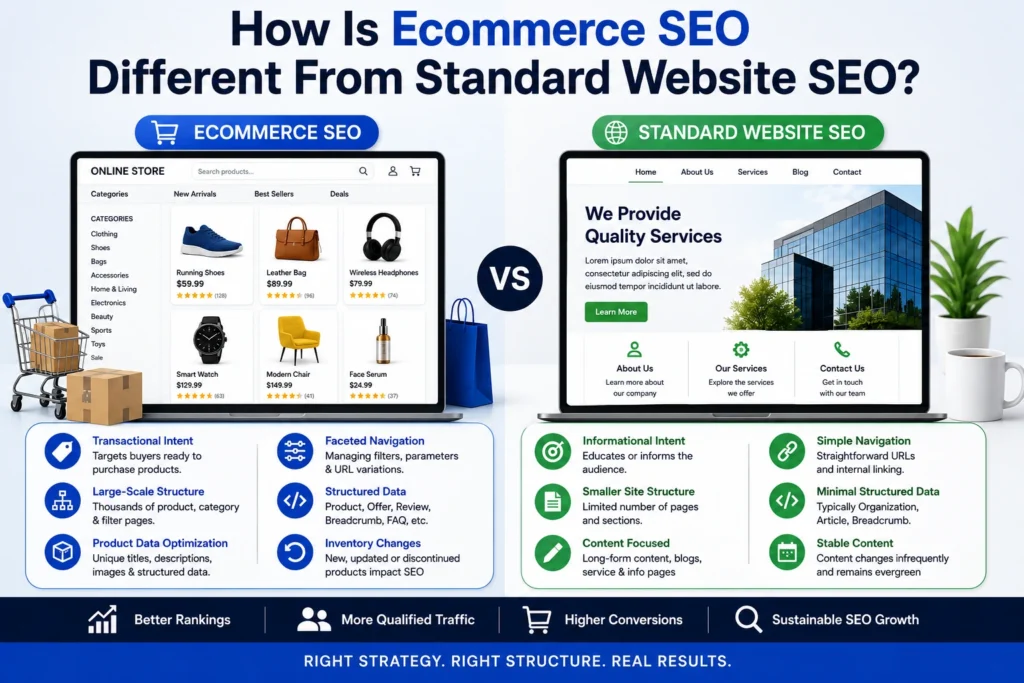
Ecommerce SEO and standard website SEO share the same foundation: search engines, rankings, and organic traffic, but their optimization requirements differ significantly once products and transactions enter the picture. A typical informational website focuses on content depth, topical authority, and the ability to answer search queries. An online store, however, must optimize numerous product and category pages while targeting both visibility and purchase intent. It also faces challenges such as faceted navigation, duplicate product descriptions, inventory-driven URL changes, structured data for pricing and reviews, and conversion-focused technical architecture. Search engines like Google may also place greater emphasis on trust signals, including reviews, secure checkout, and transparent business information, because of their impact on transactions. Below, we break down exactly where ecommerce SEO diverges from standard SEO practices.
Key Ecommerce SEO Differences and Challenges: SummaryEcommerce SEO differs from standard website SEO through its focus on transactional intent, extensive product and category pages, scalable architecture, and constantly changing catalogue data. Key challenges include managing URLs, faceted navigation, product variants, structured data, crawlability, internal linking, and discontinued inventory. Effective optimization requires accurate product information, clear indexing signals, strategic architecture, and ongoing technical management to maintain visibility, improve rankings, support conversions, and attract qualified organic traffic. |
Ecommerce SEO vs. Standard Website SEO
Ecommerce SEO and standard website SEO differ because they support different business models. Standard websites typically focus on services and enquiries, while ecommerce sites manage product catalogues, categories, variants, and shopping journeys at scale. So, we have discussed the differences below to understand each one better:
| SEO Factor | Standard Website SEO | Ecommerce SEO |
| Search Intent | Targets informational, branded, local, or service-related searches that help users understand a business or take an action. | Targets commercial and transactional searches where users may be researching, comparing, or preparing to purchase products. |
| Keyword Targeting | Focuses on service terms, informational queries, branded searches, and location-based keywords. | Targets product names, categories, specifications, sizes, models, comparisons, prices, and purchase-oriented queries. |
| Site Architecture | Must support hundreds or thousands of URLs: category pages → subcategory pages → product pages, often with filters and facets layered on top. Architecture directly affects crawl budget. | Typically flatter: homepage → service/about pages → blog posts. Fewer URL types, so crawl budget is rarely a bottleneck. |
| Internal Linking | Connects service pages, blog posts, resource pages, and other relevant business content. | Must strategically connect categories, subcategories, products, related products, and supporting content to improve discovery and topical relationships. |
| Structured Data | May use schemas such as Organization, LocalBusiness, Article, and Breadcrumb. | Commonly uses Product, Offer, ProductGroup, Review, and Breadcrumb structured data where applicable. |
| So to fix your ecommerce SEO gaps, our team offers a technical SEO strategy built around crawlability, indexing, product pages, structured data, and scalable ecommerce architecture. |
Why Does Ecommerce SEO Require More Technical Management?
Ecommerce SEO demands greater technical oversight because an online store operates as a dynamic catalogue rather than a fixed collection of pages. As the catalogue expands, some changes can affect how search engines process the site at scale. The following factors explain the specific technical areas that require ongoing management across an ecommerce website.
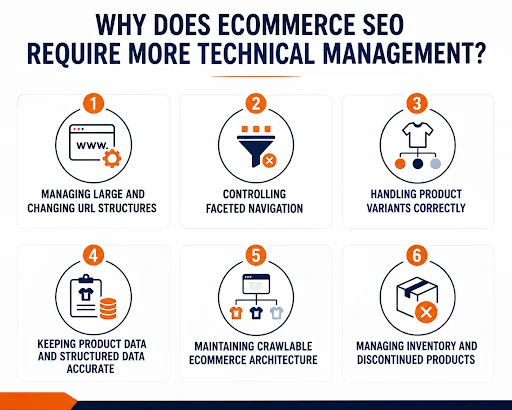
Managing Large and Changing URL Structures
Ecommerce sites can generate URLs for products, categories, variants, filters, sorting, and pagination. Without consistent URL rules, multiple URLs may represent the same or very similar content, making crawling and indexing less efficient. Google recommends using ecommerce URL structure best practices, including consistent URLs across internal links, sitemaps, and canonical tags
Controlling Faceted Navigation
Filters such as brand, size, colour, material, and price are useful for shoppers but can generate huge numbers of URL combinations. SEO management is needed to determine which filtered pages deserve indexing and which should remain outside the search index.
Handling Product Variants Correctly
A single product may have separate variations for size, colour, or model. These variants need a clear URL and canonicalization strategy, so Google understands whether they represent distinct pages or variations of one primary product.
Keeping Product Data and Structured Data Accurate
Product information such as price, availability, reviews, and variant details can change frequently. Ecommerce SEO therefore requires structured data and product information to remain synchronized with what shoppers actually see on the page. Google’s ecommerce structured data guidelines specifically identify Product and Product Group structured data as relevant for ecommerce websites.
Maintaining Crawlable Ecommerce Architecture
Search engines need clear pathways from category pages to subcategories and products. Important products should be discoverable through normal crawlable links rather than being accessible only through internal search or complex filtering systems.
Managing Inventory and Discontinued Products
Unlike most standard websites, ecommerce catalogues constantly change. Products become unavailable, return to stock, get replaced, or are permanently discontinued. Each situation can affect internal links, indexing, redirects, canonical URLs, and the usefulness of existing landing pages.
| Build a conversion-focused strategy that improves product visibility, organic rankings, qualified traffic, and measurable ecommerce revenue. |
Conclusion
For online stores that need more than standard SEO, Think Shaw provides specialized ecommerce SEO for both B2B and B2C businesses, with strategies tailored to product type, market, audience, and business goals. Our services include technical SEO audits, keyword research, product-page optimization, product markup, content optimization, and data optimization, with a focus on conversions rather than traffic alone. If your store needs an SEO strategy built around its catalogue and buying journey, Think Shaw can help turn that complexity into measurable growth.
FAQs About: E-Commerce SEO Vs Standard Website SEO
Does my online store need a different SEO strategy than my company website?
Yes; e-commerce SEO should account for your store’s catalogue, shopping journey, merchandising setup, and revenue goals rather than treating it like a service website.
Is e-commerce SEO useful if my store has only a small product catalogue?
Yes; even smaller stores benefit when SEO priorities are aligned with their product range, sales model, customer journey, and available resources.
Can ecommerce SEO support both B2B and B2C stores?
Yes; the strategy can be adapted to different buying cycles, including B2B product research and repeat purchasing or faster B2C buying decisions.
Should ecommerce SEO be connected to my store’s sales data?
Yes; connecting SEO reporting with ecommerce conversions helps identify which organic landing pages and product journeys contribute to actual revenue rather than measuring traffic alone.
When should I invest in specialized ecommerce SEO?
Consider it when your store has a growing catalogue, multiple product lines, frequent catalogue changes, or organic search is becoming an important acquisition channel.