In 2026, Google reports that AI Overviews have more than 2.5 billion monthly active users, while AI Mode has surpassed 1 billion monthly users globally. If your brand is not positioned to appear within these AI-driven search experiences, you could be missing valuable opportunities to reach customers at the moment they are researching, comparing, and evaluating businesses. As AI search expands, understanding how these systems evaluate and recommend brands is increasingly important for businesses competing for digital visibility.
Now, let’s understand how AI search evaluates brands and what determines which businesses appear in its recommendations.
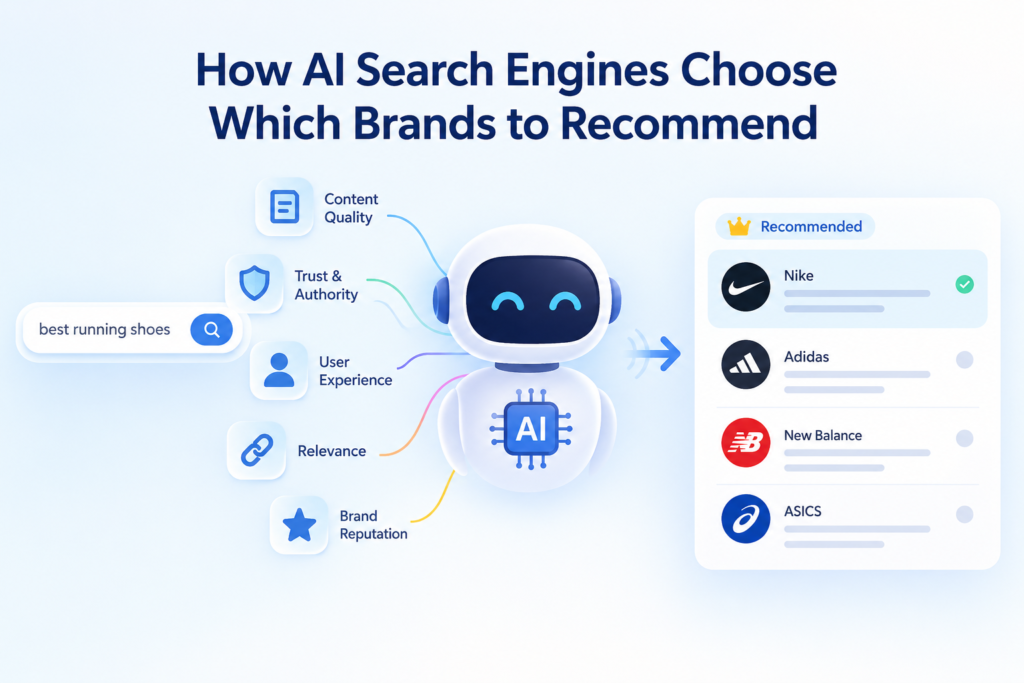
AI Search Recommendation OverviewAI search is reshaping brand discovery by evaluating clarity, relevance, trust, information quality, and topical authority when generating recommendations. Businesses can improve visibility by creating direct, useful content, keeping brand information consistent, demonstrating expertise, supporting claims with credible evidence, and strengthening technical SEO. Measuring AI search impressions alongside query types, traffic, leads, and conversions provides a clearer view of performance and helps brands refine their strategy as AI-driven search continues evolving. |
What Signals Influence AI Brand Recommendations?
Brand Information Must Be Easy to Interpret
AI systems need to establish what a brand is, what it offers, and which audiences or needs it serves before confidently incorporating it into an answer. Consistent descriptions across a website, product pages, business profiles, and other credible digital references can reduce ambiguity around the brand’s identity. Clear terminology also helps distinguish a company from similarly named businesses or unrelated entities.
Relevance Determines Whether a Brand Fits the Query
A recognizable company is not automatically an appropriate recommendation for every search. AI systems must connect the intent behind a query with information that demonstrates a brand’s suitability for that particular need. Google’s 2026 guidance emphasizes creating valuable, unique, non-commodity content for visibility in generative AI features, reinforcing the importance of genuine topical relevance rather than producing pages solely to target search variations.
Trust and Information Quality Affect AI Confidence
AI-generated recommendations depend on information that can be interpreted as credible, accurate, and sufficiently supported. This makes factual consistency particularly important when describing products, services, qualifications, locations, or claims about a business. NIST’s AI Risk Management Framework identifies characteristics including validity, reliability, transparency, explainability, and accountability as elements that contribute to trustworthy AI systems.
How Brand Information Becomes Search Context
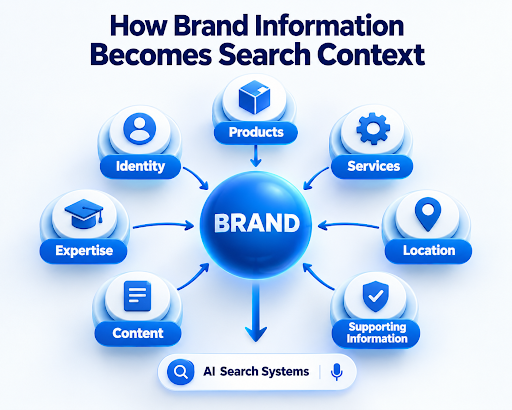
How brand information becomes search context as AI search systems connect a company’s identity, products, services, expertise, location, content, and supporting information to understand relevance, establish context, and determine how the brand may fit specific user queries and search intents across AI-driven search experiences.
How to Make Your Brand More Visible in AI Search
- Define your brand clearly: Make your business name, core offerings, locations, specialties, and areas of expertise explicit across important pages so AI systems can interpret your identity without relying on assumptions.
- Create answer-focused content: Address genuine customer questions with direct, complete responses instead of writing paragraphs primarily to insert keywords. Each page should satisfy a recognizable information need.
- Demonstrate subject expertise: Publish material that reflects actual knowledge of your industry, including original insights, expert perspectives, useful examples, research, or first-hand experience that gives the content substance.
- Keep business information consistent: Ensure important details such as company names, services, locations, product descriptions, and other identifying information remain aligned across the digital properties customers use to research your business.
- Strengthen topical coverage: Develop connected content around the subjects your brand genuinely serves. Supporting pages can establish broader expertise while allowing individual pages to address specific search intents.
- Use evidence appropriately: Support important factual or technical claims with reliable documentation and authoritative references. Google’s guidance encourages valuable, original content rather than large volumes of low-value AI-generated material.
- Make important information accessible: Ensure critical brand and service information is available as crawlable website content rather than relying exclusively on elements that search systems may have difficulty interpreting.
- Maintain useful local and commercial information: For businesses serving specific locations or selling products, provide accurate information about availability, service areas, offerings, and relevant customer considerations.
- Improve the complete search experience: AI search does not exist separately from traditional search. Google states that established SEO practices remain foundational for its generative AI features, making technical accessibility and strong website fundamentals important alongside content quality.
| AI-driven search is changing how customers evaluate brands. Think Shaw helps businesses adapt with SEO and GEO strategies designed to build stronger search visibility |
How to Measure and Improve AI Search Visibility
Monitor Generative Search Impressions
Google introduced dedicated Search Console reporting for visibility within generative AI features, including AI Overviews and AI Mode, in 2026. These reports provide website owners with a way to examine impressions associated with generative search experiences rather than relying exclusively on conventional performance reporting.
Compare Visibility Across Different Query Types
A brand may appear consistently for informational questions while remaining absent from commercial or comparison-oriented searches. Segmenting performance by query intent, topic, product, service, or audience can reveal where the brand has established relevance and where additional authoritative content may be necessary.
Connect Visibility With Business Outcomes
AI search exposure is valuable, but visibility alone does not establish whether a strategy is producing meaningful results. Compare generative-search impressions with website engagement, qualified traffic, branded searches, leads, purchases, and other business objectives to identify which areas deserve further investment.
Conclusion
AI search is changing how brands earn visibility, credibility, and consideration online. As search experiences increasingly rely on AI-generated recommendations, businesses need more than traditional keyword rankings they need a strong, technically sound, and strategically connected digital presence. At Think Shaw, we help businesses build that foundation with strategic SEO, content optimization, technical improvements, and search-focused digital strategies designed around how modern audiences discover brands.
| Your brand’s visibility should evolve as search evolves. Think Shaw combines SEO expertise with modern AI-search strategies to help businesses create a more competitive and discoverable online presence. |
Frequently Asked Questions About AI Brand Visibility
Does Google use AI-generated content for search rankings?
Google does not automatically penalize AI-assisted content. However, content created primarily to manipulate rankings or produced at scale without meaningful value can violate spam policies.
Can a small business appear in Google AI Overviews?
Yes. Business size is not an automatic barrier. Smaller companies can gain visibility when their pages provide useful, relevant information that matches specific user searches and needs.
Does E-E-A-T directly determine AI search rankings?
E-E-A-T is not a single ranking factor or score. Google uses systems designed to reward helpful, reliable content demonstrating qualities associated with experience, expertise, authority, and trust.
Does Google use llms.txt for AI search visibility?
No. Google clarified in 2026 that an llms.txt file is neither required nor used to improve or reduce visibility in Google Search.
Will FAQ pages still improve Google visibility in 2026?
FAQ content can remain useful for users, but Google’s FAQ rich result feature was discontinued in 2026. Businesses should create FAQs for genuine information needs rather than relying on rich-result exposure.